


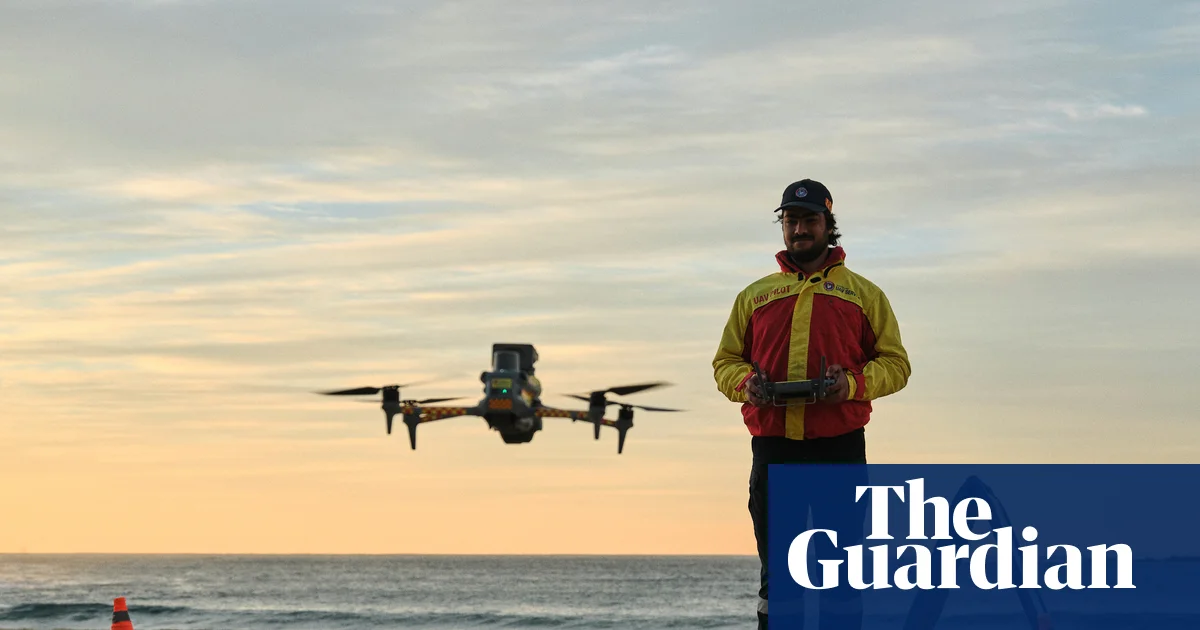
“Hey Taha, what’s the visibility like?” shouts a man with a towel slung over his shoulder.
“Uh, nice,” says Surf Life Saving New South Wales drone operator Taha Kafil-Hussain.
“Good?” the man asks. “Very good,” Kafil-Hussain assures him. Thanking him, the early morning swimmer turns and heads down the steps to Coogee beach.
Kafil-Hussain, who Guardian Australia has joined on his early morning shark surveillance flight, says: “When they’re local, they just want to see what the weather, what the water looks like, [if there’s] anything scary.”
The 22-year-old has been flying drones for SLS NSW for four years, but only at Coogee beach for a matter of weeks. Before a shark attack on 34-year-old Sydney teacher and mother Leah Stewart in June, drone surveillance was not permitted at Coogee because it lies directly under the flight path from Sydney airport’s east-west runway.
In an interview with 60 Minutes broadcast on Sunday, Stewart described the horror encounter with a four-metre white shark, after which her left arm was amputated, as “like fighting a dinosaur”. The attack, one of a series of high-profile incidents in Sydney in the past 12 months, has prompted the state government to massively ramp up its shark mitigation program.
Under a $34m initiative by the state government which rolled out on 1 July, 38 of Sydney’s ocean beaches, including Coogee, now receive dawn-to-dusk drone monitoring year round.
Seventy NSW beaches in total are part of the dawn-to-dusk program, while others will benefit from increased surveillance throughout the summer and school holidays. On Tuesday, surveillance hours will increase, running from 6.15am to 5pm each day for the start of spring, as daylight increases.
When Guardian Australia meets Kafil-Hussain in mid-winter, he arrives at 6.30am to throw up a marquee, before checking a radio to determine which direction the planes are flying in (drone surveillance at Coogee has been allowed with special permission from the airport).
Not long after, the drone takes off in a whir of plastic from a miniature landing pad, rising 60 metres into the air before heading out to sea. During each 20-minute flight, Kafil-Hussain rakes the bay in sections from left to right, backwards and forwards, leaving a checkerboard pattern on his control screen.
He says he’s looking for “anything moving in a different way than normal”.
“Anything moving against the flow of water, anything that looks a little bit long – anything alive, really.”
He pauses when he thinks he’s spotted something, to zoom in. “Looks like seaweed,” he says.
University of Sydney shark policy expert and associate professor Christopher Pepin-Neff agrees that “drones are the best technology that we have at the moment”.
But they say there are “important caveats that we need to give to the public”.
“On days that are windy, if the shark is too small, the drone operator is not going to be able to see a shark if it’s there.
“I’m slightly nervous that, in the absence of [a] large public education campaign, we have the possibility that we’re going to scare the shit out of people,” says Pepin-Neff.
With more drone surveillance comes more regular shark sightings. The NSW government says there have been more 750 sightings and more than 200 intervention actions by Surf Life Saving NSW since 1 July.
Shark listening stations are now tracking 1,698 white sharks, 938 tiger sharks and 374 bull sharks – the “target sharks” which are most frequently involved in serious shark bites.
Kafil-Hussain says he has seen more bull and tiger sharks than whites, and has raised the alarm a few times, most recently for a bronze whaler – involved in rare attacks – which he initially thought was a target shark.
after newsletter promotion
If it’s early and he’s on his own, raising the alarm means making the call to clear the water himself – otherwise he shares what he has seen with lifeguards and they make the decision, with the time from spotting a hazard to fully clearing the water about two or three minutes.
The SLS drones have a speaker attached to them, allowing him to communicate directly with surfers and swimmers.
It’s a technology familiar to followers of the Instagram account Drone Shark App, run by Jason Iggleden, who has been using a drone since 2018 to surveil beaches including Bondi, Tamarama and Bronte.
Videos on the account show an enormous seal barrel-rolling through the water and a swirling vortex of Australian salmon, while in another a whale lingers beneath a kayaker in Tamarama.
“I just had a bit of a vision to help … with getting people out of water with sharks, and just showing them the beauty of what’s out there,” he said.
The licensed and insured drone flyer, who continues to work independently, now passes on any sightings to SLS NSW. He is a firm believer in the drone surveillance, saying the ability to spot target sharks grows with experience.
“I don’t think you really need to consider much more than drones, to be honest,” he says.
Pepin-Neff is supportive of other non-lethal technologies, such as SMART drum lines. They say a trial of new artificial intelligence detection software on drones will take the pressure off humans to discern between more and less dangerous sharks. But their message on controversial measures like shark nets, here to stay on NSW beaches, and culling, is unequivocal: “They do not work.”
‘Not a perfect solution’
Kafil-Hussain, who drives each day from his home in Parramatta, has now flown drones at most Sydney beaches, from Palm Beach in the north to Cronulla in the south. Every beach is different – he sees turtles, dolphins, the occasional whale. Coogee is home to a wobbegong, a low-swimming carpet shark which does not hunt humans but can attack if threatened.
“He’s not around. He’ll pop out eventually,” says Kafil-Hussain.
When Guardian Australia visits the beach, arriving before sunrise, it is already heaving with eastern suburbs dog walkers, swim clubs and surfers. Just weeks after the attack on Stewart, Kafil-Hussain says numbers at the beach have only been growing.
Pepin-Neff says the drone program will “restore confidence” ahead of a busy summer, but there is “no silver bullet”. “Drones are a great tool but they’re not a perfect solution.”
Pepin-Neff swims at fully enclosed beaches, like Marrinawi Cove in Barangaroo, but their advice for those that swim at unenclosed beaches: “Swim between the flags.”
“The ocean is the wild and we need to treat the beach like the bush.”
