


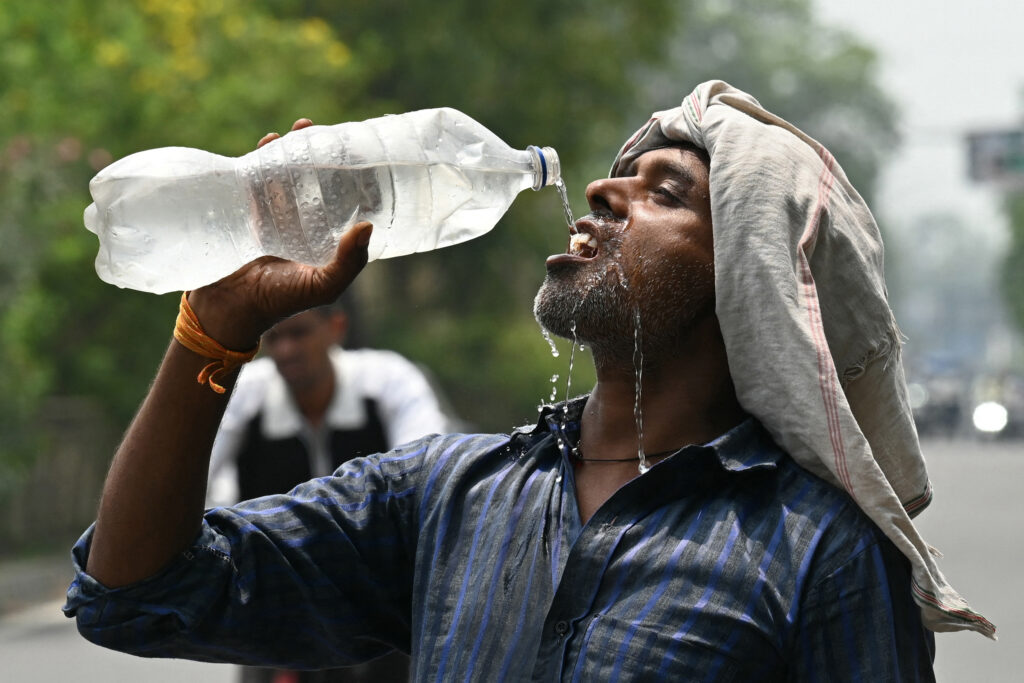
More than 451,000 people are projected to die across the globe in the next six months from the additional heat brought by a super El Niño, according to estimates from climate scientists released Wednesday.
The El Niño—the warm phase of the Pacific Ocean’s recurring cycle, when heat from the ocean is released into the atmosphere—began in June. It can intensify and affect storms, fisheries and rainfall patterns far from the Pacific, raising global land temperatures.
In the new estimates, scientists at the University of Chicago Climate Impact Lab project the hotter land conditions brought by El Niño will resemble the higher temperatures climate change is predicted to deliver in 20 years.
The estimated heat death toll, the scientists warned, are on top of the impacts from droughts, wildfires and flooding, expected from hotter temperatures and shifting rainfall patterns in a world already superheated by greenhouse gases.
Michael Greenstone, a co-founder of the Climate Impact Lab and an economics professor, said scientists have long been able to predict the impacts of higher temperatures on crops. But now, they can predict the impact an El Niño can have on deaths.
“This is such a large number that it can be numbing, but it is made up of parents and children, grandparents and neighbors, people going to work, caring for families, and living their lives,” Greenstone said in a statement. “This report allows decisionmakers to see exactly where emergency actions can be taken now to save tens of thousands of lives in the coming months.”
The countries most affected by land temperatures increased by 1.2 degrees Celsius over the next six months are Nigeria, Indonesia, Sudan, India and Brazil. Collectively, the five countries account for more than 97,000 of the projected heat deaths. The U.S. is in the top 20 most affected nations, with 3,500 projected additional heat deaths, according to the study.
As El Niño conditions began affecting the Asia Pacific in June, the International Federation of Red Cross and Red Crescent Societies (IFRC) said in a statement that local chapters are already working to prepare for and respond to these evolving climate risks. Their preparations include strengthening early warning systems, providing cash and livelihood assistance and promoting climate-resilient agricultural practices.
Intensifying heat, drought and pressure on agriculture, water and energy systems could further amplify risks, a statement from the humanitarian network said, making extreme weather more intense, less predictable and more disruptive for vulnerable communities. Alexander Matheou, IFRC’s regional director for Asia Pacific, said there still is a window to act.
“We know where the risks are emerging, and we have the tools to respond early,” Matheou said. “What is needed now is the commitment to invest ahead of the crisis—rather than paying a far higher price later.”
This El Niño, which could be the strongest on record, could permanently push the planet’s average annual temperature past the 1.5 degrees Celsius warming threshold enshrined in scientific documents and political agreements as a turning point for potentially irreversible climate impacts.
The warm conditions from June 2026 to February 2027 will resemble the higher temperatures that climate change is projected to deliver in 20 years, leading to 44 percent more extremely hot days than expected in a normal year. Forecasts suggest El Niño will remain beyond February 2027 through spring 2027, potentially pushing death counts higher.
The study authors wrote that El Niño is effectively leapfrogging the world into the future, causing temperatures which won’t be the norm for another two decades and before countries have time to adapt and protect themselves.
The report combined peer-reviewed methods on the relationship between temperature in more than 24,000 regions across the world and mortality and seasonal temperature forecasts. The death projections were compared to the same months of an average year between 1996 and 2025.
Time-sensitive projections can guide multilateral and humanitarian organizations’ decisions about where to direct emergency funds to avoid tens of thousands of deaths, the study said. It can also inform governments of all levels where to target their resources.
The climate lab’s adaptation inventory finds that heat warnings, health outreach to vulnerable populations, cooling centers and hydration stations, worker protections and expanded health system capacity can help people cope with extreme heat.
Tamma Carleton, faculty head of research for the Climate Impact Lab and an assistant professor at the University of California, Berkeley, said increasing emergency response and better targeting efforts can save many lives this year.
“But 20 years from now, once today’s extreme temperatures become the new normal, we don’t want to be in a constant state of emergency,” Carleton said.
About This Story
Perhaps you noticed: This story, like all the news we publish, is free to read. That’s because Inside Climate News is a 501c3 nonprofit organization. We do not charge a subscription fee, lock our news behind a paywall, or clutter our website with ads. We make our news on climate and the environment freely available to you and anyone who wants it.
That’s not all. We also share our news for free with scores of other media organizations around the country. Many of them can’t afford to do environmental journalism of their own. We’ve built bureaus from coast to coast to report local stories, collaborate with local newsrooms and co-publish articles so that this vital work is shared as widely as possible.
Two of us launched ICN in 2007. Six years later we earned a Pulitzer Prize for National Reporting, and now we run the oldest and largest dedicated climate newsroom in the nation. We tell the story in all its complexity. We hold polluters accountable. We expose environmental injustice. We debunk misinformation. We scrutinize solutions and inspire action.
Donations from readers like you fund every aspect of what we do. If you don’t already, will you support our ongoing work, our reporting on the biggest crisis facing our planet, and help us reach even more readers in more places?
Please take a moment to make a tax-deductible donation. Every one of them makes a difference.
Thank you,

Reporter, Texas Renewables
Arcelia Martin is an award-winning journalist at Inside Climate News. She covers renewable energy in Texas from her base in Dallas. Before joining ICN in 2025, Arcelia was a staff writer at The Dallas Morning News and at The Tennessean. Originally from San Diego, California, she’s a graduate of Gonzaga University and Columbia University Graduate School of Journalism.
