


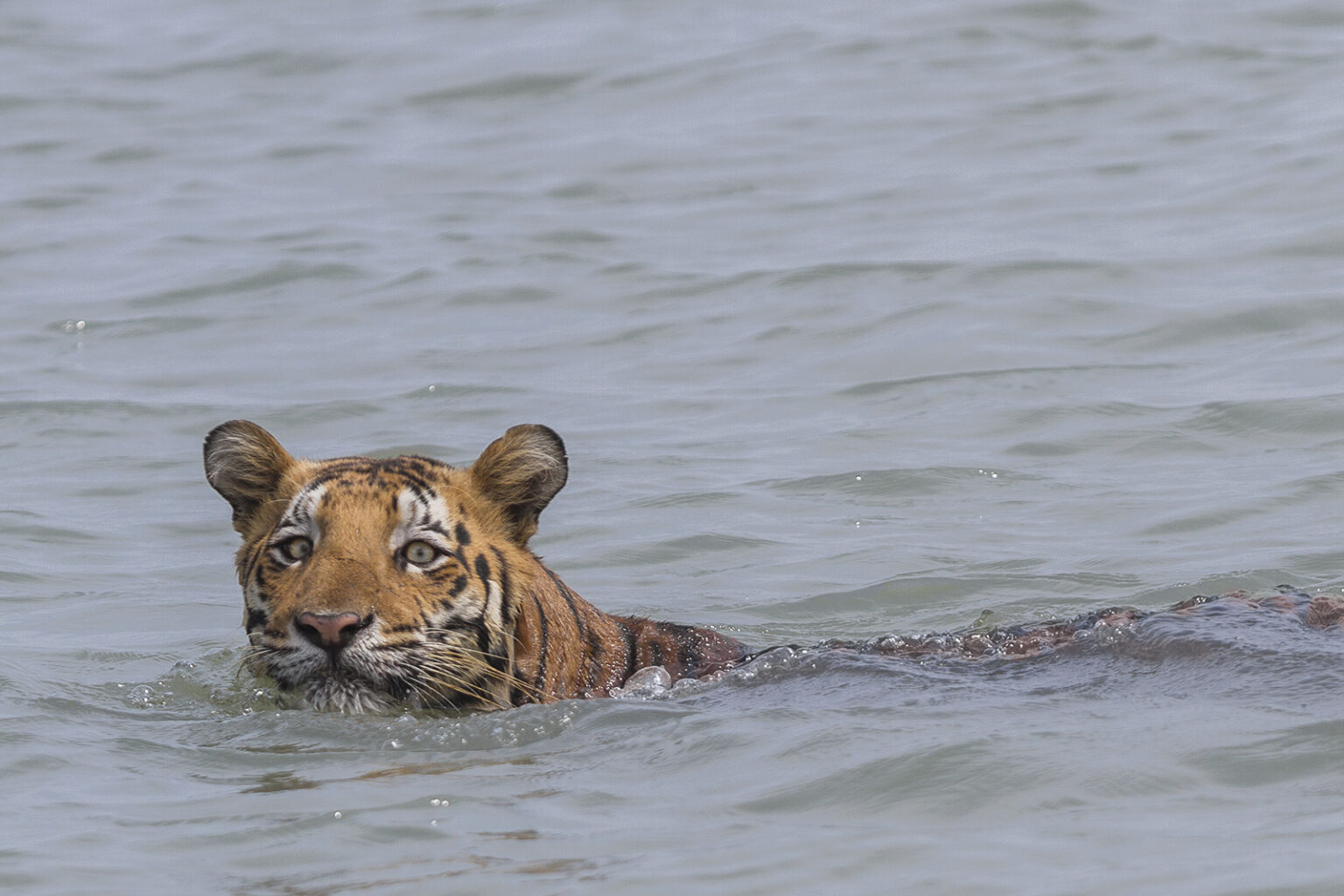
- Researchers analyzing parasite infections of Bengal tigers and their prey population in the Sundarbans in Bangladesh have raised concerns about the critically endangered species’ conservation.
- Researchers in South Asia warn that parasitic infections can act as silent killers to stressed tigers and cubs.
- Human settlements near habitat elevate the risk of parasite transmission between wild and domestic animals, the research suggests.
- Experts recommend reducing human-wildlife contact and adopting integrated and long-term wildlife disease prevention.
A typical roundworm measures roughly 2.7% of the average length of a Bengal tiger or weighs just three-millionths of one percent of the largest of the world’s big cats.
Though these parasites do not pose a major threat to Bengal tigers (Panthera tigris), researchers across South Asia, the cat’s native range, warn that parasitic infections can act as silent killers, particularly when the big cats are weakened by poor nutrition, injury or other diseases.
South Asia is home to roughly 4,367 Bengal tigers: 3,682 in India, 429 in Nepal, 131 in Bhutan and 125 in Bangladesh, according to the latest estimates.
The IUCN lists the Bengal tiger as an endangered species, although it is classified as critically endangered in Bangladesh.
Bangladeshi researchers, analyzing fecal samples collected from wildlife across the Sundarbans mangrove forest, detected the highest parasite infection rate in Bengal tigers. A study published by the Bangladesh Forest Department in July makes recommendations to address the issue.
Sultan Ahmed, a professor in the Department of Microbiology and Immunology at Sylhet Agricultural University and one of the authors of the study, told Mongabay, “The most important recommendation is to keep the mangrove forest away from human interference.”
Assigned by the Forest Department, the researchers collected fecal samples in two phases in 2024 and 2025.
According to their analysis, the highest parasite infection rate, 85.3%, was detected in Bengal tigers, followed by 84.9% in rhesus monkeys (Macaca mulatta), 73.6% in deer and 66.7% in wild pigs.
In molecular analysis, roundworms (including Toxocara cati and Strongyloides spp.), hypdatid worms (Echinococcus granulosus), liver flukes (Opisthorchis clonorchis) and parasitic tapeworms (Spirometra spp.) were detected as the predominant parasite species in the wild animals studied.
The role of human settlements
The study across the Bangladesh part of the Sundarbans found households were, on average, about 450.7 meters (1,479 feet) from the forest, but the median distance was just 100 m (328 ft), indicating that many homes were located close to the forest edge.
It said that the proximity and shared environments between domestic animals and wildlife facilitate the transmission of pathogens across species.
Published in 2025, a separate study on Bengal tigers and leopards at the Wildlife Research and Training Centre in Gorewada in the Indian state of Maharashtra, detected several parasitic infections, including Sarcocystis spp., Toxocara cati, Spirometra spp. and another form of tapeworm, Diphyllobothrium spp.
This study’s researchers warned that such infections can cause chronic malnutrition, especially under stressful conditions and affect Bengal tigers’ fitness and reproductive success, and, in severe cases, lead to death.
Citing studies in Maharashtra in western India, the researchers suggested that habitat encroachment and the resulting human-wildlife interactions increased the risk of parasite transmission between wild and domestic animals, as free-ranging wildlife was found to be exposed to diverse pathogens in shared environments.
Parag Nigam, Head of the Department of Wildlife Health Management under the Wildlife Institute of India, observes that domestic cattle, buffalo and free-roaming dogs serve as primary reservoirs for helminths, flukes, and tick-borne pathogens, which spill over into shared pastures and water sources.
Stressing the importance of breaking transmission chains at human-wildlife boundaries and maintaining high natural immunity across wild populations, he told Mongabay, “The most effective baseline measure is managing the livestock buffer surrounding tiger reserves.”
Another 2025 study on gastrointestinal parasites in wild mammals in Chitwan National Park, Nepal, found that the proximity of wildlife habitats to human settlements in Chitwan intensifies the risk of zoonotic transmissions, particularly from parasites such as Strong-yloides spp. and Toxocara spp.
One of the authors of the study, Babita Maharjan, an assistant professor at Tribhuvan University’s Amrit Campus and a member of the Nepal Zoological Society, told Mongabay. “Wildlife-livestock interaction may increase the risk of transmission of infections to tigers directly through consumption of infected livestock and indirectly through shared habitats, water resources, and infected prey populations.”
In 2018, a Bengal tiger in Bhutan was diagnosed with fatal neurocysticercosis, an infection of the central nervous system, caused by Taenia solium, commonly known as pork tapeworm, marking the first recorded case of this human parasite in a non-domestic cat.
Analyzing the death, a 2021 study said that the mechanism for the parasite exposure in this unusual case was unknown.
However, the study says: “It is possible that the tiger may have ingested infective T. solium eggs through direct consumption of human fecal or consumption of water or food contaminated with human feces.”
Camera-trap records from Bhutan’s Nature Conservation Division showed that the deceased tiger’s home range extended to the outskirts of hugely populated Thimphu, according to the study.

Why parasite infection is concerning
Wildlife health expert Parag said parasites are a real issue for Bengal tigers, but poaching, forest degradation and shortage of prey are still the main enemies of the animal.
“That said, you can’t just ignore these parasites either,” he said. “They act like a slow, quiet drain on a tiger’s health.”
A strong, fully grown, wild tiger can usually handle a basic parasite load without much trouble but if it gets old, injured or can’t find enough food, these intestinal worms and tick-borne blood parasites take a heavy toll, Parag explained.
The parasites weaken the animal further, cause severe anemia and ruin its ability to hunt wild prey. A weak tiger then turns to village cattle because they are easier to catch, which directly triggers human-tiger conflict in the fringe areas.
“The bigger worry is what happens to the cubs, and smaller, isolated reserves,” Parag said. “Roundworms and flukes can easily kill young cubs before their immune systems even build up, which hits the local tiger population growth hard.
“Plus, in smaller pockets where tigers don’t have enough genetic variety, their immunity takes a hit, making whole groups vulnerable to sudden sickness.”
Zoologist Babita warned that parasitic infections can be a serious health and conservation concern for Bengal tigers, particularly when an animal is immunocompromised, injured, nutritionally stressed or exposed to heavy or multiple infections.
“Multiple infections are often more damaging than single infections, can weaken the immune system, and make an animal more susceptible to additional diseases,” she said.

Prevention measures
Sultan, one of the authors of the latest study, suggested an integrated, long-term wildlife disease surveillance program in the Sundarbans to monitor parasitic and other infectious diseases in Bengal tigers and their prey species.
He also advised parasite control in livestock and domestic animals around the mangrove forests and periodic de-worming of forest department staff.
“A Central Wildlife Disease Diagnostic Laboratory should be established,” Sultan said.
Parag said that minimizing parasitic risks in wild tigers requires landscape-level, ecosystem-based strategies rather than direct veterinary interventions.
He recommended that authorities implement routine, non-invasive monitoring by analyzing fecal samples collected during annual, on-site surveys.
Prey population management plays a vital, indirect role in mitigating parasitic threats, Parag added: “When wild prey is abundant and easy to hunt, tigers remain in peak physical condition, allowing their immune systems to naturally suppress and tolerate endemic parasite loads.”
To take advantage of prey management, he suggested prioritizing active grassland management and water-body maintenance to sustain optimal densities of wild ungulates and rigorously surveilling them for disease to prevent outbreaks. Maintaining clean flows of water to limit the concentration of aquatic snails and vector larvae is also required, he said.
Educating forest-dependent communities about proper grazing practices, hygiene and de-worming of livestock can also enhance the effectiveness of these measures to mitigate gastrointestinal parasite infections in tigers, Babita said.
She also recommended interdisciplinary collaboration with epidemiologists, ecologists, biologists and medical and veterinary professionals.
Banner image: South Asia is home to roughly 4,367 Bengal tigers. Researchers say parasitic infections could act as silent killers to the cats via Wikimedia Commons (CC BY-SA 4.0).
Bangladesh gets ready for its first release of tiger rescued from poachers’ trap
Citations:
Kolangath, S. M., Upadhye, S. V., Pawshe, M. D., Shalini, A. S., Dhoot, V. M., & Bhangale, P. K. (2025). Parasitic profiling of tigers and leopards of Maharashtra. International Journal of Veterinary Sciences and Animal Husbandry, 10(3), 42–46. doi:10.22271/veterinary.2025.v10.i3a.2107
Maharjan, B., Jain, P., & Koju, N. P. (2025). Zoonotic risks and conservation challenges: Gastrointestinal parasites in wild mammals of Chitwan National Park, Nepal. International Journal for Parasitology: Parasites and Wildlife, 26, 101041. doi:10.1016/j.ijppaw.2025.101041
Phuentshok, Y., Choden, K., Alvarez Rojas, C. A., Deplazes, P., Wangdi, S., Gyeltshen, … Gurung, R. B. (2021). Cerebral cysticercosis in a wild Bengal tiger (Panthera tigris tigris) in Bhutan: A first report in non-domestic felids. International Journal for Parasitology: Parasites and Wildlife, 14, 150–156. doi:10.1016/j.ijppaw.2021.02.003
