


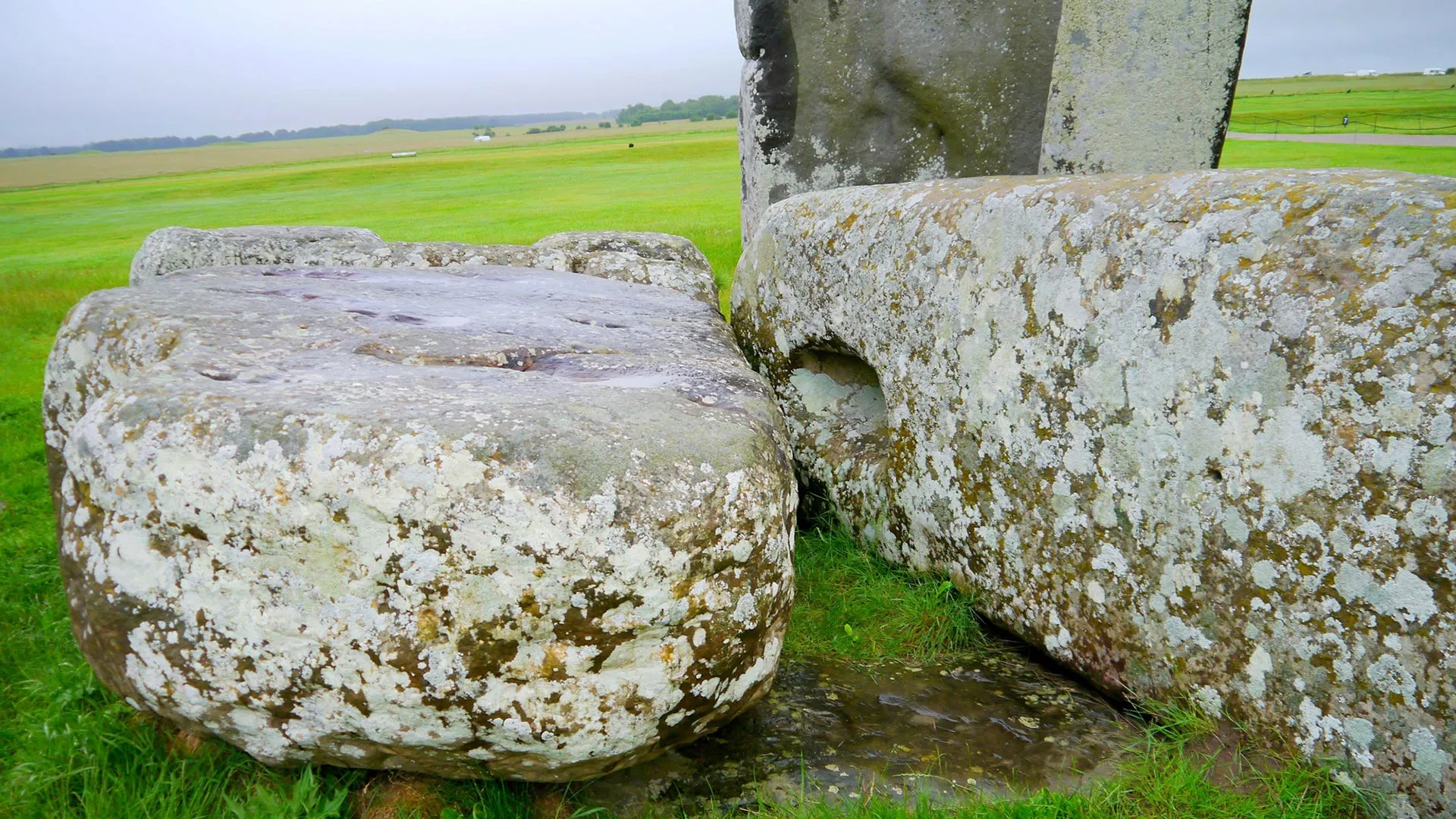
The mystery surrounding Stonehenge’s enormous six-ton Altar Stone has taken another turn. Scientists have eliminated several suspected sources of the ancient sandstone slab, narrowing the search for where it originated thousands of years ago.
A new study published in the Journal of the Geological Society presents the most comprehensive geological investigation yet of the Altar Stone, offering new clues about one of Stonehenge’s most enduring mysteries.
Measuring 4.9 meters (about 16 feet) long, the massive sandstone slab lies at the heart of the famous prehistoric monument on Salisbury Plain in southern England. For more than a century, archaeologists and geologists believed it had been transported from Wales. However, recent research using advanced analytical methods overturned that long-standing theory and identified northeastern Scotland as a more likely source.
Now, a new international investigation has refined the search even further, although the stone’s exact birthplace remains unknown.
New Geological Clues Narrow the Search
To investigate the Altar Stone’s origins, researchers combined fresh observations of the monument with detailed examinations of stone fragments preserved in museum collections.
Using multiple scientific techniques, the team studied the sandstone’s physical structure, mineral content, chemical composition, and isotopic signatures. Together, these characteristics provide a distinctive geological fingerprint that can be compared with rock formations across Britain.
The scientists focused particular attention on the Orcadian Basin in northeastern Scotland, an area previously identified as a promising candidate. However, none of the locations examined so far has produced rock with the same combination of characteristics as the Altar Stone.
Although the findings have not revealed the stone’s original location, they allow researchers to eliminate several possibilities and concentrate future investigations on more promising areas.
Professor Duncan Pirrie, Emeritus Professor at the University of South Wales and leader of the study, explained:
“This is the most comprehensive geological investigation of the Altar Stone ever undertaken. By combining a wide range of analytical techniques, we have built the clearest picture yet of the stone’s composition and tested the leading theories about its origins. So far, none of the locations examined have the same set of characteristics as the Altar Stone. That tells us the search is not over, but we are now far better equipped to focus on the areas most likely to yield an answer.”
From Wales to Scotland: A Century-Old Theory Overturned
For generations, the prevailing explanation placed the Altar Stone’s origins in western Wales. That assumption changed when earlier scientific investigations revealed evidence pointing much farther north, toward Scotland.
The latest findings build on that discovery by establishing more precise geological criteria for identifying a potential match.
Professor Richard Bevins, Honorary Professor in the Department of Geography and Earth Sciences at Aberystwyth University, said:
“For almost a century, the prevailing view was that the Altar Stone came from west Wales. Our previous research overturned that assumption and pointed instead to Scotland as the most likely source. This latest study significantly refines the search by identifying the specific geological characteristics we need to look for, allowing future investigations to be targeted more effectively. With each new piece of evidence, we move closer to solving one of Stonehenge’s most enduring mysteries.”
Rather than disproving Scotland as a possible source, the new investigation helps scientists distinguish between rock formations that appear promising and those that do not match the stone’s distinctive properties.
Solving Stonehenge’s Six-Ton Mystery
Determining where the Altar Stone came from could reveal much more than the birthplace of a single rock. It could also help explain how prehistoric communities acquired and transported enormous stones over remarkable distances.
Stonehenge was constructed in multiple stages between approximately 3000 and 1600 BC. Its builders are known to have moved massive stones across the landscape, including the smaller bluestones, which traveled roughly 225 kilometers (140 miles) from western Wales.
If the Altar Stone originated in northeastern Scotland, its journey to Salisbury Plain would have been considerably longer. Establishing its precise source could therefore offer important clues about the transportation methods, organization, and engineering abilities of the people who built Stonehenge.
Professor Nick Pearce, Emeritus Professor of Geochemistry in the Department of Geography and Earth Sciences at Aberystwyth University, emphasized why eliminating possible sources represents genuine progress:
“In a geological detective story such as this, ruling out potential source areas is just as important as identifying new ones. Every location eliminated narrows the search and brings us closer to discovering where the Altar Stone originated. The stone is unique among those at Stonehenge, and tracing its source would provide valuable new insights into its remarkable journey to Salisbury Plain thousands of years ago.”
The researchers believe the detailed geological fingerprint developed during this investigation will guide future searches and could eventually identify the Altar Stone’s original location. Such a discovery would help illuminate one of prehistoric Britain’s most extraordinary engineering accomplishments.
The international research team included geologists and archaeologists from the United Kingdom, Canada, Italy, and Sweden. Participating organizations included the University of South Wales, Aberystwyth University, University College London, the University of Aberdeen, the University of Plymouth, the James Hutton Institute, the Swedish University of Agricultural Sciences, the University of Milano-Bicocca, and several industry partners.
