


- The drought-adapted succulent spekboom (Portulacaria afra) has long been trumpeted as the crown prince of South Africa’s nature-based carbon sink solutions.
- The World Bank ensured its coronation with a $120 million outcome-based bond, structured and named in its honor.
- According to Amazon, the tech giant’s commitment to buy carbon credits from the first developer to draw on the bond gave other financiers the confidence to back the industrial-scale project. Does this make the tech giant the power behind the throne of an emerging nature-based carbon credit sector?
- Mongabay’s investigation uncovers a sector dominated by international corporations whose investment promises are hard to scrutinize, in a cautionary tale of what happens when projects fail.
This is the third article in Mongabay’s three-part investigation of spekboom-led ecosystem restoration in South Africa. This is part of an award-winning collaboration between independent science writer Leonie Joubert, the Stellenbosch University School for Climate Studies, and the Henry Nxumalo Foundation which supports investigative journalism in Africa. Read parts one and two.
GQEBERHA, South Africa — Browsed. Heavily browsed. Knackered. This farm camp is well on the knackered side of the degradation scale, threadbare after decades of heavy livestock pressure. But the single shrub at Nick Hamp-Adam’s feet may help change that. It just needs a second chance.
This young spekboom plant (Portulacaria afra) is more stocky shrub than rooted cutting. It’s had more time than usual in the nursery to bulk up ahead of being released into the wild. But for the moment, it’s stricken on its side, roots exposed.
Hamp-Adams, general manager for Return to Thicket, one of the smaller restoration projects in this nook of South Africa’s Eastern Cape province, is about to set things right. He sinks to his knees, finds a hand-sized stone and begins reopening the original planting hole.
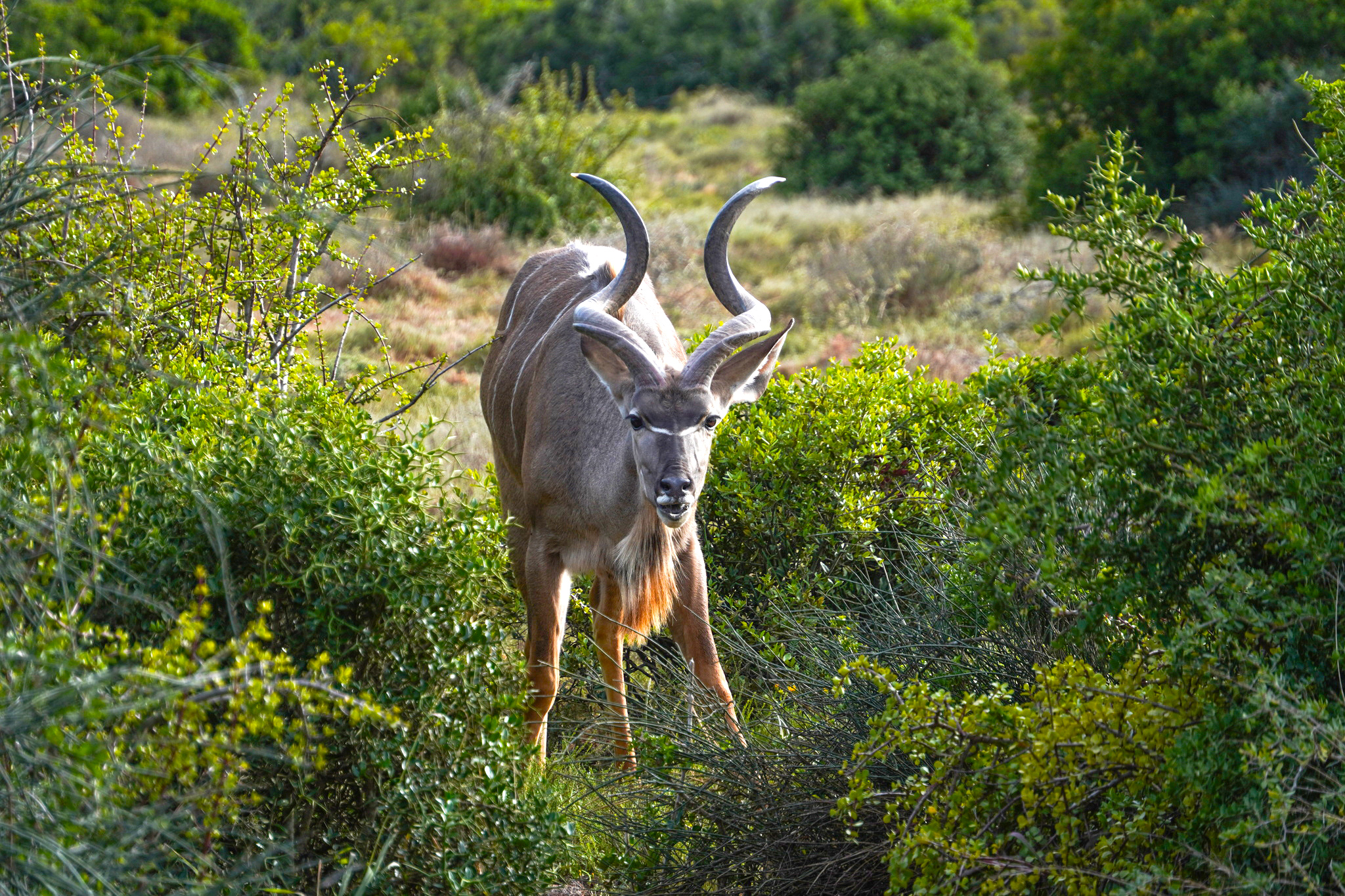
“Kudu, most likely …”
His breath is metered by his efforts with the digging tool.
“… came through …”
Strike.
“… grabbed it …”
Strike.
“… probably wasn’t planted deep enough.”
Strike.
He’s gentle when he rights the plant, taking care as he tamps the soil around its roots. Tough plants, generally. Don’t need much coddling. Except during planting. Treat them like babies during planting.
This individual is one of thousands of cuttings of this drought-tolerant endemic succulent that are being popped into the ground across 2,100 hectares (5,200 acres) of exhausted farmland recently purchased by Return to Thicket. As the vegetation regrows, it’s expected to draw the equivalent of 10.3 metric tons of carbon dioxide from the atmosphere per hectare per year over the course of three decades. That’s the equivalent of emissions from nearly four round-trip flights for a single person between London and New York.
But that’s not what makes this particular shrub noteworthy. This plant, and the countless others around the camp, were rescued from another thicket restoration project in the area, one that closed down a few years back when its international backer pulled out.
It’s a cautionary tale of what happens when developers, carbon market control bodies and financiers aren’t transparent in their operations or open to public scrutiny.
Examining this novel kind of industrial-scale development — ecosystem repair funded by carbon markets — has become particularly relevant now. The World Bank has created an outcome-based bond tailored specifically to help fund restoration projects working to repair Albany thicket, a small but important biome in South Africa where spekboom grows naturally and where its mass planting is expected to help heal degraded farmlands.

The thicket biome is a small plant community, covering only 1.71 million hectares (about 4.2 million acres) and making up just 2.4% of the country’s total footprint. Yet this niche bond recognizes the need for a fund that’s specifically structured to restore the 90% of the biome that’s partially or badly degraded. Where there once was impenetrable hedge-like thicket, many places have been reduced to near desert. The most likely way to repair the region is through the mass planting of spekboom and paying for the work through the carbon markets.
The World Bank created a pot of $120 million specifically for this. According to Amazon, the tech giant’s commitment to buy some of the carbon credits from the first project to benefit from the bond gave financiers enough confidence in the business model to come on board with additional funding.
The first project to draw on this purse expects its restoration work to bring around $500 million into a stagnant farming community over the next 40 years. This will come from just over half its operations, with more planned, and will flow in through wages, rental income, carbon credit revenue sharing with farmers, taxes, and small business development initiatives.
This investigation has examined the origins of spekboom-led restoration, the science behind its potential promise, and the possible pitfalls if projects don’t meet those expectations. In this third and final part, Mongabay finds an emerging nature-based carbon capture sector that has become dominated by international corporations whose investment promises are hard to scrutinize. Now, key questions remain around what happens when projects operate in an opaque accountability environment, and the possible fallout if projects fail.

Going bust
The trail of breadcrumbs between this former farm camp and what’s become known as the Lake Kariba scandal is sparse in the news coverage. But it’s there.
Concerns about the possibility of fraud in the nature-based carbon offsets sector had been surfacing for some time. But one particular case sent shockwaves through the industry in Southern Africa in 2023. The New Yorker magazine’s Heidi Blake broke the story of a forest conservation project in Zimbabwe, billed as one of the largest of its kind and spanning more than 700,000 hectares (1.7 million acres), that had grossly inflated the amount of atmospheric carbon pollution it claimed to have avoided through keeping trees standing in the Zambezi River Valley.
More than half of the project’s 27 million carbon credits were found to be fabricated. The project was owned by Guernsey-based company Carbon Green Investments (CGI), with Swiss carbon credit broker South Pole handling the development, according to Bloomberg.
The repercussions were felt as far south as here, close to where Hamp-Adams is doing his veld inspection. South Pole, which had been running a small spekboom restoration operation nearby, quietly shut it down following the Lake Kariba incident. In the wake of the closure, Hamp-Adams’ team rescued some of the orphaned spekboom.

The closure left an unknown number of people without jobs, and an unknown number of hectares abandoned in a state of disrepair. Were these lands browsed, heavily browsed, or knackered? It’s hard to know. South Pole, one of the most powerful global brokers in the industry, is tight-lipped.
When Mongabay asked for details on the project’s closure — how far along it was, how many jobs were lost or didn’t materialize, what the carbon-capture goals were — the company said merely that this was an early-stage pilot.
“As with many pilot initiatives, we periodically assess their commercial viability,” South Pole responded by email through a media consultant. “In this case we decided to close the project. We’re not able to offer further information at this time.”

Clear as mud
Spekboom has long been trumpeted as the crown prince of South Africa’s nature-based carbon cleanup solutions. The World Bank ensured its coronation recently with its newly minted $120 million outcome-based bond, structured and named in its honor. The listing of this novel financial instrument was made possible through Amazon’s backing, according to the tech giant, with the corporation agreeing to buy some of the carbon credits from the first developer to draw on the funds.
Does this make Amazon the power behind the throne in an emerging nature-based carbon credit sector?
Not in terms of the running of the restoration projects themselves, but in what sustainability scientist Henrik Österblom and colleagues at the Stockholm Resilience Centre at Sweden’s Stockholm University say is the emergence of a keystone actor from the corporate world that has an outsized influence on the system in which projects like this operate. The idea riffs off the concept of keystone species in nature, like termites in an African savanna, which are regarded as ecosystem engineers, so significant is their role in shaping the environment around them.
Here the concept applies to Amazon having disproportionate influence to shape a niche emerging nature-based carbon sink sector in a tiny corner of Africa where farmers need ecosystem repair as urgently as a burn victim needs lifesaving skin grafts.
Did Amazon’s door-to-door consumer goods delivery model find another commodity to trade with?
Amazon isn’t investing directly in this farming community, as has been misreported in places. It also isn’t buying these spekboom-generated carbon credits to offset its own emissions, either. The corporation is frank that its approach is to buy credits in order to sell these on to partners in its supply chain who need to offset their own emissions. Amazon has created a one-stop digital shop to handle the transactions: its newly launched carbon credit exchange, the Sustainability Exchange, where its partners can buy “trusted” and “high-quality” carbon credits.
The corporation was vague on the details of how it will trade the credits on its exchange and would not reveal if it will pay market prices or benefit from a bulk-buy discount. Its media office said only that the price for these credits reflects their higher market value as a result of being of better quality.
Amazon said it doesn’t disclose the commercial terms of its agreements; however, the media office confirmed that the corporation will build a charge for administering the service into the selling price. This includes a “small margin to cover headcount, tech, registry fees, and other costs.” Amazon would not share details on the precise structure and pricing of these add-ons.

Intermediary traders and carbon market exchanges usually charge between 5% and 30% for administrative fees, according to Carbon Market Watch.
In its 2023 report, the nonprofit watchdog warned that without a line of sight on the costing structure of these fees, the public can’t adequately scrutinize the numbers. This lack of transparency makes it difficult to verify if fees are reasonable or if profit markups have been built in. Carbon Market Watch calls for greater transparency around pricing, markups and admin fees, and urges buyers to boycott intermediaries who don’t make this information public.
Big promises, closed books: The opaque new currency of carbon credits
The first spekboom restoration project to benefit from the World Bank bond is Singapore-based infrastructure developer Imperative Global Solutions Pte. Ltd., a company founded in 2022 that focuses on nature-based ecosystem restoration, funded through carbon markets.
Spekboom restoration projects until now have been artisanal in scale, most of them under 5,500 hectares (about 14,000 acres).


Imperative’s arrival in 2024 changed that. Work kicked off in November that year with a 10,000-hectare (nearly 25,000-acre) pilot planting phase, which it completed in just over a year. The company then secured $91 million in loans, which accelerated its planting ambitions. The World Bank bond provided $25 million, and another $66 million came from a handful of other investors. The flush in money allows it to increase its first-phase operation five times, with another big expansion planned thereafter. Imperative plans to have a total of 100,000 hectares (about 247,000 acres) under spekboom by around 2030.
As these tough succulents grow, the company expects them to draw down 41.6 million metric tons of carbon dioxide equivalent (tCO2e) over the next 40 years. This will allow Imperative to earn the equivalent number of carbon credits, as one metric ton of CO2 removed from the atmosphere converts to one carbon credit. Amazon has agreed to buy some of the first crop to come from one half of the project: 1.95 million credits in all, which amounts to 9.4% of the 20.8 million carbon credits that this new 50,000-hectare (124,000-acre) planting is expected to produce over four decades.
Imperative anticipates $500 million reaching the community from the first 60,000 hectares (nearly 150,000 acres) over 40 years. How much of this materializes depends on how much atmospheric carbon the spekboom plantings draw from the atmosphere as they grow, the price of carbon credits over time, and the revenue sharing agreed between Imperative and the farmers it has partnered with. Imperative wouldn’t disclose the terms of the contracts with farmers, though, which stipulate the details of the revenue share. (Imperative’s business model differs from others in that it opts to rent land from farmers rather than buying. This allows the restoration work to reach more land and landowners to keep their properties.)
The method to calculate the carbon drawdown potential of a recovering thicket has been developing for over two decades. But it’s still a relatively young field, and it can only advance as fast as the early spekboom plantings grow. A project’s business model may forecast 10 tCO2e of drawdown per hectare per year. But project staff may only know in 10-15 years what the actual accumulation of carbon is in the soils and plants. If it’s only 5 or 7 tCO2e, the project will only earn the equivalent number of carbon credits.

“We only get paid for what we deliver,” says Scobie Mackay, Imperative’s CEO.
The market price of this novel currency is another factor.
Carbon credits from the first plantings should start to trickle in as soon as 2027 or 2028, according to Imperative. How much each credit is worth depends on its type and price fluctuations on the market. Nature-based carbon drawdown credits that come from forestry plantations involving monocrop tree planting are on the lower end of the range for the reforestation and revegetation category. These were selling for around $14 in 2025, according to the World Bank. Projects that provide biodiversity habitat repair alongside their climate benefits, like these spekboom projects, have higher values. Imperative’s Mackay references the data provider and analytics firm MSCI Carbon Markets on this, although he wouldn’t disclose the price category that applies to Imperative’s credits. MSCI told Mongabay that the most likely price point for these spekboom-generated credits is around $45.
Meanwhile, an industry insider who asked not to be named told Mongabay that most local projects are working on a value of $20 to $25 a credit.
How much will Amazon pay for its 1.95 million carbon credits? How much of that will flow into the farming community in Albany thicket country, and over what period of time?
Neither Amazon nor Imperative would reveal the price they’ve settled on. But these credits, they say, will be high-value, bought at a fixed price and purchased during the first earning period, which Amazon gives as an open-ended “more than a decade.”
Based on this, and the range of prices for this category of credit, Mongabay estimates that Amazon’s bill for the 1.95 million carbon credits could be anything from $39 million at the lower range of $20 per credit, to $87.75 million if trading at $45 a credit.
The carbon credit returns reaching the community will ultimately depend on how much organic carbon shows up in the plant and soil samples measured over the coming years, which depends on how well the next four or five years of plantings take root, as reported previously, and on the company’s profit-sharing agreements.


Keep it real
Sonia Latola smiles coyly when the attention turns to her on a warm winter’s afternoon as she knock-knock-knocks a 3-month-old spekboom cutting free from its rooting container beneath the domed shade cloth at the Hive Ecosystems nursery, less than an hour’s drive from some of Imperative’s farms. She and her colleague Elistine Fisant live in the area and are, for the time being, enjoying the flush of jobs that these planting projects bring. Every day, these two transfer thousands of cuttings into crates that get hauled up a precarious country road by tractor. There, a crew with pickaxes and hand trowels will place the young plants gently but speedily into the ground, cutting by cutting, laboriously and by hand.
Like Return to Thicket, Hive Ecosystems is a small but established spekboom restoration project in a sector that is now seeing a growth spurt as the World Bank and other financiers recognize the business model for funding ecosystem restoration in these exhausted farmlands.
Many of the people Mongabay interviewed — farm laborers, businesspeople, landowners, and many others — say they don’t understand how this strange new currency of carbon credits works. They can’t fully grasp how invisible carbon dioxide translates into the tangible dollars and cents that are promised in recent press releases. They do hold onto the hope, though, that these new investments will bail out desperate farmers and put real cash in the pockets of people in a part of the world where jobs are scarce and the farming economy of yesteryear is on its knees.

For more than two centuries, South Africa’s big developers have mostly been in extractive sectors such as mining and related industries. The developers of tomorrow are viewing ecosystem repair as a new frontier, recognizing the business opportunities that will allow for the rehabilitation of the very natural infrastructure left damaged by extractive industries. That some prominent Global North financiers are seeing the business potential of investing in ecosystem repair in an area as tiny and niche as South Africa’s Albany thicket biome suggests that farming with a novel agricultural crop in the Global South — carbon — may indeed be the new gold rush, for better or for worse.
Banner image: The southern greater kudu (Tragelaphus strepsiceros strepsiceros) is one of the common browsing animals endemic to Albany thicket. Image © Pierre-Louis Stenger via iNaturalist (CC BY-SA 4.0).
FEEDBACK: Use this form to send a message to the author of this post. If you want to post a public comment, you can do that at the bottom of the page.

