


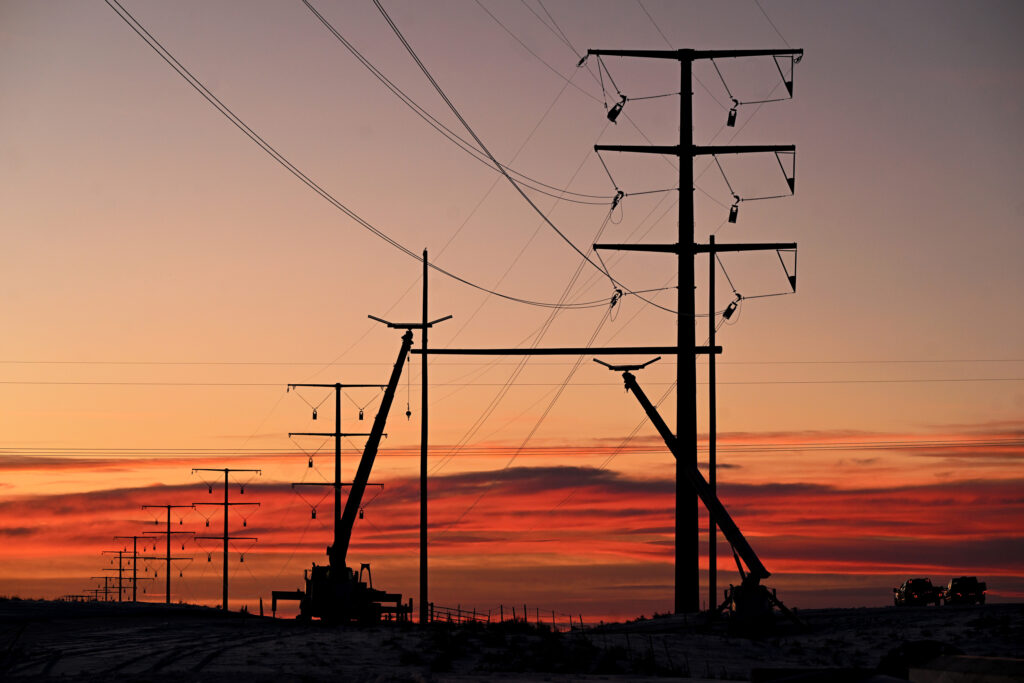
The Senate voted Monday to advance long-sought bipartisan legislation to speed permitting of big energy projects, amid acrimony over whether the bill’s support for clean energy will be overwhelmed by the fossil fuel industry’s expansion plans.
Less than a week after Democrats’ overwhelming victory in the midterm elections, the party’s incumbents were divided over the measure. Republicans propelled the 73-25 vote to get the Bipartisan American Affordability and Jobs Act of 2026, or BAAJA, over the first in a series of parliamentary hurdles. It means the current Congress, one of the least productive in the past 40 years, will have a chance to reshape energy project decision-making in the United States before the GOP surrenders the reins of leadership.
The legislation is an attempt to streamline the rules and regulations that have increased over the past 70 years, hindering the nation’s ability to build infrastructure rapidly. High-voltage transmission lines, crucial for delivery of clean energy, take 10 years on average to build. The issue has become more urgent as electricity demand surges, in part due to the proliferation of artificial intelligence data centers.
After years of effort, proponents of clean energy and fossil fuel energy struck a compromise that they say will get projects moving while protecting communities.
But the bill still faces challenges.
Some Democratic senators who voted for cloture, thereby limiting debate on the bill, made clear they will work to amend the measure to ensure that it does not erode the rights of Native American tribal nations to make decisions on projects that affect their lands. But any changes to the legislation risk losing Republican support. And the bill still must pass the House, where Republicans have a slimmer majority and House Minority Leader Hakeem Jeffries has already voiced opposition.
Perhaps the wildest card is President Donald Trump, who even while the Senate vote was underway, denounced wind energy. “I will not approve wind turbines because wind turbines are a major loser,” he said during an impromptu news conference.
Despite his opposition to wind energy, Trump praised the legislation as “a great bill that’s supposed to be bipartisan.”
“We are behind it 100 percent,” Trump said.
Afterward, the legislation’s co-author, Sen. Sheldon Whitehouse (D-R.I.), released a statement making clear that Democrats could withdraw their support if the president’s war against renewable energy continues. “As I have said all along, the ultimate success of this bill depends on the Trump administration getting wind turbines up and spinning to get affordable energy on the grid, and we still need to make progress on that front before final passage,” he said.
Weighing the Trade-Offs
The deep divisions over the measure reflect how much permitting reform has become a referendum on the chief weapon the environmental movement has used thus far in the drive to curb climate change: the power to block fossil fuel projects, mainly through lawsuits.
Not only has that approach failed to reduce U.S. greenhouse gas emissions, it has also been turned against clean energy projects and the transmission lines they need to deliver renewables from remote wind farms and solar arrays to population centers. Proponents of the bill argue that it is time to discard defensive environmentalism and turn instead to a strong offense—leveraging the power of low-cost wind, solar and storage to propel a transition.
Since unveiling the permitting deal before the election, Whitehouse, the ranking Democrat on the Senate Environment and Public Works Committee, has sought to reassure fellow advocates of climate action that the legislation would remove roadblocks that have limited clean energy expansion.
“This bill is the floor, not the ceiling, of our climate and environmental aspirations,” Whitehouse said in a news conference just prior to the vote. “We look forward to accomplishing big things with our big Democratic majorities.”
But many environmentalists hoped that the Senate would fail to reach the 60-vote threshold, allowing the huge Democratic majority in the next Congress to rewrite the legislation wholesale. Opponents’ biggest concern are provisions that make it more difficult for state and tribal governments to stop oil and gas pipelines and other infrastructure projects through lawsuits and environmental review.
“This bill was shaped by the very industries that have spent decades damaging our health, exploiting our resources, and putting our futures at risk,” said Mar Zepeda Salazar, legislative director at Climate Justice Alliance, after the vote.
One major fossil fuel industry proponent, Williams Companies, even had advocates in the Senate this year: Sen. Alan Armstrong (R-Okla.), former chief executive of the pipeline company, and the staff he brought on. He said the legislation was his top priority when Oklahoma’s governor appointed him to fill a Senate vacancy in March.
And yet, the measure had overwhelming support from the clean energy industry, which has been stymied by backlogs in permitting and connections to the electric transmission grid.
The Senate vote “is a critical step toward modernizing our outdated permitting process and getting ready-to-build clean energy projects moving,” said Frank Macchiarola, chief advocacy officer for the American Clean Power Association, in a statement.
While most climate and environmental groups oppose the bill, several prominent ones urged the Senate to support the initial vote, including the Environmental Defense Fund and Evergreen Action.
“In our judgment, the trade-offs right now, as they exist in the bill, are a risk-to-reward proposition that we are willing to take,” said Pete Wyckoff, Evergreen Action’s vice president of policy, in an interview.
Wyckoff said Evergreen’s support is based on an optimistic view that governors, future Congresses and presidents will do more work to promote renewable energy and reduce carbon dioxide emissions, and that clean energy will win in the market if given a chance. And it’s an acknowledgement that current legal tools to stop fossil fuel development aren’t effective enough and are now being “weaponized,” he said, to stop wind farms and other clean projects.
“What we need is a very, very rapid buildout towards clean” energy, Wyckoff said.
The legislation’s supporters favored a vote in the lame-duck session of the current Congress, doubting that the Democratic-led Congress taking office next year could craft a bill that Trump would sign.
This story is funded by readers like you.
Our nonprofit newsroom provides award-winning climate coverage free of charge and advertising. We rely on donations from readers like you to keep going. Please donate now to support our work.
Several studies have shown that wind, solar and battery storage would increase if the current legislation passes. Economic modeling indicates the bill would save ratepayers by bringing more low-cost supply to the electric grid. The Center for Climate and Energy Solutions estimates $2.5 billion in annual savings on residential electricity bills. The bill’s authors also included provisions that would require new data centers to cover their own energy costs.
“This is a real downpayment on the affordability agenda that was so much on Americans’ minds when they went to the polls last Tuesday,” Whitehouse said on the Senate floor.
But Sen. Jeff Merkley (D-Ore.), who is in line to be chairman of the Senate Environment and Works Committee in the new Congress, said the bill could make it easier to build more data centers powered by on-site natural gas plants. And he noted that by making it easier to build natural gas pipelines to transport the fuel overseas as LNG, the legislation’s overall impact could mean greater greenhouse gas emissions.
“Getting more renewable electrons where they are needed doesn’t tackle climate change if you simultaneously promote the burning of more fossil fuels,” Merkley said in a statement before he voted against moving forward with the legislation.
Addressing Concerns
Prior to the vote, the bill’s co-sponsors amended the bill to respond to some of the concerns environmental advocates raised about the initial version. Many of the objections focused on the “permit certainty” provisions in the original bill, which limit the federal government’s ability to stop a project after it receives initial approval. Critics said this part of the legislation would make it difficult for a future president to oppose fossil fuel projects.
Earthjustice, an advocacy group, released an analysis of the amended bill, saying that while it “provides some meaningful improvements, it fails to address very serious concerns.” The group praised some of the changes to permit certainty, but said the amendment as a whole fails to solve the core problem, which is that the legislation “gives the Trump administration very broad authority to fast-track harmful projects.”
Among the changes, the amendment revises the “look-back period” that establishes the baseline of past trends for determining if the government is treating a project arbitrarily or differently from others. Under the initial bill, the period was five years, which meant the next president would deal with a baseline set almost entirely by the Trump administration. Under the amendment, the baseline is 10 years.
Other changes the co-authors made addressed concerns Tribal nations raised about erosion of their ability to challenge projects, under the National Historic Preservation Act, for their impact on historically or culturally important sites. Some Democrats who voted to advance the legislation, including Sen. Catherine Cortez Masto of Nevada and Sen. Brian Schatz of Hawaii, said they want to see further changes before voting for final passage. Former Interior Secretary Deb Haaland, who was just elected governor of New Mexico and the first Native American woman governor in the country, said she remains opposed to the bill in its revised form.
The legislation, expected to generate tens of thousands of jobs by eliminating hurdles for construction projects, had overwhelming support from labor unions. During the vote, one of the bill’s co-authors, Sen. Martin Heinrich (D-N.M.), the ranking member of the Senate Energy Committee, wore his late father’s lapel pin honoring his 60 years of service as a utility laborer with the International Brotherhood of Electrical Workers. “BAAJA will create over 100,000 trades and manufacturing jobs, good-paying jobs that workers can be certain will be around to support their families through a project’s completion,” Heinrich said before the vote.
Heinrich, who is in line to take over as chairman of the Senate Energy Committee in the new Congress, acknowledged that the bill was “not perfect,” but was a necessary compromise to ensure the nation can build the infrastructure it needs and lower energy costs.
“We had to find common ground,” he said.
About This Story
Perhaps you noticed: This story, like all the news we publish, is free to read. That’s because Inside Climate News is a 501c3 nonprofit organization. We do not charge a subscription fee, lock our news behind a paywall, or clutter our website with ads. We make our news on climate and the environment freely available to you and anyone who wants it.
That’s not all. We also share our news for free with scores of other media organizations around the country. Many of them can’t afford to do environmental journalism of their own. We’ve built bureaus from coast to coast to report local stories, collaborate with local newsrooms and co-publish articles so that this vital work is shared as widely as possible.
Two of us launched ICN in 2007. Six years later we earned a Pulitzer Prize for National Reporting, and now we run the oldest and largest dedicated climate newsroom in the nation. We tell the story in all its complexity. We hold polluters accountable. We expose environmental injustice. We debunk misinformation. We scrutinize solutions and inspire action.
Donations from readers like you fund every aspect of what we do. If you don’t already, will you support our ongoing work, our reporting on the biggest crisis facing our planet, and help us reach even more readers in more places?
Please take a moment to make a tax-deductible donation. Every one of them makes a difference.
Thank you,

Bureau Chief, Washington, D.C.
Marianne Lavelle is the Washington, D.C. bureau chief for Inside Climate News. She has covered environment, science, law, and business in Washington, D.C. for more than two decades. She has won the Polk Award, the Investigative Editors and Reporters Award, and numerous other honors. Lavelle spent four years as online energy news editor and writer at National Geographic. She spearheaded a project on climate lobbying for the nonprofit journalism organization, the Center for Public Integrity. She also has worked at U.S. News and World Report magazine and The National Law Journal. While there, she led the award-winning 1992 investigation, “Unequal Protection,” on the disparity in environmental law enforcement against polluters in minority and white communities. Lavelle received her master’s degree from Columbia University Graduate School of Journalism, and is a graduate of Villanova University.

Reporter, Clean Energy
Dan Gearino covers the business and policy of renewable energy and utilities, often with an emphasis on the midwestern United States. He is the main author of ICN’s Inside Clean Energy newsletter. He came to ICN in 2018 after a nine-year tenure at The Columbus Dispatch, where he covered the business of energy. Before that, he covered politics and business in Iowa and in New Hampshire. He grew up in Warren County, Iowa, just south of Des Moines, and lives in Columbus, Ohio.
