


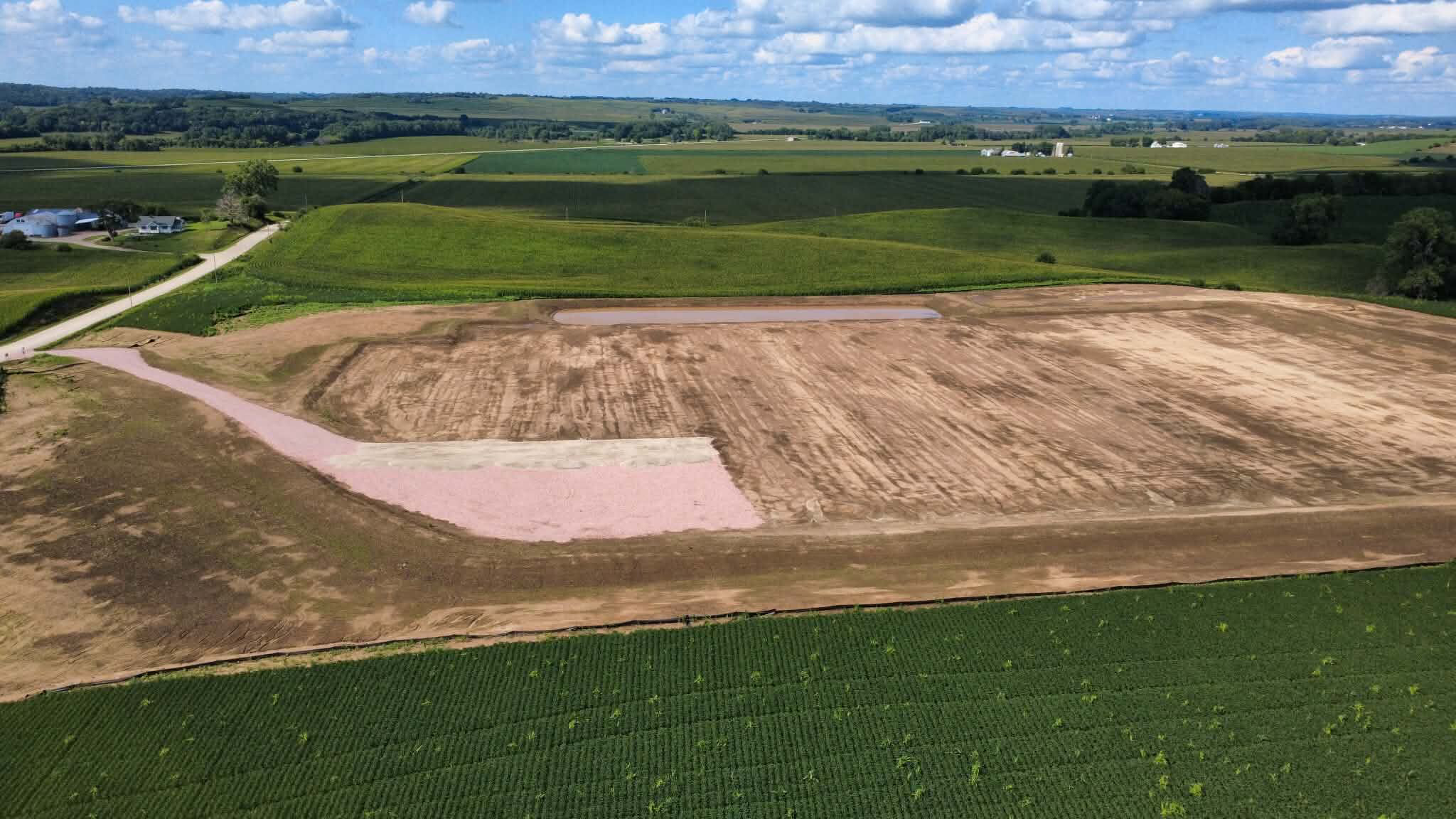
In a matter of days, a dirt pit the size of five football fields appeared next to the weathered headstones of Center Cemetery in Castana, Iowa.
The excavation site sits on the edge of the Loess Hills, a 200-mile corridor of craggy bluffs and ridges bordering the Mississippi River valley in western Iowa. The hills, formed from erodible silt deposited by melting glaciers at the end of the last Ice Age, are among the most distinctive landscapes of the American heartland.
In this treasured landscape, residents whispered that a private developer was building a lagoon to store animal-waste byproducts trucked in from a meat-processing plant in neighboring Woodbury County.
“It was just sort of a rumor,” said Scott Koepsell, whose family owns farmland less than a mile from the site. “But we didn’t know for sure … and we had no good answers.”
On a single day in late June, Alison Manz of the Department of Natural Resources’ field office for southwest Iowa received four separate complaints related to construction activities at the site. The field office wasn’t aware of any project there, so Manz contacted Hawthorn Land Holdings, the private equity group that has owned the acreage for several years.
According to Iowa Department of Natural Resources (DNR) records, Brian Gallup of Hawthorn Land Holdings told Manz that the company was developing a solid waste pit to store “industrial byproduct waste” from the Seaboard Triumph Foods pork processing facility 50 miles away in Sioux City.
Waste from the pits would be applied as fertilizer to nearby farmland at a rate less than two tons per acre per year, Gallup told Manz. Under Iowa’s rules for solid waste and sludge, that rate doesn’t require a permit.
While Manz tried to determine if the project construction violated any rules, angst grew in Monona County. County Supervisor Bo Fox said he only learned about plans for the lagoon when he received a panicked phone call from a resident whose land borders the site.
“I started checking around because we didn’t know anything about it,” Fox said.
Fox called a July 14th town hall meeting to address the matter, where he reiterated his dismay that the county was never notified of the project by the developer or the Iowa DNR.
At the meeting, Jay Layman, manager of Hawthorne Land Holdings, assured the 50-some attendees that the project team had communicated with the Iowa Department of Natural Resources before beginning construction.

However, those conversations had been entirely with staff in the solid waste office at the central Des Moines office, not with the regional field office responsible for DNR permitting, inspection and compliance in Monona County. Until receiving complaints from residents, the regional DNR field office and the county did not know about the project.
Laymann also explained that the site would hold DAFcake, the solid residue left over when liquid hog manure is condensed and dehydrated in a process known as “dissolved air flotation.”
Though Hawthorn Land Holdings never disclosed the source of the manure to Monona County staff or residents, multiple public records analyzed by Inside Climate News link the planned storage lagoon to Seaboard Triumph Foods, a meatpacking plant jointly owned by American pork giant Seaboard Foods and Missouri-based Triumph Foods. With 2,900 workers, the facility is the largest employer in Sioux City, slaughtering and processing more than 110,000 hogs each week.
According to notes in the DNR’s complaint database, Gallup explicitly told Manz in June that the project was for Seaboard Triumph Foods. During a later phone call, he asked Manz whether their correspondence was public record, “because we didn’t want Seaboard mentioned.”
Also in late June, an employee of ProAg Engineering, the engineering firm consulting on the project, emailed Manz chemical analyses of the waste “being considered” for storage onsite. The analyses, conducted in 2024, included samples of “screw press solids,” the dense cakes formed by mechanically dehydrating manure, from Seaboard Triumph Foods.
ProAg submitted the same analyses to Theresa Stiner, a senior environmental specialist in the DNR’s central solid waste office.
But following the July 14th Monona County Board of Supervisors meeting, Seaboard Triumph Foods seemed to back out of any agreement they’d had with Hawthorn Land Holdings.
This story is funded by readers like you.
Our nonprofit newsroom provides award-winning climate coverage free of charge and advertising. We rely on donations from readers like you to keep going. Please donate now to support our work.
When Stiner contacted ProAg the next day to clarify the type and source of the material they planned to spread, she was told the project wouldn’t proceed.
Days later, a Sioux City-area news station, KTIV, reported that Seaboard Triumph Foods said it was “not associated” with the Monona County site. The pork company did not respond to multiple requests for comment by Inside Climate News.
Meanwhile, in a Facebook group Koepsell founded, called “Keep Monona County Free from Imported Waste,” community members gathered to share information about the project, swap notes on state law and local ordinances and organize to pack county meetings.
Many residents expressed outrage that a waste lagoon could be built a few hundred feet from a cemetery where they had buried loved ones. Others denounced the creation of an uncovered animal waste basin in the scenic Loess Hills. The National Park Service has twice evaluated the region for possible national park or monument status, but ultimately left its management to the state of Iowa.
Koepsell is worried about strong odors from the dried manure and any chemicals used to treat it, as well as the potential threats to the local water table. Private well contamination is a growing concern in Iowa, where the immense production and land application of manure already fuel dangerously high nitrate loads in municipal water supplies, posing risks to the public and the environment.
Still, said Koepsell, “We’ve been very clear that we respect farmers’ right to raise livestock and apply manure to their fields. This is not what we’re targeting at all,” Koepsell said. “We’re targeting the import of waste.”
Their resistance paid off.
In a letter presented to the Monona County Board of Supervisors and read aloud at a July 21 meeting, Jay Layman wrote that Hawthorn Land Holdings was withdrawing the project.
“We will not bring the material to the site—neither now nor in the future—and we are ending the project in its entirety,” Layman wrote. His letter went on to explain the project’s planning process, and to acknowledge the company’s lack of transparency. “We believe the project was lawful, and we could spend the next year proving it. But being right is worth very little if it costs you the trust and friendship of your neighbors,” it read.
Layman did not respond to multiple requests for comment by Inside Climate News.
Though residents are relieved to know the project won’t go through, they fear the regulatory gaps could allow similar projects in the future, either nearby, or elsewhere in Iowa. “We can’t monitor things if we don’t know what’s going on,” Fox said.
At a minimum, county officials expected to be notified of the waste lagoon before construction began, he said.
Even in a state like Iowa with relatively hands-off oversight of animal agriculture, traditional manure storage structures must obtain permits, pass DNR inspections and, in many cases, gather input from local communities. “If a farmer wants to put in a CAFO or something like that, they’ve got to get permits and notify the neighbors and everything else before they can even start off,” Fox said.
That hadn’t happened with the Castana site in part, it turns out, because Iowa state code doesn’t regulate animal waste generated at a processing plant as manure.
In a letter sent to Layman, Manz noted that the Seaboard Triumph Foods slaughterhouse doesn’t meet the definition of an animal feeding operation (AFO). Animals aren’t held onsite long enough for the facility to count as an AFO, explained Manz, and so the waste they generate isn’t regulated as manure.
Instead, it’s considered an industrial byproduct and faces fewer handling requirements than traditional manure, Manz said.
“It’s interesting that an individual farmer or producer has more restrictions on them than an industry does,” said Fox, of the industrial waste classification.
Koepsell and the other concerned residents have now shifted their focus to the county’s zoning ordinances and the DNR’s rules for notifying and involving local governments. They hope to secure greater protection and transparency for future projects. After all, if Seaboard Triumph Foods has exhausted its capacity to store and manage waste on site, more basins could be coming to the area.
Iowa law states that DNR approval doesn’t override local authority. So, even if the agency approves a waste basin project, a county is not required to allow construction if it doesn’t comply with local zoning ordinances.
However, the DNR also isn’t required to notify counties when solid waste permits or construction sites are pending. And, as in Monona County, local governments aren’t likely to begin rezoning proceedings for projects they don’t know are coming.
The state is set to adopt stricter rules for solid waste management at the end of September, but those rules don’t require the DNR to notify local governments either.
Several Monona County residents are now drafting a petition for rulemaking to fix that notification gap. If successful, the petition could require the DNR to notify the host county of a proposed waste facility and to require proof of local approval before issuing any state approvals or permits.
At a recent board of supervisors meeting, Monona County officials also agreed to draft a letter to Hawthorn Land Holdings requesting the basin be filled in and emphasizing that an industrial waste facility could not be built on land zoned for agriculture.
“It’s alarming that a project of this magnitude can be propped up in a month without any county or DNR officials being notified,” Koepsell said. “That’s a big gap in Iowa law and county law. If it can happen here, it can happen anywhere in Iowa.”
About This Story
Perhaps you noticed: This story, like all the news we publish, is free to read. That’s because Inside Climate News is a 501c3 nonprofit organization. We do not charge a subscription fee, lock our news behind a paywall, or clutter our website with ads. We make our news on climate and the environment freely available to you and anyone who wants it.
That’s not all. We also share our news for free with scores of other media organizations around the country. Many of them can’t afford to do environmental journalism of their own. We’ve built bureaus from coast to coast to report local stories, collaborate with local newsrooms and co-publish articles so that this vital work is shared as widely as possible.
Two of us launched ICN in 2007. Six years later we earned a Pulitzer Prize for National Reporting, and now we run the oldest and largest dedicated climate newsroom in the nation. We tell the story in all its complexity. We hold polluters accountable. We expose environmental injustice. We debunk misinformation. We scrutinize solutions and inspire action.
Donations from readers like you fund every aspect of what we do. If you don’t already, will you support our ongoing work, our reporting on the biggest crisis facing our planet, and help us reach even more readers in more places?
Please take a moment to make a tax-deductible donation. Every one of them makes a difference.
Thank you,

Reporter, Iowa
Anika Jane Beamer covers the environment and climate change in Iowa, with a particular focus on water, soil and CAFOs. A lifelong Midwesterner, she writes about changing ecosystems from one of the most transformed landscapes on the continent. She holds a master’s degree in science writing from the Massachusetts Institute of Technology as well as a bachelor’s degree in biology and Spanish from Grinnell College. She is a former Outrider Fellow at Inside Climate News and was named a Taylor-Blakeslee Graduate Fellow by the Council for the Advancement of Science Writing.
