


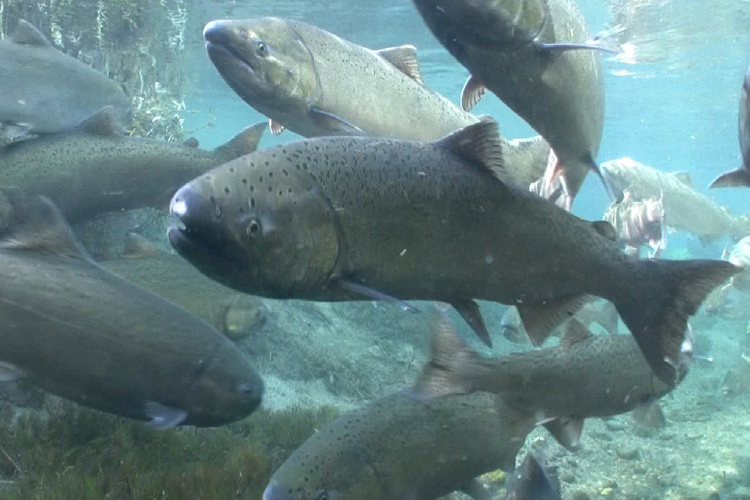
The Klamath River in the U.S. was heavily dammed over the 20th century, blocking spawning Chinook salmon. As a result, the population of salmon that spawned in the river, which runs through Southern Oregon and Northern California, declined by roughly 90%. However, a recent study found that removing the dams resulted in a quick return of the fish to the river.
In 2024, four dams were removed from the Klamath, allowing Chinook salmon (Oncorhynchus tshawytscha) to recolonize habitat that had been unavailable to them for roughly a century. Shortly after the dams were removed, 7,742 Chinook salmon migrated up the Klamath River past the former dams. In 2025, that number jumped to more than 13,000. The fish expanded into 345 kilometers (214 miles) of formerly blocked river, recolonizing 88% of their known historical habitat, the study found.
First author of the study Damon Goodman told Mongabay in an email that they expected the Chinook to return to the river but didn’t know how long it would take. “What surprised us was the speed and scale of their response – it felt like we were running to keep up with the fish! These fish navigated challenging rapids, engineered fishways, and a large lake to reach habitats that had been inaccessible for more than a century.”
Goodman and colleagues employed a specialized underwater sonar camera that uses sound waves instead of light to produce moving images of fish swimming through the river.
“Think of it as an underwater video camera that can see through muddy water, even in complete darkness,” he said. They installed the camera near the former Iron Gate Dam site and continuously monitored fish throughout the fall migration. They measured individual fish and could distinguish Chinook salmon from other fish species to estimate how many passed through the site.
“This technology was particularly valuable because the river remained extremely turbid following dam removal, making traditional underwater video monitoring impractical. It allowed us to document the return of thousands of salmon that otherwise would have been difficult to observe,” Goodman said.
Goodman is optimistic that Chinook salmon on the Klamath could have a substantial recovery, but they aren’t out of the woods yet.
“The speed of recolonization demonstrates that these fish retain a remarkable ability to find and use newly accessible habitat. However, returning to historical population levels will require successful reproduction over multiple generations, along with improvements in habitat conditions, water quality, and fish passage throughout the basin. Dam removal was an enormous step forward, but it doesn’t eliminate all the challenges facing salmon,” Goodman said.
Scott Hinch, a salmon ecologist at the University of British Columbia who was not involved in the study, told The New York Times that the speed of the salmon recovery is remarkable. “Everything has to fall into place to make something like this possible,” Hinch said.
Banner image: Chinook salmon. Image courtesy of Michael Humling, U.S. Fish & Wildlife Service.
