


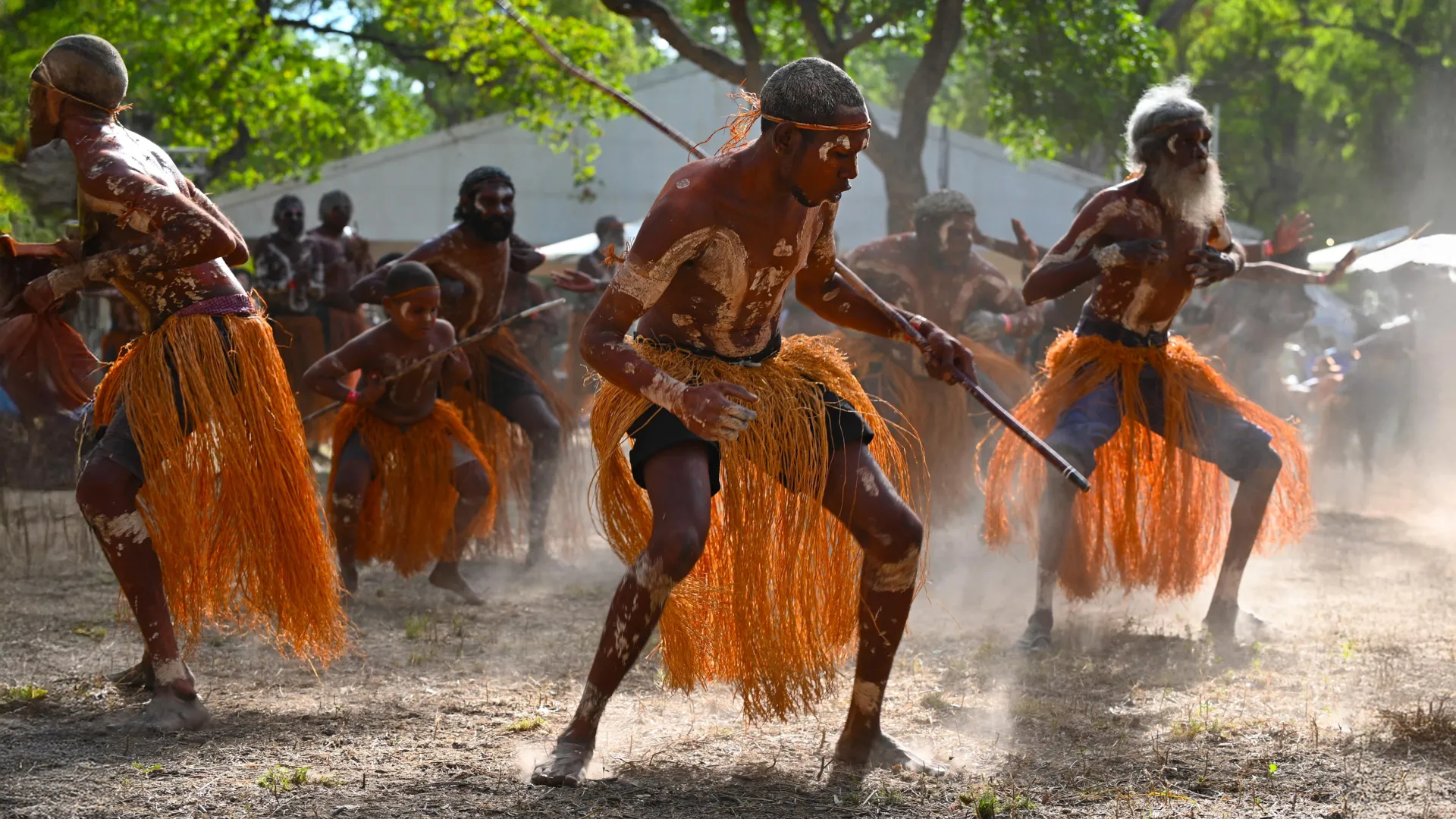
New research suggests that Australia’s Indigenous population before European colonization was far larger than historical estimates have indicated. Scientists now estimate that approximately 2.22 million Indigenous people lived across the continent before the arrival of the First Fleet in 1788, potentially up to seven times the number suggested by some earlier calculations.
The findings also reveal the devastating scale of the population decline that followed colonization. According to the researchers, an estimated 93% of Australia’s Indigenous population was lost within less than 80 years of European arrival, a much greater decline than previously recognized.
Professor Corey Bradshaw, a Global Ecology Professor at Flinders University and Chief Investigator at the Australian Research Council Centre of Excellence for Indigenous and Environmental Histories and Futures (CIEHF), contributed to the national research effort. Working alongside Indigenous partners, the team is investigating how Indigenous population numbers have changed throughout Australia’s history.
By combining advanced computer models with several sources of historical and scientific evidence, the researchers developed new estimates that substantially challenge previous assumptions.
“Understanding the size of Indigenous populations in Australia before European invasion in 1788 is essential to truth-telling and reconciliation,” says Professor Bradshaw.
New Evidence Reveals Millions of Indigenous Australians Before Colonization
To reconstruct Australia’s Indigenous population before European settlement, the researchers brought together ethnographic observations, archaeological findings, genetic reconstructions, and computer models. They also examined how many people different environments across the continent could have supported.
Earlier population estimates often relied heavily on calculations made during the 1930s by anthropologist Alfred Radcliffe-Brown. His influential assessment placed Australia’s Indigenous population before colonization at approximately 250,000 people.
However, Radcliffe-Brown recognized that his estimate did not fully account for the devastating effects of deadly diseases, violence along colonial frontiers, and broader structural violence. Subsequent research has shown that these forces had a much greater impact than was historically acknowledged, suggesting that many early population figures were already substantial underestimates.
Using modeled and genetics-based estimates (supported by, but not relying on, historical or ethnographic accounts), the team calculated a median Indigenous population of 2.22 million before colonization. This corresponds to approximately 0.29 people per square kilometer across Australia.
The figure is substantially higher than earlier historical estimates, which generally ranged from 250,000 to 1 million people.
Researchers believe those lower estimates were influenced by the widespread population losses caused by disease, frontier violence, and systemic oppression before the earliest Australian censuses were conducted.
A Devastating 93% Population Collapse After 1788
The revised population estimate also allowed scientists to calculate the scale of the demographic catastrophe that followed European colonization.
Using their model alongside early census records, the researchers estimated that approximately 2.06 million excess deaths occurred between 1788 and 1861. That represents an average of roughly 28,200 excess deaths annually over the 73-year period.
By 1861, the Indigenous population had declined to an estimated 7% of its size before colonization, representing a staggering 93% reduction.
“These devastating findings highlight the major impacts of invasion experienced by Indigenous Australians, and demonstrate their remarkable survival, resilience and recovery over the past century,” says lead author Associate Professor Alan Williams, a Partner Investigator in CIEHF representing EMM Consulting and who is also an Adjunct Research Fellow at James Cook University.
Although Australia’s Indigenous population has increased since the 1950s, it has not yet returned to its estimated size before European arrival.
According to the 2021 Australian census, the Indigenous population was approximately 37% of the study’s estimated median population in 1788.
If population growth continues along current trends, the researchers project that Indigenous population numbers may not return to their estimated pre-colonial level until around 2047.
What the Findings Mean for Australia’s History
Beyond revising historical population figures, the study highlights the long-lasting consequences of colonization for Indigenous Australians.
The researchers say the scale of the demographic collapse has important implications for understanding intergenerational trauma, persistent disadvantage, and the development of policies that better support Indigenous communities.
“The findings highlight the scale of demographic catastrophe experienced by Indigenous Australians due to colonization, with the implications being a heightened understanding of intergenerational trauma and to inform future policy that assists Indigenous people. In addition to recognizing this intergenerational trauma and disadvantage, it is also time to recognize intergenerational privilege,” says co-author Distinguished Professor Lynette Russell of the Monash University Indigenous Studies Centre and CIEHF.
The findings also demonstrate why scientists must draw on several independent methods when reconstructing population histories, particularly when written records are incomplete, unreliable, or shaped by historical biases.
By combining genetic research, archaeological evidence, environmental modeling, and historical information, the team was able to develop a more comprehensive picture of Australia’s Indigenous population before and after European colonization.
Distinguished Professor Larissa Behrendt AO, Chair of the CIEHF Centre Advisory Committee, says the findings demand a fundamental reassessment of the country’s history while also recognizing the extraordinary endurance of Indigenous Australians.
“These research findings challenge us to rethink the scale of what happened after 1788. We are not talking about a marginal consequence of colonization but a demographic catastrophe at the heart of the Australian story. But the research also tells us something extraordinary. Our survival is one of Australian history’s most remarkable stories,” said Distinguished Professor Larissa Behrendt AO Chair, CIEHF Centre Advisory Committee.
The study, “Large size of the Australian Indigenous population prior to its massive decline following colonial invasion,” was published in Nature Human Behaviour. Its authors are Alan Williams, Raymond Tobler, Billy Griffiths, Sean Ulm, Matthew Nitschke, Michael Bird, Shane Ingrey, Frédérik Saltré, Kirsty Beller, Ian McNiven, Nicholas Pitt, Lynette Russell, Alistair Paterson, Christopher Wilson, and Corey Bradshaw.
The research received joint funding from the Australian Research Council Centre of Excellence for Indigenous and Environmental Histories and Futures (CE230100009) and the Australian Research Council Centre of Excellence for Australian Biodiversity and Heritage (CE17010001).
