


Scientists have discovered remarkably preserved traces of dinosaur blood inside 115-million-year-old bones, revealing that delicate biological molecules can survive far longer than previously believed. The breakthrough could transform how researchers study prehistoric animals and even influence the search for ancient life beyond Earth.
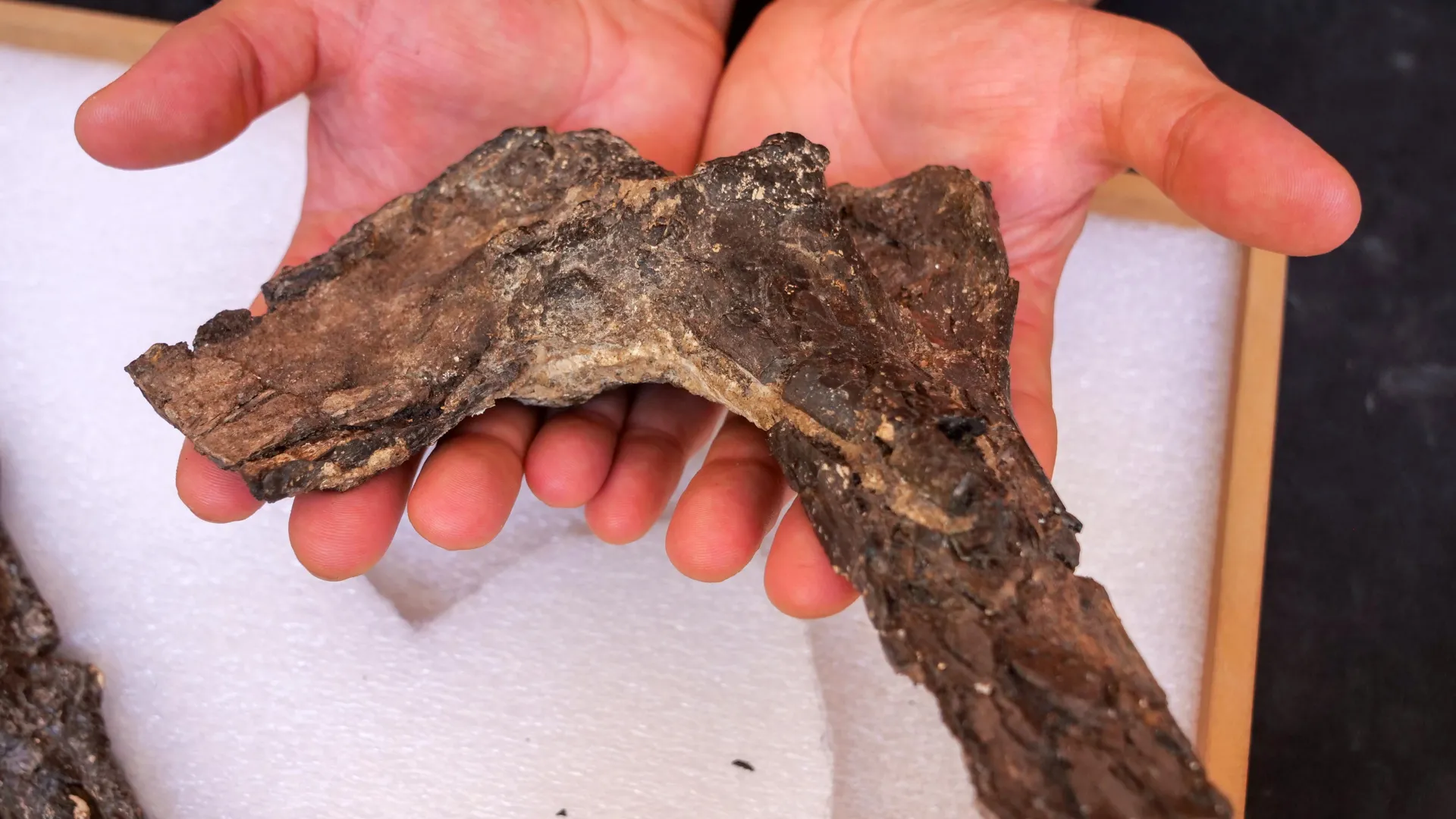
An international team led by Curtin University found fossilized red blood cells and chemical evidence of blood molecules in the remains of Aratasaurus museunacionali, a meat-eating theropod dinosaur discovered in northeastern Brazil. The findings, published in the Proceedings of the National Academy of Sciences, also include amino acids associated with collagen, an important structural protein found in bones and other connective tissues.
The discovery provides the first definitive chemical confirmation of molecules derived from hemoglobin inside fossilized dinosaur red blood cells. Earlier research had identified structures resembling blood cells in ancient fossils, but scientists had not conclusively demonstrated the presence of these particular molecular remains within them.
Ancient Dinosaur Blood Preserved Inside Fossilized Bones
When researchers examined the dinosaur’s limb bones, they identified numerous mineralized red blood cells inside vascular canals, the tiny passages that once contained blood vessels. Chemical analysis revealed preserved heme molecules, which are components of hemoglobin, the protein that allows red blood cells to transport oxygen.
Finding these molecules provided direct chemical evidence that the fossil contained remnants of ancient blood. It also demonstrated that some biological materials once thought too fragile to survive for millions of years can remain detectable under exceptional conditions.
The study was led by John Curtin Distinguished Professor Kliti Grice, founding director of Curtin University’s WA-Organic and Isotope Geochemistry Centre and an Australian Research Council Laureate Fellow.
“To detect intact heme-derived molecules in 115-million-year-old red blood cells is astonishing: this really is a landmark discovery,” Professor Grice said.
“It not only extends the known fossil record of blood, but also offers a direct molecular window into the physiology of long-extinct animals so we may better understand them and the world they lived in.”
How Dinosaur Blood Survived 115 Million Years
The extraordinary preservation appears to be connected to a mineral called hausmannite. This mineral helped stabilize the fossilized blood cells and preserve their molecular components (including amino acids of collagen) over an immense span of geological time.
In effect, the mineral created a natural time capsule that protected microscopic evidence of the dinosaur’s biology long after its death.
Researchers believe the conditions surrounding the dinosaur’s burial were also crucial. They suspect the animal was quickly covered by sediment in an environment with little oxygen and abundant microbial activity. These conditions may have helped preserve biological material that would ordinarily have broken down and disappeared.
The international research effort brought together scientists from Curtin University’s School of Earth and Planetary Sciences, the Japan Agency for Marine-Earth Science and Technology, the Brazilian National Museum, the Regional University of Cariri, and Johns Hopkins University.
A Discovery That Challenges Fossil Preservation Limits
The findings challenge a longstanding assumption in paleontology that molecules associated with blood, particularly those derived from hemoglobin, could not remain preserved across such enormous periods of time.
Beyond confirming the survival of ancient blood components, the discovery raises the possibility that other fossils may contain molecular information that conventional examinations have overlooked.
“These findings challenge longstanding assumptions that certain biomolecules such as hemoglobin cannot survive deep time,” Professor Grice said.
“It opens exciting new avenues for molecular-level paleontology, allowing us to investigate the evolution of blood, metabolism and even activity levels in ancient animals.”
Such information could eventually help researchers better understand how extinct animals functioned, including aspects of their metabolism and physiology that are difficult to reconstruct from bones alone.
Implications for Ancient Life Beyond Earth
The significance of the discovery may extend well beyond dinosaurs. Understanding how fragile biological structures can survive for millions of years could also help scientists identify possible traces of ancient life in other extreme environments, including those beyond Earth.
Professor Martin Van Kranendonk, head of Curtin University’s School of Earth and Planetary Sciences, said the results are changing how researchers understand the preservation of molecular structures over vast timescales and under harsh conditions.
These insights could be valuable to astrobiology, a field that investigates the possibility of life elsewhere in the universe. If biological molecules or their chemical signatures can persist under the right conditions for more than 100 million years, scientists may need to reconsider where and how they look for evidence of ancient organisms.
“This study exemplifies how coordinated efforts across institutions, continents and scientific disciplines can unlock extraordinary insights into ancient life,” Professor Van Kranendonk said.
The research was supported by a 2021 Australian Research Council Laureate Fellowship awarded to Professor Grice.
The study, titled “Heme signatures in mineralized red blood cells within vascular canals of a 115- million-year-old dinosaur bone,” was published in the Proceedings of the National Academy of Sciences.
