


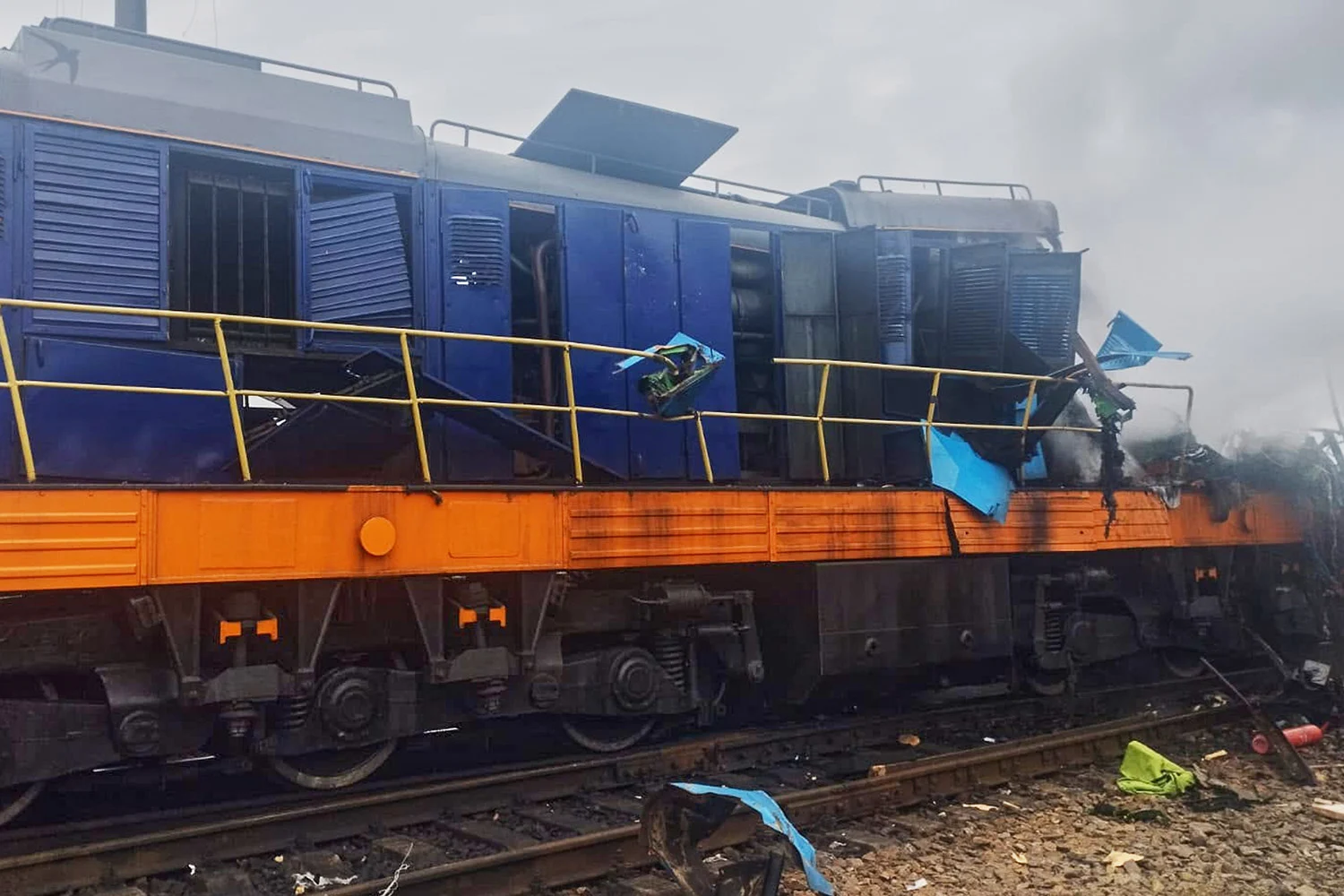
Vladimir Putin certainly knows how to say goodbye. On Sunday morning, Russia launched a drone attack on a train that was about to cross Ukraine’s border into Poland. The drone met its target and exploded on impact. Nobody was hurt because Ukrainian security had detected the incoming projectile and emptied out the train, as has now become common protocol in the country. But the attack made global headlines when Carl Bildt and Boris Johnson, the former prime ministers of Sweden and Britain, respectively, revealed on social media that they had passed that same border crossing just minutes earlier on a specially chartered train. It’s difficult not to interpret the incident, so far out west and so near the border of a NATO member state, as a message from Putin to Europe: Get out and stay out—or else.
I was on the chartered train, too, along with dozens of senior European diplomats, politicians, and think tankers, returning from an annual national security conference held at a secure location in Kyiv. Most of us imagined we’d be safe on our journey partly because, until very recently, Russia had been unable to strike trains to Kyiv’s west. But more than that, there was strength in numbers. Surely, we reasoned, Moscow wouldn’t try to attack a group of conference attendees that included sitting national security advisors from France, Germany, and the United Kingdom, along with several ministers from across Europe?
Vladimir Putin certainly knows how to say goodbye. On Sunday morning, Russia launched a drone attack on a train that was about to cross Ukraine’s border into Poland. The drone met its target and exploded on impact. Nobody was hurt because Ukrainian security had detected the incoming projectile and emptied out the train, as has now become common protocol in the country. But the attack made global headlines when Carl Bildt and Boris Johnson, the former prime ministers of Sweden and Britain, respectively, revealed on social media that they had passed that same border crossing just minutes earlier on a specially chartered train. It’s difficult not to interpret the incident, so far out west and so near the border of a NATO member state, as a message from Putin to Europe: Get out and stay out—or else.
I was on the chartered train, too, along with dozens of senior European diplomats, politicians, and think tankers, returning from an annual national security conference held at a secure location in Kyiv. Most of us imagined we’d be safe on our journey partly because, until very recently, Russia had been unable to strike trains to Kyiv’s west. But more than that, there was strength in numbers. Surely, we reasoned, Moscow wouldn’t try to attack a group of conference attendees that included sitting national security advisors from France, Germany, and the United Kingdom, along with several ministers from across Europe?
We were wrong.
More than the attack itself, which was a tiny snapshot of what regular Ukrainians experience every day, what struck me the most in my latest visit to Kyiv was learning how battlefield dynamics were once more seesawing back in Moscow’s direction. Russia has updated its latest version of the Iranian Shahed-136 drone, the Geran-5, into something resembling a cruise missile that travels at about 370 miles per hour, with a range of more than 600 miles and an explosive payload of nearly 200 pounds. This is no longer a souped-up drone, which was the story of the last two years of battlefield innovation and which pops up on TV shows such as Taylor Sheridan’s Lioness. The Geran-5 is essentially a missile. Ukraine currently has no drone that can stop it. And since Kyiv has run out of missile interceptors, its people are sitting ducks as Moscow produces these new drones by the thousands and Putin becomes bolder in the targets he selects.
Winter is truly coming for Ukraine. At the conference, I chaired a lunch discussion with some of the country’s leading energy and mining CEOs. Our topic was how to keep Ukraine powered and warm as temperatures dip below freezing. The energy executives struck a brave note as they described to me how they were spending $4 underground for every dollar in plain sight. In other words, they were trying to make the country’s energy infrastructure immune from drone attacks. They told me how they were making extra transformers and grid parts so they could quickly replace infrastructure damaged in an attack. Their plan felt convincing. Yet, an hour after our lunch, we learned that Russia had bombed two major steel plants, taking out some of the key precursors Ukraine would require to prepare its contingencies. Wars keep peeling back new layers of the onion.
The Russia-Ukraine conflict is now well into its fifth year. Every few months, momentum has seemingly shifted from one side to the other, back and forth over and again. Recently, Kyiv seemed in the ascendancy with an increased frequency of drone attacks deep into Moscow, hitting Russian energy infrastructure and bringing the war home to regular Russians. The most telling sign of this shift in momentum was when Putin low-keyed his beloved Victory Day parade in the spring, worried about potential attacks. More recently, the United States and its Gulf allies turned to Ukraine for advice on how to ward off Iran’s drone and missile strikes on energy infrastructure in the Middle East. Kyiv had gone from not having any “cards,” as U.S. President Donald Trump famously remarked in a 2025 Oval Office meeting with Ukrainian President Volodymyr Zelensky, to holding the key to any country seeking to defend itself from Iran, North Korea, or Russia.
Parts of that shift in momentum still hold true, but Russia’s latest innovations in drone technology threaten a swing back in the Kremlin’s favor. And perhaps, even in Iran’s, if Moscow shares its Geran-5 parts with Tehran, giving the Islamic Republic a greater ability to attack ships in the Strait of Hormuz or U.S. bases and energy infrastructure in the Gulf. As one technology executive involved in weapons production told me, nobody currently knows how to stop dozens of drones hurtling to their target at above 300 miles per hour.
As always, money could determine which side ultimately wins out in these various arenas of conflict. Roksolana Pidlasa, a Ukrainian economist and member of parliament, was honest in her assessment for Ukraine in a discussion on the conference mainstage. “The budget is not great,” she said, pointing to how Kyiv has spent $42 billion so far this year on defense. “The war has become so expensive that this year, we cannot even cover basic military costs.” Prime Minister Sergii Koretskyi explained how the government was making itself more flexible to build resilience in the face of continuing attacks. “There must be decentralization in energy, in logistics, and in other sectors,” he said. Some of this is already evident as the country’s energy demand has dropped by 30 percent this year, in part because families and small businesses have set up their own solar installations. But reductions in demand are rarely good signs for an economy; much of it is also because of declining industrial output in the face of consistent enemy attacks.
Read More
-
Anti-tank hedgehogs are stacked near the border with Russia in Karsava, Latvia, on Aug. 16, 2024. Anti-tank hedgehogs are stacked near the border with Russia in Karsava, Latvia, on Aug. 16, 2024. Is Europe Ready for a New Era of Russian Dirty Tricks?
After the Kremlin’s failure in Ukraine, Putin’s new plan aims westward.
-

People come and go at an emergency heating tent following Russian missile and drone attacks on Ukrainian energy infrastructure. People come and go at an emergency heating tent following Russian missile and drone attacks on Ukrainian energy infrastructure. Keeping Kyiv Warm Under Fire
As Russian strikes batter the grid, a corruption scandal deepens Ukraine’s winter crisis.

-

An activist wearing a mask of Russian President Vladimir Putin poses with a mockup of a nuclear missile in front of the Russian embassy in Berlin on June 23, 2023. An activist wearing a mask of Russian President Vladimir Putin poses with a mockup of a nuclear missile in front of the Russian embassy in Berlin on June 23, 2023. Why Even a Cornered Putin Won’t Press the Red Button
Great powers have been humbled many times without escalating to nuclear war.
Could diplomacy end this seemingly endless war? U.K. National Security Advisor Jonathan Powell reminded attendees of a memorable quip about the Middle East peace process by former Israeli Prime Minister Shimon Peres: “The good news is that there is light at the end of the tunnel. The bad news is that there is no tunnel.” Powell’s point was that the recent bout of talks between Washington and Moscow, which included visits by Trump confidantes Steve Witkoff and Jared Kushner, as well as a separate one by CIA Director John Ratcliffe, represented the construction of a tunnel. When the time finally arrives, a system of understandings, red lines, and off-ramps may be the necessary components that could help usher in a deal. It’s a useful perspective, although it felt overly optimistic as we watched Kushner speak in a video conference that has now become public. “War is just negative,” he declared, and “peace is very, very positive,” as attendees watched on, confused by the platitudes. Later, describing ongoing talks and his visit to Moscow, Kushner said: “President Trump’s very, very committed to this. … President Zelensky is very committed … and from what we heard, President Putin is very committed to this as well.” The conference hall erupted in laughter. So much for the integrity of the tunnel.
As we convened in Kyiv, I had one eye on my old haunt in New Delhi, where Indian Prime Minister Narendra Modi had convened a BRICS summit and welcomed Putin, Chinese President Xi Jinping, and Iranian President Masoud Pezeshkian, among other leaders. Ukraine wasn’t mentioned once in the summit’s official communiqué. It reminded me how the world today can feel as if we are living in multiple parallel timelines all at once. The main point of convergence, however—and the reason why I’m more worried today than I have been in a while—is that wars everywhere are becoming more aerial, more robot-controlled, and more AI-inflected. All of this means war is becoming more dangerous, more unpredictable, and with greater chances of mistakes. For a while in the last two years, it felt as if defensive technologies were keeping up with offensive ones. This may no longer be the case.
