


When Boris Nadezhdin began campaigning for Russia’s parliamentary elections as an independent candidate over the summer, more than four years on from the full-scale invasion of Ukraine, the politician was driven by a belief that Russians wanted peace. His experiment proved short-lived: Within weeks, authorities piled on such legal pressure that by late July, he felt compelled to leave the country or face likely imprisonment.
Nadezhdin, 63, is not a natural firebrand, and his campaign wasn’t radical. If he erred, he thinks it was by not fading into irrelevance after a failed bid for president two years ago. “I must have irritated some Kremlin officials,” Nadezhdin said in a video interview last month from Paris. One of the highest-profile government critics to flee Russia since 2022, he appeared exhausted by the events that had put him at the center of the Kremlin’s latest push to root out dissent.
The Russian government has little tolerance for genuine opposition, but certain figures have remained active in the political arena by policing their own speech. But ahead of this year’s State Duma elections—the first since the full-scale invasion—authorities began purging the last political elements advocating for peace. After Nadezhdin, they set their sights on the anti-war Yabloko party, which a court has barred from standing in the elections.
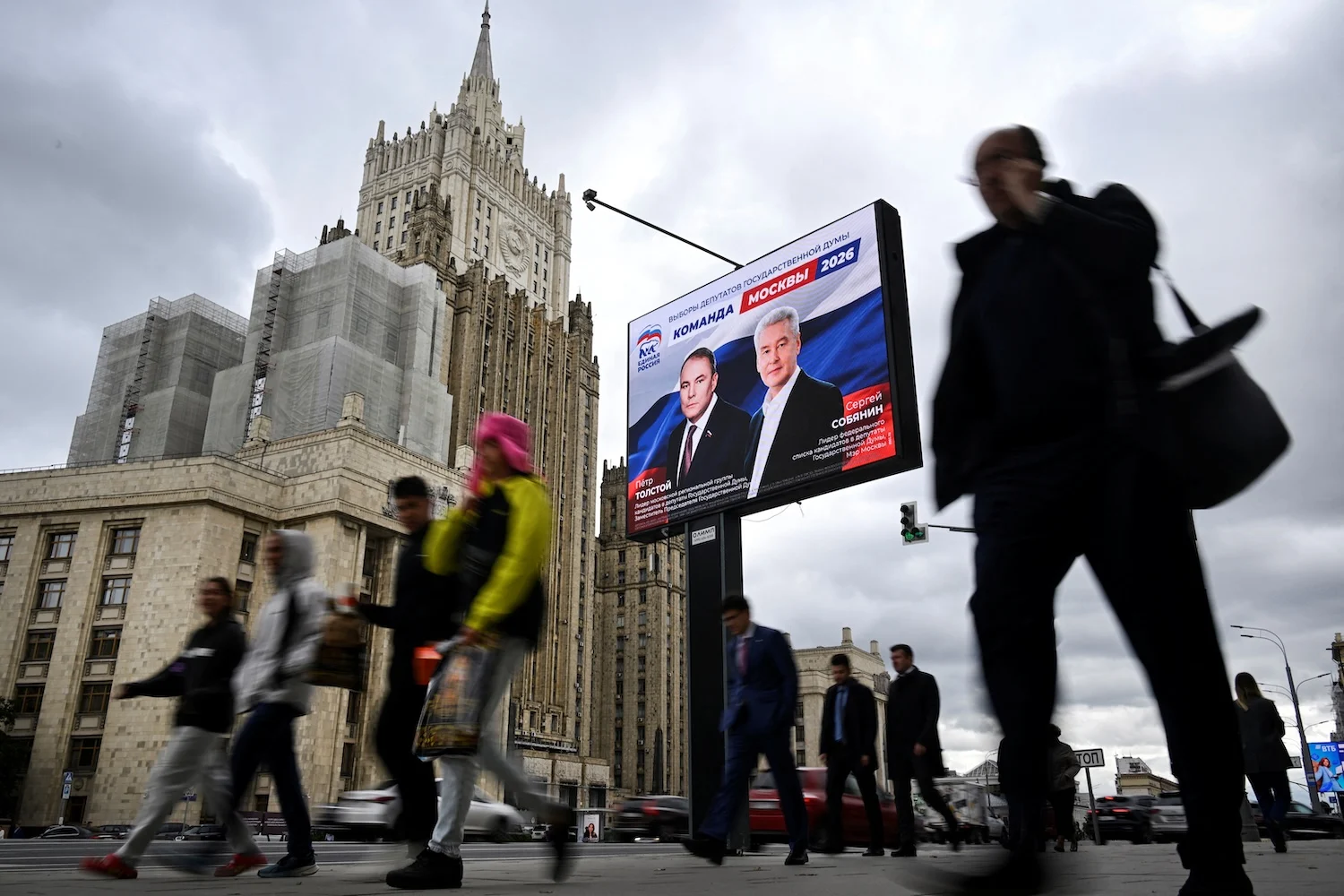
For the Kremlin, it’s important that the war in Ukraine has the veneer of public support. Speaking at a congress of the ruling United Russia party in August, Russian President Vladimir Putin told a packed conference hall that the Duma elections, held from Sept. 18 to 20, will “reaffirm the stability of the state” and “become an expression of the common will of millions of people.”
By the same token, while the tightly controlled elections present no real threat to Putin’s hold on power, they offer a chance for Russians to register their displeasure with the war. As Ukrainian drones strike deeper into Russia and a peace deal remains elusive, the Kremlin might believe that opening the vote to anti-war candidates would expose cracks in the foundation of its support.
Russia’s State Duma, the lower legislative house, brings together 450 deputies. Its roster gives the impression of some diversity, including communists, nationalists, and even some self-described liberals. In reality, space for disagreement is vanishingly small. United Russia holds 70 percent of the seats, and the rest are all part of what is known as the systemic opposition: parties that differ in their priorities but broadly support United Russia.
“It’s not like a parliament in European countries,” said Dmitry Gudkov, a former independent representative in the Duma from 2011 to 2016. “It’s a place where all the players have been created in the Kremlin. They are all managed by the administration.”
Nadezhdin’s career spans the history of post-Soviet Russia, and for much of it, he counted himself among the ranks of the systemic opposition. Unlike more rabble-rousing personalities, including his former ally Boris Nemtsov and Alexei Navalny, Nadezhdin has suggested that by leveling his criticism toward policy and not Putin himself, he believed he could remain a constant advocate for peace—if a politically hindered one.
Since the 2022 invasion of Ukraine, Russia has instituted sweeping measures to limit people’s ability to talk about the war, threatening prison for offenses such as “discrediting” the military. Two years ago, Nadezhdin ran a defiant and unexpectedly successful anti-war campaign for president, testing the limits of this censorship. Seeing a rare opening for quiet protest, more than 100,000 Russians endorsed his bid before the Central Election Commission barred him from standing, citing 9,000 supposedly erroneous signatures. Nadezhdin launched a legal challenge, which was shot down.
Undeterred, Nadezhdin hoped to replicate his previous momentum with what he called an “even more vigorous campaign for peace.” His pamphlets bore a seemingly innocuous slogan: “Peace, development, fair elections, strong cities.” However, on July 10, a few weeks after he submitted documents to the Central Election Commission to register his candidacy, the Justice Ministry branded Nadezhdin a “foreign agent,” barring him from office.
Unlike during Nadezhdin’s run for president, the pressure didn’t stop there. He was convicted of displaying “extremist symbols,” an administrative charge stemming from a link shared on his social media accounts in 2023 to a video showing a picture of Navalny, and later banned from leaving the country. But a few weeks later, shortly after he had received a notice to appear before Russia’s Investigative Committee—meaning that authorities were likely pursuing more serious criminal charges—Nadezhdin saw that his exit ban had been lifted. He and his wife flew to Kazakhstan, where they applied for French visas, and soon they were in Paris.
The move abroad and looming charges in Russia immensely complicate Nadezhdin’s life. “I have no idea yet where or how I’ll be living in the coming months and years,” he said. Though he judged that exile is better than prison, he admitted that the Russian authorities have succeeded in sidelining him. Based on the advice of his lawyers, Nadezhdin has decided to stop engaging in political activity for now.
As Nadezhdin’s ordeal played out, Russians opposed to the war turned their attention to the liberal Yabloko party, long seen as a Kremlin-approved stand-in for genuine opposition. Founded in 1993, the party was an early agitator for democratic reforms but withered in the early 2000s, failing to win a seat in the Duma since 2003. Yet Yabloko still contested elections, even as leaders acknowledged their role was limited to influencing political discourse and, in recent years, being the sole party to oppose the war in Ukraine.
With no other anti-war option on the ballot, interest in Yabloko surged. During one week in late July, traffic to four of the party’s major social media platforms doubled, according to a Russian election monitoring project. The Wall Street Journal reported that Yabloko’s Instagram following had grown by 100,000 in just a few weeks.
The party takes its name from the Russian word for “apple,” and unwitting observers would be forgiven for thinking that young people had developed a peculiar obsession with the fruit, judging by the videos that started cropping up on social media. In one, a young man with red hair dances on Red Square, mouthing the words to a pop song of the same name. As of late August, it had 350,000 likes. Viewers understood the video’s unmistakable endorsement of Yabloko in the kind of coded language that has become a hallmark of wartime political discourse in Russia.
“Yabloko, which never claimed to be anything serious, unexpectedly became the party people want to vote for,” said Ilya Yashin, an exiled Russian politician based in Berlin. “Because at the level of rhetoric, it is the only one saying that the war must end.”
Though it looked as if the party might become a lightning rod for discontent, its hopes were dashed as quickly as they rose. The nationalist Rodina party filed a lawsuit challenging Yabloko’s registration on Aug. 7, claiming that it broke the law by taking money from Western donors, among other things. A Moscow court agreed, and Yabloko’s appeal was rejected, meaning that it will not appear on the party-list ballot. (Its candidates can still stand in single-member constituencies.)
According to Nikolai Petrov, a senior research fellow at the New Eurasian Strategies Centre, the hasty ban reflects a miscalculation on the part of the Russian government. Based on Yabloko’s historically poor performance on the ballot and that many of its well-known candidates were already sidelined, the Kremlin was banking on the party receiving few votes and thus demonstrating that “there is absolutely no public appeal to end the war.” But when the opposition party seemed to gain steam, Petrov said, the Kremlin “didn’t have any way out except for not letting Yabloko participate.”
In July, United Russia’s approval rating had dipped to its lowest point since the start of the full-scale invasion. Officials’ urgency in suppressing critical voices seems to be a product of both this flagging approval and the state of the war, which this year crept into Russians’ daily lives more than ever before. Drones explode over Moscow with regularity, people wait to fuel up their cars in lines more than half a mile long, and ordering products from Wildberries—the Russian equivalent of Amazon—has become unreliable since Ukraine started targeting its warehouses.
Petrov said Yabloko’s ban could, paradoxically, be seen as a “huge victory” for the anti-war party, at least symbolically. Polls diverged in their estimation of the party’s support but generally put it in the single digits nationwide; there was a good chance that it wouldn’t have crossed the 5 percent threshold needed to enter the Duma. Yet, for a few weeks, it won airtime, sympathy, and thousands of new supporters. “Yabloko demonstrated that the Kremlin is afraid of them,” Petrov added.
Such an outcome is seemingly the best that anti-war factions could currently hope for, but even this paradigm could be short-lived. This election season suggests that the Kremlin will come down harder against budding anti-war voices in the future, perhaps making Yabloko’s “victory” a bitter one.
If recent events are any indication, what little space remains for anti-war politicians in Russia is closing. Take Yabloko: Even before the electoral drama, some of its most senior members were making the news for receiving harsh prison sentences, a process that hasn’t slowed down. Just days after the party was banned from running, its deputy chairman, Lev Shlosberg, was sentenced to 11 years and one month in prison for discrediting the armed forces.
The party’s existence might be at stake. Gudkov, the former Duma representative, said he wouldn’t be surprised if Yabloko was soon liquidated. “They will be destroyed,” he said. “They are not needed for the system anymore.”
Meanwhile, figures such as Nadezhdin face issues all their own—questions of how to stay relevant as a politician in exile, where most political resistance to the Kremlin now happens. Yashin, the other exiled politician, recently formed a political party called Peaceful Russia. He envisions corralling often quarrelsome anti-war voices abroad and someday returning home to “take power,” however improbable that may be.
For now, however, the opposition figures outside Russia have little practical way to influence developments back home as citizens prepare to vote.
According to Yashin, the quashing of Nadezhdin and the Yabloko party represents the “logical conclusion” of an increasingly repressive and controlled political system—but one that will be undone with time. “Putin’s departure will open up space for political struggle and for the transformation of this system,” Yashin said. “But today, the opposition can be either underground or in exile or in prison.”
