


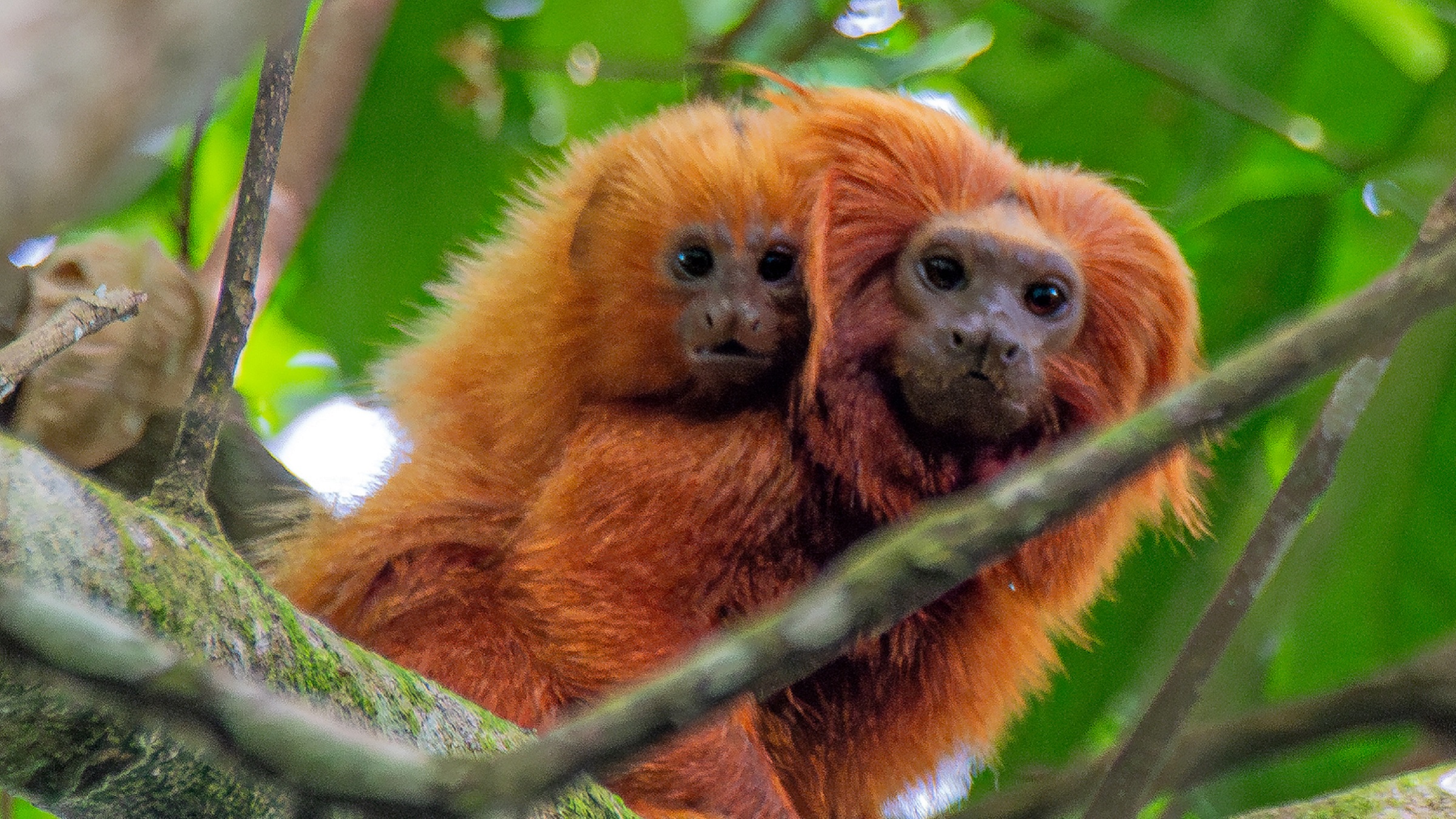
- Golden lion tamarins, an endangered species of monkey endemic to Brazil’s Atlantic Forest, are susceptible to yellow fever: An outbreak in 2017-2019 wiped out roughly 30% of the population.
- A new study finds that certain environmental factors, including habitat connectivity and human population, were linked to higher numbers of deaths during the outbreak.
- Scientists have identified areas where tamarins could be at high risk for yellow fever transmission, which could help guide vaccination efforts and help protect the monkeys in the event of another deadly outbreak.
After a two-hour drive from the airport in Rio de Janeiro, you reach a special park dedicated to a special animal in Brazil’s Atlantic Forest. There, you can take a guided tour through the green and perhaps catch a glimpse of vibrant orange: The pelage or furry coat of one of this region’s most famous resident, the golden lion tamarin.
Between 2017 and 2019, a yellow fever epidemic killed roughly 30% of the population, leaving only 2,500 alive. This small, endangered monkey, which nearly went extinct in the 1970s, is relegated to fragmented forests in the state of Rio de Janeiro, about 2% of their original territory, according to conservation nonprofit Save the Golden Lion Tamarin.
But the tamarins (Leontopithecus rosalia) have made a significant recovery, rebounding to roughly 4,800 individuals according to a 2023 census.
To better prepare for a possible outbreak in the future, a group of researchers wanted to find out how different environmental factors affected yellow fever transmission between tamarins. Their research identified high-risk areas, which could guide conservationists aiming to vaccinate the population against future epidemics.
Mapping an outbreak
Researchers compared mortality data from 2014-2016, before yellow fever struck, with more than 1,000 deaths that occurred during the outbreak in 2017-2019, information that was gathered by the nonprofit Golden Lion Tamarin Association (known in Brazil as Associação Mico-Leão-Dourado). They then looked at how a series of variables in the environment itself, including human population, forest cover and habitat connectivity, might be linked to the deaths.
Notably, they found that areas with higher human density had significantly lower tamarin survival rates during the outbreak. This comes down to cross-species transmission, said Maxime Pierron, a University of Strasbourg ecologist and first author on the study. Yellow fever is a zoonotic disease: It can infect both humans and animals, specifically primates.
“We can both get [yellow fever], so it’s easy … to share it,” he said.
Habitat connectivity had a similar effect. Though it improved survival before the outbreak began, that outcome flipped once the epidemic got underway.
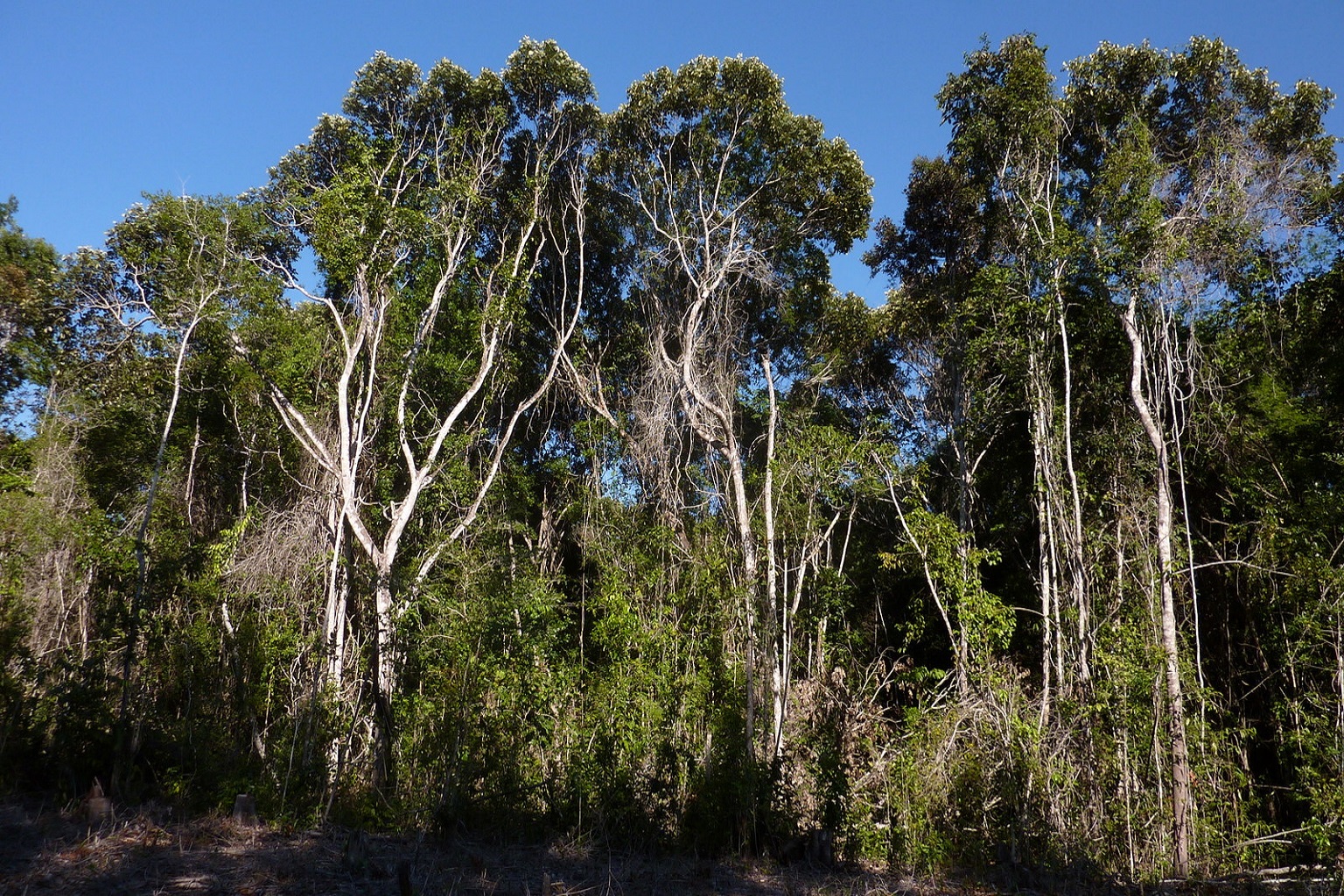
“[Connectivity] reduces mortality because it improves the gene flow and it allows primates to evade threats more easily, so it’s great,” Pierron said. “But during an outbreak, it turns out that this also facilitates the movements of mosquitoes that are infected with yellow fever,” which increases transmission, he added. The researchers found yellow fever caused more deaths in forests that were better connected.
The value of connectivity
Despite this, Pierron warned that the findings should not be interpreted as an argument against reforestation and restoring or relinking fragmented habitat.
“Reforestation is both welcome and urgently needed around the world,” he wrote in an email to Mongabay, adding that “in this context, it is essential to combine reforestation with landscape-informed disease monitoring and to integrate disease ecology into conservation planning.”
Connected habitat could help the tamarin population recover from a future outbreak, Carlos Ruiz-Miranda, co-author of the study and board president of the Golden Lion Tamarin Association, told Mongabay in a voice message.
“The more connected the habitat is, the faster or more likely the recovery and recolonization,” he said.
University of Wisconsin-Madison anthropologist Karen Strier, who has studied monkeys in the Atlantic Forest since 1982, said the research brought to mind an old ecological debate between scientists known as SLOSS (single large or several small): a disagreement on the ideal structure of wildlife reserves. One of the arguments against larger areas, she said, was that diseases within them could spread.
“Connectivity is important, but it has some costs too, and I think it’s important to be aware of those costs,” Strier said. “Not because we should stop trying to connect habitats, but so that we can think as [the paper’s authors] do about how to mitigate the risks.”

Vaccination nation
A key part of that mitigation is vaccinating tamarins against yellow fever. AMLD staff began that process in 2020. They’ve immunized just over 500 individuals so far, according to Ruiz-Miranda.
According to Pierron, “death risk during the outbreak can serve as a proxy of transmission risk.” In other words, based on where deaths occurred during the outbreak, scientists can predict areas where the disease might spread more easily in the future. These high-risk areas are “priority zones” for vaccination.
The team has already immunized some individuals from most populations, Ruiz-Miranda said, and plans to vaccinate individuals from the rest in the future. To vaccinate the monkeys, a team captures them and brings them to a field laboratory, he said, where they sedate the animals. They collect hair samples for DNA studies and take measurements before injecting the vaccine. The team tattoos numbers on each animal’s inner thigh to make sure they don’t vaccinate the same individual twice, he said, and then they release them where they were found.
According to Marcos da Silva Freire, a scientific advisor at Brazil’s Oswaldo Cruz Foundation, who helped develop the yellow fever vaccine for golden lion tamarins, the immunization campaign should continue indefinitely. Though vaccinated animals will eventually die, keeping at least a percentage of the population protected helps “avoid some disaster with yellow fever reemergence in the region,” he said.

Banner image: Two golden lion tamarins in Brazil. Image by Henrique Bitencourt via Wikimedia Commons (CC BY-SA 4.0).
Alex Megerle is an intern writer at Mongabay, where he covers wildlife and conservation, and a student in the Massachusetts Institute of Technology Graduate Program in Science Writing.
More to explore:
Reconnecting ‘island habitat’ with wild corridors in Brazil’s Atlantic Forest
The next great threat to Brazil’s golden lion tamarin: Yellow fever
Citations:
Pierron, M., Ponchon, A., Ruiz‐Miranda, C. R., Martins, A., Sueur, C., & Romano, V. (2026). When conservation meets contagion: Mapping yellow fever risk to guide vaccination in an endangered primate. Journal of Applied Ecology, 63(6). doi:10.1111/1365-2664.70463
Dietz, J. M., Mickelberg, J., Traylor‐Holzer, K., Martins, A. F., Souza, M. N., & Hankerson, S. J. (2024). Golden lion tamarin metapopulation dynamics five years after heavy losses to yellow fever. American Journal of Primatology, 86(7). doi:10.1002/ajp.23635
Dietz, J. M., Hankerson, S. J., Alexandre, B. R., Henry, M. D., Martins, A. F., Ferraz, L. P., & Ruiz-Miranda, C. R. (2019). Yellow fever in Brazil threatens successful recovery of endangered golden lion tamarins. Scientific Reports, 9(1). doi:10.1038/s41598-019-49199-6
FEEDBACK: Use this form to send a message to the author or editor of this post. If you’d like to post a public comment, you can do so at the bottom of the page.

