


Millions of people open Wordle each day hoping to solve its five-letter puzzle before their six guesses run out. Now, researchers at Binghamton University, State University of New York, say mathematics can dramatically improve the odds.
By applying information theory, the team developed a strategy that solved 99% of Wordle puzzles in simulations. The key is surprisingly counterintuitive. Instead of always trying to guess the answer as quickly as possible, the method favors words that reveal the greatest amount of useful information.
How Wordle Turns Every Guess Into a Clue
Wordle gives players six attempts to identify a hidden five-letter word. The game begins with no clues, so the first guess can be any valid word.
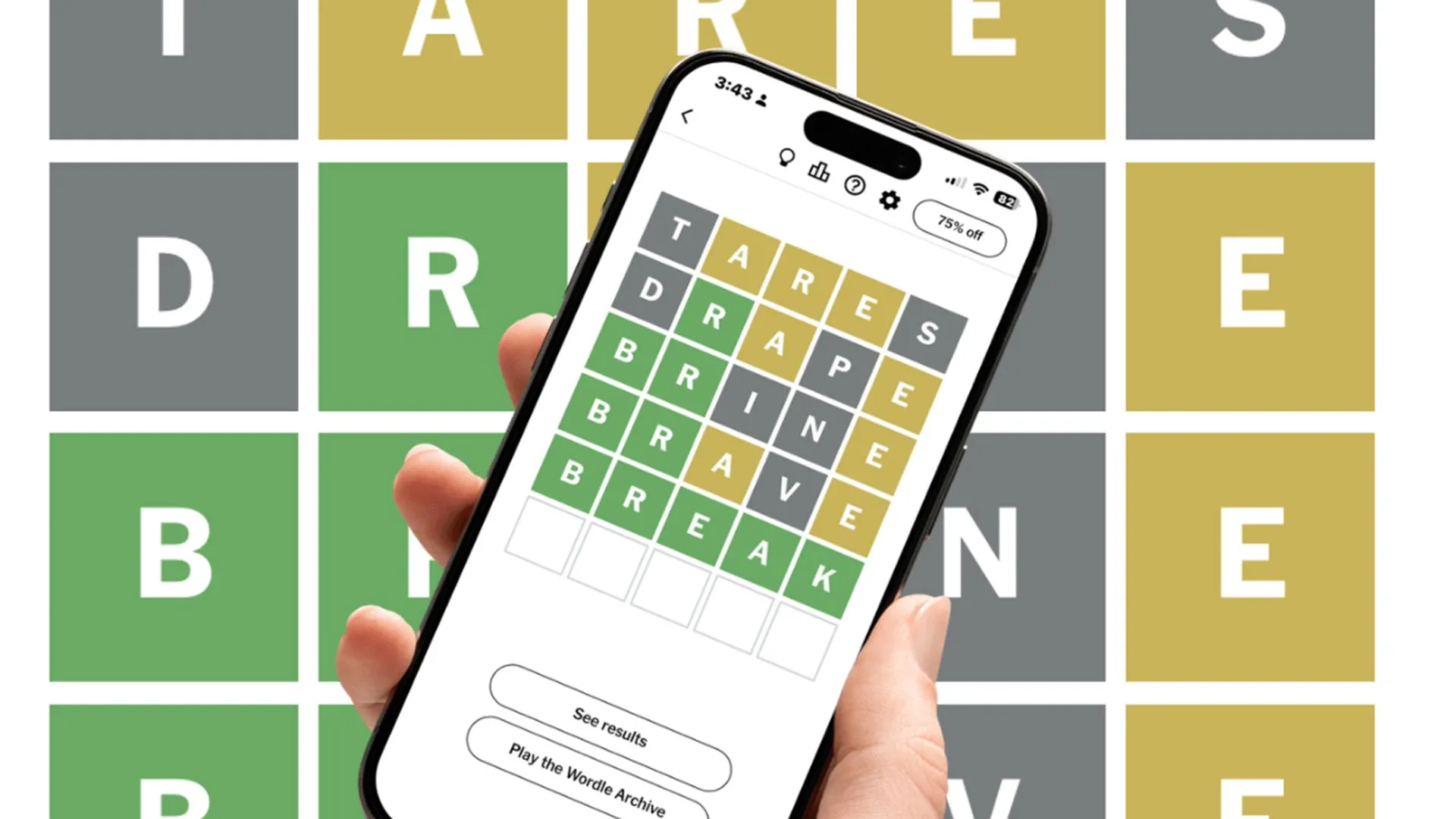
After each attempt, Wordle uses colors to show how close the player is:
- Grey means the guessed letter does not appear in the secret word.
- Yellow means the letter is in the secret word, but it is in the wrong position.
- Green means the letter is both correct and in the correct position.
Players use those clues to narrow the possibilities with each new guess. The game ends when all five squares turn green or when the player uses all six attempts without finding the answer.
That process of progressively reducing possible answers makes Wordle a natural problem for information theory, a branch of mathematics concerned with measuring and communicating information.
The Math Behind a 99% Wordle Strategy
The research team, led by Assistant Professor Congyu “Peter” Wu, focused on a concept known as Shannon entropy.
Shannon entropy is a mathematical way of measuring uncertainty. In simple terms, it can help determine how much useful information a particular choice is expected to reveal. The concept was developed as part of modern information theory and is widely used to study how efficiently information can be transmitted, stored, or processed.
In Wordle, that means asking a different question. Instead of simply choosing the word that seems most likely to be correct, the researchers looked for guesses that would eliminate the greatest number of possibilities.
“Let’s say you’re at a certain guess. The previous guesses will eliminate a whole bunch of options, and based on the remaining options, guessing some words will send you into a trajectory where information gain is speedier,” said Wu, a faculty member at the Thomas J. Watson College of Engineering and Applied Science’s School of Systems Science and Industrial Engineering.
A word that appears unlikely to be the final answer can therefore still be extremely valuable if its letters help divide the remaining possibilities into smaller groups.
“A subtle but important insight from the paper is that a guess doesn’t have to be the most likely answer; it simply has to be informative,” said Donald Stephens, a doctoral student at Binghamton University. “By applying Shannon entropy, the objective shifts to maximizing the expected reduction in uncertainty rather than the probability of being right. In practice, this approach can lead to solving the puzzle in fewer guesses.”
Why the Best Guess Can Look Wrong
To a human player, some of the strategy’s recommendations might initially seem strange or even random. But the goal is not necessarily to solve the puzzle immediately. It is to make each guess reveal enough information to make the next decision easier.
For example, when several possible answers remain, choosing a word that tests a useful combination of letters could eliminate many of them at once. Even if that word has little chance of being the actual solution, the feedback it produces may point much more clearly toward the correct answer.
Using the strategy during a real Wordle game would require running a separate script or program. After each guess, the player would enter Wordle’s color-coded feedback into the program. The software would then calculate the next guess expected to provide the most information.
Information Beats Common Letter Guessing
The researchers compared their approach with a more conventional strategy centered on frequently used letters (e.g., “A,” “E,” “R”).
The difference was substantial. In simulations, the information theory method successfully solved 99% of Wordle puzzles. The common letter strategy solved 90%.
That result highlights an important distinction between simply choosing letters that appear often and choosing guesses that provide the greatest amount of new information. Common letters can certainly be useful, but the mathematical approach continually adjusts its choices based on what has already been learned.
A Classroom Project Becomes Published Research
The work did not begin as a formal research project. Instead, it grew out of a class assignment in which Wu challenged students to demonstrate how information theory could be used to solve a real problem.
The students chose Wordle, turning a popular daily puzzle into a practical test of mathematical decision-making.
Co-author Talal Aladaileh said that the project’s evolution from a classroom exercise into a published paper reflects the rigor, depth, and quality of the School of Systems Science and Industrial Engineering program at Binghamton.
“The courses here don’t just teach concepts; they push you to apply them in ways that have real, lasting impact,” Aladaileh said.
Wu said the project demonstrates how information theory can move beyond simply describing uncertainty and instead become a tool for making better decisions.
“What is especially creative and valuable about the team’s intellectual contribution,” Wu said, “is that it transformed a static measurement (Shannon entropy) in a scientific domain into a dynamic solution that helps accomplish a popular task better, which showcases the team’s deep understanding of class material and their talent as engineers.”
The paper, “Solving Wordle Using Information Theory,” was published in the Northeast Journal of Complex Systems.
