

Close Menu
NCIJ Network NCIJ Network
    What's Hot

    Windows 11 KB5127936 update released with 41 changes and fixes

    October 29, 2026

    Mini-gardens for bees on Peterborough bus stop roofs approved

    October 29, 2026

    Needle exchange: Vulnerable at risk as ‘life-saving’ drug needle site closes

    October 29, 2026
    Facebook X (Twitter) Instagram
    Trending
    • Windows 11 KB5127936 update released with 41 changes and fixes
    • Mini-gardens for bees on Peterborough bus stop roofs approved
    • Needle exchange: Vulnerable at risk as ‘life-saving’ drug needle site closes
    • Early tech warning hopes to give Sumatra’s peat community a head start on fires
    • QatarEnergy locks in more US LNG through 20-year deal with Woodside
    • UW campus closures limit rural college access
    • Detroit May Block Moroun Concrete Plant From Further Neighborhood Growth — ProPublica
    • Is this play-safe budget a sign that the prime minister is planning an early election? | Larry Elliott
    • About
      • Our Team
      • Editorial Policy
      • Editorial Independence
      • International Support
    • Trust & Standards
      • AI Usage Policy
      • Conflict of Interest Policy
      • Corrections Policy
      • Ethics Policy
      • Fact-Checking Policy
      • Source Protection
    • Get Involved
      • Guide for Sources
      • Support Independent Journalism
    • Legal
      • Cookie Policy
      • Privacy Policy
      • Terms of Use
    Facebook X (Twitter) Instagram
    NCIJ Network NCIJ Network
    Thursday, October 29
    • Home
    • World
    • Ai
    • Business
    • Politics
    • Health
    • Crypto
    • Science
    • Technology
    • Cybersecurity
    • Defense & Security
    • Economy
    • Energy
    • Europe
    • More
      • Fact Check
      • Investigations
      • Opinion & Analysis
      • Environment
    NCIJ Network NCIJ Network
    Home»Science

    A striking Mars cloud may be born from surprising physics

    NCIJ NETWNCIJ NETWORKBy NCIJ NETWNCIJ NETWORKOctober 29, 2026 Science No Comments4 Mins Read
    Share
    Facebook Twitter LinkedIn Pinterest Email

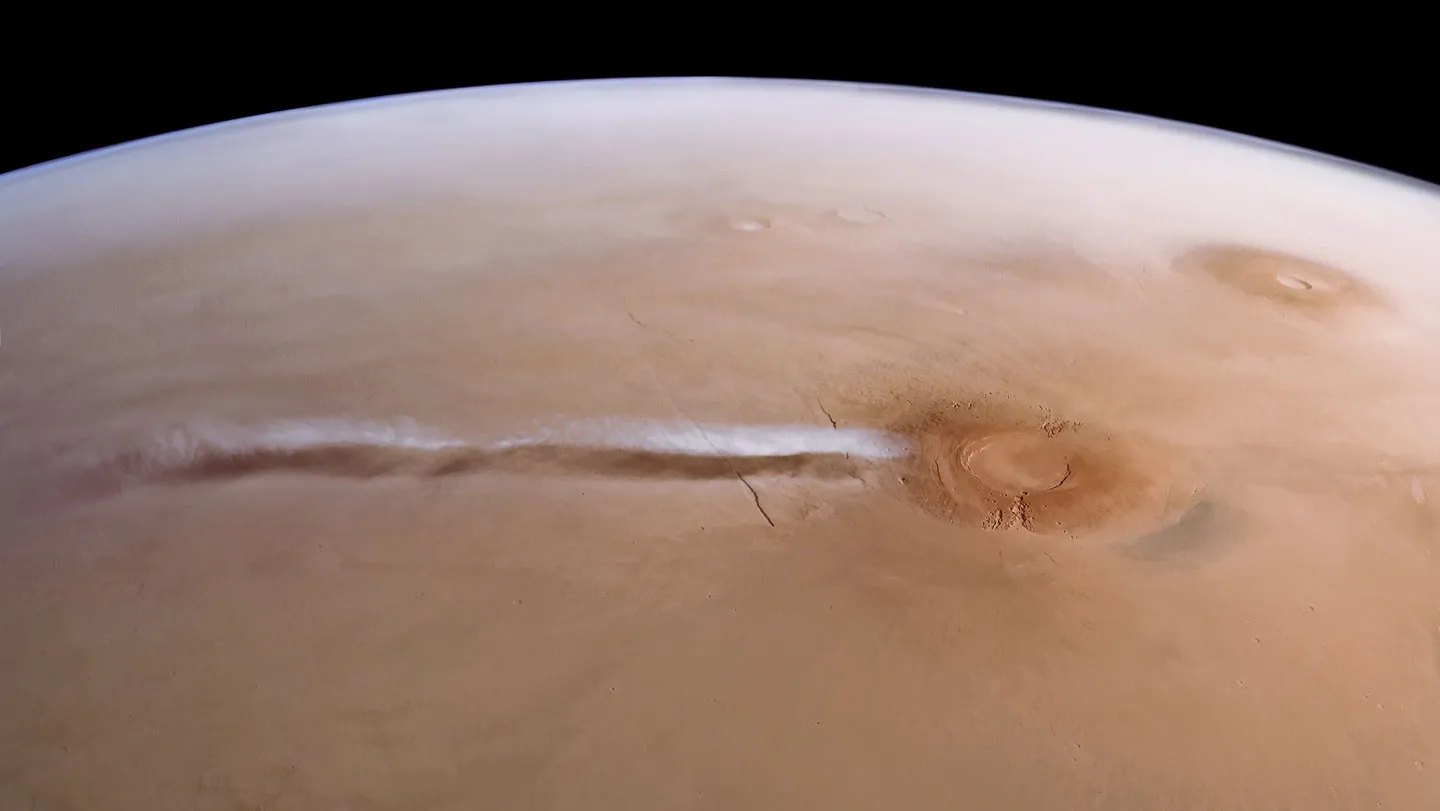
    One of Mars’ strangest clouds may rely on unusual physics to emerge. 

    The Red Planet’s ribbonlike cloud — which stretches as long as four Grand Canyons laid end-to-end — may form without a speck of starting material to seed it, researchers report October 7 in Nature Geoscience. This manner of forming clouds, called homogenous nucleation, was thought to be possible on paper but not to occur naturally.

    Tiny particles such as dust or salt floating in the air seed typical clouds on Earth. But that cloud physics doesn’t seem to apply to the Arsia Mons Elongated Cloud. Beyond its impressive length, this wisp of water ice is remarkably consistent, forming daily in the same spot roughly 45 kilometers high on the slope of a Martian volcano for several months each year.

    Sign up for our newsletter

    We summarize the week’s scientific breakthroughs every Thursday.


    The team tried and tried but couldn’t reproduce the cloud’s formation, including its lengthy tail and consistent cycle, with computer models employing standard cloud physics, says François Forget, an astrophysicist at the Laboratoire de Météorologie Dynamique, or LMD, in Paris. 

    There’s no shortage of dust on Mars. The trouble is that high up in a thin Martian atmosphere, few cloud-forming dust particles stay suspended. Instead, they probably clump together and eventually fall, says planetary physicist Jorge Hernández-Bernal, who did the work at LMD. This left cloud formation without seeds as the most convincing explanation, he says.

    Nailing a Mars cloud’s features

    Every day during some seasons on Mars, a long wispy cloud emerges along the flanks of the Arsia Mons volcano, as seen in the observations video spanning three Martian hours. How that cloud forms has been a mystery. A new simulation, bottom, included unusual physics, in which clouds form without starting material. That approach replicated the shape and timing of Mars’ Arsia Mons Elongated Cloud for the first time.

    ESA, EHU (top); J. Hernández-Bernal et al./Nature Geoscience, 2026 (bottom)

    The team’s model suggests that the eye-catching plume originates when air flowing across the volcano triggers a rapid lifting of a moist parcel of air. The decrease in pressure at that altitude lets the air parcel expand, rapidly cooling it.  

    The newly cooled air now has 100,000 times more moisture than it can hold, the team’s model suggests. This excess moisture undergoes homogenous nucleation, rapidly forming more stable ice crystals. Winds sweep the forming cloud outward, creating the cloud’s distinctive long shape. 

    While the model doesn’t perfectly match satellite observations, it does capture how the phenomenon that leads to the cold air pocket reoccurs day after day, just like the real cloud does. 

    The study was surprising because “homogeneous nucleation is generally treated in our field as this theoretical concept,” says Samuel Atwood, an atmospheric and planetary scientist at the University of Maryland, Baltimore County and NASA Goddard Space Flight Center in Greenbelt, Md., who was not associated with the study.  

    “It’s a pretty compelling story that they’re telling with the model, but it’s only one view or one perspective on it,” Atwood says, adding that future measurements supporting the team’s finding will provide more certainty. Hernández-Bernal says that he plans to validate the study by testing alternative explanations.  

    Sponsor Message


    Even beyond Mars, the study provides food for thought. Previous studies have suggested that on Earth, meteor smoke provides particles for cloud formation in an upper layer of the atmosphere called the mesosphere, though a few studies have suggested homogenous nucleation could be responsible. Now that scientists are proposing homogenous nucleation on Mars, Hernández-Bernal says, “maybe there will be an increased interest in investigating this on Earth.” 

    born cloud Mars Physics striking surprising
    NCIJ NETWNCIJ NETWORK
    • Website

    Keep Reading

    Mini-gardens for bees on Peterborough bus stop roofs approved

    Serious pollution by water industry remains high despite £5bn investment, say regulators

    Meteors don’t just burn up. What really happens is far more violent

    Scientists just broke a textbook rule of physics

    Your blood pressure could be dangerous even when your numbers look normal

    RAF base chemical contamination worst in UK, report finds

    Add A Comment
    Leave A Reply Cancel Reply

    Editors Picks

    Windows 11 KB5127936 update released with 41 changes and fixes

    October 29, 2026

    Mini-gardens for bees on Peterborough bus stop roofs approved

    October 29, 2026

    Needle exchange: Vulnerable at risk as ‘life-saving’ drug needle site closes

    October 29, 2026

    Early tech warning hopes to give Sumatra’s peat community a head start on fires

    October 29, 2026
    Latest Posts

    I finally found a magnetic phone grip I never want to remove

    August 16, 2026

    As petrol prices soar, electric bikes gain ground in Nigeria | News

    August 16, 2026

    Solana Research Institute’s $18B Crash Claim Faces a Data Gap

    August 16, 2026

    Subscribe to News

    Get the latest sports news from NewsSite about world, sports and politics.

    NCIJ Network is an independent digital news platform delivering trusted investigative journalism, European and global news, in-depth analysis, and fact-based reporting with accuracy, transparency, and integrity.

    Facebook X (Twitter) Instagram Pinterest YouTube

    Windows 11 KB5127936 update released with 41 changes and fixes

    October 29, 2026

    Mini-gardens for bees on Peterborough bus stop roofs approved

    October 29, 2026

    Needle exchange: Vulnerable at risk as ‘life-saving’ drug needle site closes

    October 29, 2026

    Subscribe to Updates

    Get the latest creative news from FooBar about art, design and business.

    Type above and press Enter to search. Press Esc to cancel.