


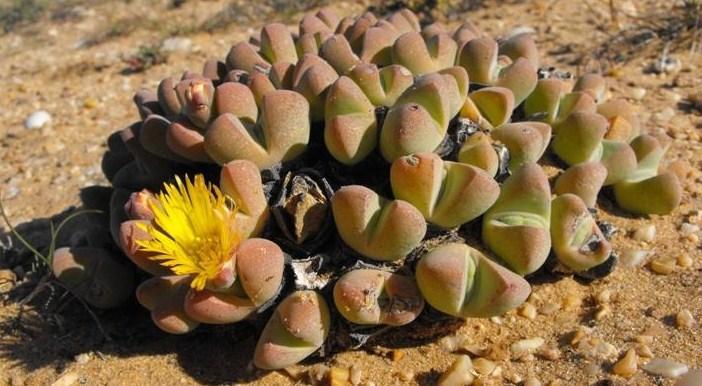
The brown clockfig, an extremely rare succulent growing in the hot, arid border region of Namibia and South Africa, was recently assessed as critically endangered by the IUCN, the global wildlife conservation authority.
The western Gariep Valley is a vast landscape spanning the southern part of Tsau ǁKhaeb National Park in Namibia and the Richtersveld region of Northern Cape province in South Africa. It’s in this harsh environment, shaped by extreme heat and dryness, that the brown clockfig (Cheiridopsis brownii) grows on quartz ridges, shale, gravel, and sandy soils, and in cracks and fissures in desert mountains.
The IUCN estimates the species, with thick leaves and daisy-like yellow flowers, has a total range of 424 square kilometers (164 square miles) in the valley, but occupies only around 60 km2 (23 mi2) of this area.
Habitat loss due to overgrazing is among its major threats. Another is the demand for mineral resources such as diamonds, with mining permits being issued across the region. That’s placed more of the species’ already limited habitat under pressure in both South Africa and Namibia.
“The vast desertification of the Aniesvlakte [plain in South Africa’s Richtersveld region] as a direct result of severe overgrazing, as well as the mass desertification caused by sand moving from the coast due to unrehabilitated mines, are threatening to swallow most of the remaining population in South Africa,” Pieter van Wyk, a botanist with South African National Parks (SANParks), who carried out the most recent assessment, told Mongabay via email.
Another threat comes from new green-energy developments — massive-scale green hydrogen projects — planned over vast sections of where this species occurs, van Wyk said.
Additionally, a prolonged drought from 2012-202, combined with other factors, resulted in a decline in the species’ population of 50-90% since 1992. Climate change is expected to intensify these pressures, bringing higher temperatures and declining rainfall to the region.
By 2052, the IUCN assessment projects that another 80-100% of the population could be lost. It adds that targeted conservation activities are not currently being conducted for the plant.
Van Wyk said it’s crucial to protect all the brown clockfigs in the extremely dry, low-lying areas of the Gariep Desert adjacent to the Oranje River, since they support insects that in turn sustain the region’s highly arid- and heat-adapted spiders and reptiles.
However, the species’ population has reached levels so concerning that the Richtersveld Desert Botanical Garden, founded and curated by van Wyk, has started collecting specimens for conservation. This includes seeds that van Wyk collected in 2021 from an area where populations were designated to be destroyed for diamond mines.
Van Wyk said it “remains shocking” that a highly resilient species like the brown clockfig can easily grow in circumstances where no human can survive, yet “simply cannot survive the land use practices” wrought by humans.
Banner image: A brown clockfig in South Africa’s Gariep Valley. Image © pietermier via iNaturalist (CC BY-NC 4.0).
