


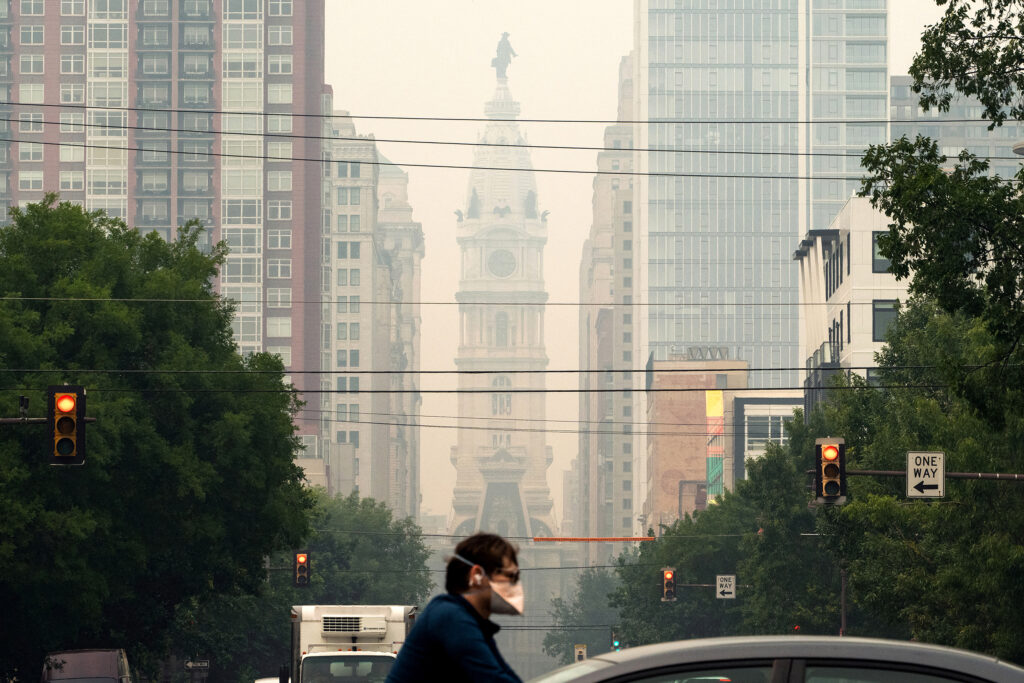
Karen Schaeffer is used to spending a lot of time thinking about how to keep kids happy and healthy. But only recently has she confronted a new problem at the childcare center she runs in Lititz, Pennsylvania: hazardous air wafting south from wildfires blazing far away in Canada.
“Until the past few years, we’ve never had to worry about this,” she said.
This marks her 39th year at St. Paul Christian Early Learning Center, where she and her staff take care of 130 children ranging from infants to elementary school-aged students.
On July 17, she made the decision to keep all the children indoors. That day the Environmental Protection Agency’s air quality index (AQI) in Lititz hit 270—a level deemed very unhealthy for everyone.
“I could smell it in the air, and we were just like, ‘we’re not going outside at all,’” Schaeffer said of the air quality, which was rated Code Purple by AirNow.gov. “We need to balance it, because normally we want the children to be outside, but we need to educate people to understand that air quality is extremely important, and it can threaten the health of our staff and especially the young children.”
The same day, not far down the road, dozens of children at a different summer camp program for older kids were playing outdoors at a community pool, despite the haze.
It’s a new reality for a place unaccustomed to dealing with the impacts of wildfires. The state’s industrial air pollution was significantly curbed decades ago with passage of the federal Clean Air Act and the Pennsylvania Air Pollution Control Act. Very dirty air is either a distant memory, a history lesson or simply forgotten for many Pennsylvanians. But during the summer of 2023 this region of Pennsylvania saw similar conditions as the event in 2026, as thick smoke from Canadian wildfires smothered the sky.
As the climate warms, people in places like Pennsylvania will have to figure out how to adapt as wildfire smoke becomes a more common summer hazard.
“I’m in my 40s now and growing up this was not a usual thing—getting a blanket of wildfire smoke over the region that will last for days,” said Alex Bomstein, executive director of the Clean Air Council. He lives in Philadelphia and believes the risks of these newer unhealthy air quality events are poorly understood by the general public.
“During these incidents, when I went outside I wore an N95 mask,” he said. “I saw several other people wearing masks, but the vast majority were not, and that’s dangerous.”
The wildfire smoke poses new challenges for everyone, but particularly for vulnerable populations, like young children, older adults and outdoor workers.
Nicholas Muller studies the intersection of environmental policy and economics at Carnegie Mellon University. Last year he co-authored a paper in the journal Communications Earth & Environment estimating that wildfire and prescribed burn smoke had caused $200 billion in health damages in 2017 in the U.S. It was associated with 20,000 premature deaths and disproportionately impacted socially vulnerable groups, including people of lower socioeconomic status, senior citizens and people of color. Children are also particularly affected by poor air quality because they breathe more rapidly and can absorb more pollution than adults.
The main problem is particulate matter. Specifically, very small inhalable particles, known as PM2.5, which are many times smaller in diameter than a human hair. They can be inhaled deeply into the lungs where they cause negative short-term health impacts, like asthma attacks, or longer-term health problems, like chronic bronchitis. From the lungs they can pass into the bloodstream and can contribute to other illnesses like cardiovascular disease and dementia.
“Exposure over periods of time to elevated PM2.5 increases our risk of death,” Muller said. “The way that works is populations that have higher baseline mortality have worse impacts from the exposure. It exacerbates existing risks.”
Muller lives in Pittsburgh, a city that has made strides in cleaning up its skies but is still considered to have some of the dirtiest air among major U.S. cities.
“PM2.5 readings [in Pittsburgh] are often between 10 and 15 micrograms [per cubic meter of air],” Muller explained. “The readings I’ve seen were over 200 micrograms [in mid-July]. That’s 20 times higher concentration. PM2.5 at that level is extremely dangerous. The relationship between impact—whether it’s illness or a premature death, just gets worse as the concentration gets higher.”
In this summer’s event, the smoke is crossing an international border and traveling such long distances that places like Pennsylvania can’t manage the source and are simply left to try to manage the impacts, Muller said.
“My view is we should be managing information and guidance about what people should and shouldn’t do,” he said. “At least in the short term, when we’re dealing with a smoke event, that’s about all you can do in a distant community.”
Connecting the Climate Dots
Although a number of factors contribute to the impact and intensity of wildfires, including forest management practices, building development and other human activities, the warming climate, largely caused by burning fossil fuels, is the main driver of hotter, dryer conditions that make wildfires more likely and more intense.
Another key factor is what’s known as the vapor pressure deficit: the difference between the amount of moisture that’s in the air and the amount of moisture the air could hold at saturation. As the climate heats up, that difference increases and the “thirstier atmosphere” is able to suck out more moisture out vegetation and soils to further dry the landscape and make it more conducive to wildfires.
This story is funded by readers like you.
Our nonprofit newsroom provides award-winning climate coverage free of charge and advertising. We rely on donations from readers like you to keep going. Please donate now to support our work.
State Rep. Greg Vitali chairs the House Environmental and Natural Resource Protection. He has often been a lone voice for environmental issues during his 35-year career in Harrisburg. Vitali believes the issue of climate change has been largely ignored in Pennsylvania due to the state’s political makeup and history of fossil fuel production. Even when smoke fills the sky, he doesn’t see many people connecting the dots.
“I don’t hear that connection being made with people—with citizens generally or with political people in Harrisburg,” said Vitali. “People aren’t saying, ‘God, we can’t even breathe the air now. Isn’t it time we start addressing climate change?’”
When it comes to protecting outdoor workers, the Pennsylvania Department of Labor and Industry has guidance for employers to keep people safe during weather events. A spokeswoman for the department noted that there are no laws or regulations in Pennsylvania specific to outdoor work during poor air quality events. However, the federal Occupational Safety and Health Administration requires employers to have a place of employment that “is free from recognized hazards.”
A number of states have enacted climate-related laws to protect workers from the impacts of extreme heat. In Harrisburg, several bills have recently been proposed, but not enacted, to provide workers more protections from heat, give paid leave to employees during a climate-related emergency and create a basic income program for people impacted by extreme weather events. Vitali is unaware of any recently proposed legislation related to keeping people safe during poor air quality events.
The Pennsylvania Department of Human Services, through its Office of Child Development and Early Learning, regulates childcare centers like the one Karen Schaeffer runs in Lititz. It shares weather guidance with childcare centers, but decisions about what to do with that information are made on the ground, by the people running the centers. The state agency doesn’t licence summer camps for older children, but it does share general health information with summer camps when concerns about camper and staff safety come up. Because decisions about air quality are left up to individuals, public education about the dangers of pollution is even more important. Schaeffer doesn’t believe more regulations are the answer, but “helping people understand this is extremely important,” she said.
Schaeffer noted the center she runs and the church it’s part of have pursued several environmentally-friendly initiatives, including putting up solar panels on the roof, growing a meadow full of wildflowers and building outdoor learning centers for the kids. Those playspaces sat empty on July 17, the day she kept the children inside because the air was hazardous to breathe.
“The goal is to really give back to our community, and make sure we’re a safe haven,” she said.
It’s a job made harder when unhealthy air blows in from far away.
“What we’re dealing with is an international issue,” she added. “And we know the climate has changed dramatically.”
About This Story
Perhaps you noticed: This story, like all the news we publish, is free to read. That’s because Inside Climate News is a 501c3 nonprofit organization. We do not charge a subscription fee, lock our news behind a paywall, or clutter our website with ads. We make our news on climate and the environment freely available to you and anyone who wants it.
That’s not all. We also share our news for free with scores of other media organizations around the country. Many of them can’t afford to do environmental journalism of their own. We’ve built bureaus from coast to coast to report local stories, collaborate with local newsrooms and co-publish articles so that this vital work is shared as widely as possible.
Two of us launched ICN in 2007. Six years later we earned a Pulitzer Prize for National Reporting, and now we run the oldest and largest dedicated climate newsroom in the nation. We tell the story in all its complexity. We hold polluters accountable. We expose environmental injustice. We debunk misinformation. We scrutinize solutions and inspire action.
Donations from readers like you fund every aspect of what we do. If you don’t already, will you support our ongoing work, our reporting on the biggest crisis facing our planet, and help us reach even more readers in more places?
Please take a moment to make a tax-deductible donation. Every one of them makes a difference.
Thank you,
