


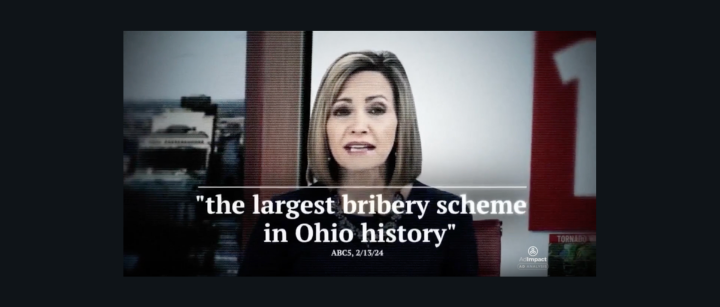
Democratic ads in the Ohio Senate race are highlighting a political bribery scandal involving an energy company that benefited from a 2019 nuclear-power bailout law. It’s true, as the ads say, that Republican Sen. Jon Husted backed the legislation and that the company supported his campaigns. But Husted hasn’t been charged with or accused of any wrongdoing in the scandal, which is the impression the ads may leave with voters.
We’ll explain what happened in the case, which led to federal and state charges against lobbyists, former FirstEnergy executives and former Ohio House Speaker Larry Householder, who received a 20-year federal prison sentence in 2023 for leading a racketeering conspiracy involving about $61 million in bribes for Householder to shepherd the bailout bill through the Legislature. FirstEnergy backed the bill in order to save two of its nuclear power plants. The legislation called for monthly fees added to consumers’ electric bills in order to provide more than $1 billion over seven years for nuclear power. FirstEnergy paid $230 million in penalties in a 2021 settlement with federal prosecutors.
Husted was the state’s lieutenant governor from 2019 to 2025, when he was appointed by Gov. Mike DeWine to the U.S. Senate seat vacated by Vice President JD Vance. Democrat Sherrod Brown, a former longtime senator from the state, is challenging Husted in the Senate race.
Vance ran for the Ohio Senate seat in 2022, after the FirstEnergy bribery scandal had come to light. He and President Donald Trump have supported Husted’s candidacy.
An ad from Brown shows TV news clips in rapid succession, the first saying, “now to the largest bribery case ever in Ohio” and a second saying, “one prominent name keeps coming up, Sen. Jon Husted.” The senator’s name is then repeated three times by other newscasters. A narrator says: “FirstEnergy spent millions bribing public officials. The executives spent at least $3.5 million to help Husted’s campaign. Husted was referred to as FirstEnergy’s ‘golden boy.’ Husted led the charge for a billion-dollar bailout and cost you thousands on your electricity. Jon Husted got paid. Ohio got the bill.”
The 30-second ad began airing in late August, according to the ad tracking service AdImpact. A 15-second version began airing mostly on TV streaming devices on Sept. 1. That version begins by saying, “FirstEnergy spent millions bribing officials,” and then switches to the news clip saying that “one prominent name keeps coming up, Sen. Jon Husted.” The two sentences are accurate on their own, but strung together they leave the wrong impression that Husted had been accused or charged with accepting bribes. He hasn’t.
Another ad, funded by outside Democratic groups LCV Victory Fund and WinSenate, says, “FirstEnergy, the largest corruption scheme in state history, and Jon Husted is at the center of it,” going on to say that the company “helped Husted’s campaign with a secret million dollar payment, and Husted got them a massive bailout.”
FirstEnergy did contribute $3.5 million that ultimately benefited Husted’s campaigns; the $1 million “secret” payment went to a so-called dark money group, Freedom Frontier, which then gave more than $1 million to a super PAC backing Husted’s run for governor in 2017, as the Associated Press story highlighted in the outside-group ad said.
Another $2.5 million was also given by FirstEnergy to a dark-money nonprofit, State Solutions, which is affiliated with the Republican Governors Association, as a network of news organizations reported. That money, donated in 2018, was to back DeWine for governor, with Husted then as his running mate for lieutenant governor.
Dark money groups, such as some 501(c)(4) nonprofits, don’t disclose their donors. While some may find the use of dark money in politics to be distasteful or improper, it’s legal (within certain parameters, including that the dark money groups work independently of campaigns). Such spending increased after the Supreme Court’s 2010 Citizens United decision, which said corporations or independent groups could spend unlimited amounts in elections. Both political parties utilize dark money.
Husted also supported the energy legislation in question — House Bill 6 — and still says it was needed to shore up nuclear energy in the state. The federal and state trials, as well as reporting on the scandal, show that Husted was in contact with FirstEnergy executives in the run-up to the bill passing and being signed into law by DeWine on July 23, 2019.
“Jon Husted was focused on diversifying our energy base and saving Ohio’s nuclear power plants to keep costs low and grow the economy,” Husted campaign spokesperson Amy Natoce told us when we asked about the Brown campaign’s 30-second spot. “Unbeknownst to everyone working on the policy matter, there were a number of bad actors involved in the process. Many have already been held to account, and Jon Husted himself offered testimony to ensure justice is served.”
Natoce said the ad amounted to “baseless lies.” The individual statements in the ads are mostly accurate; it’s the juxtaposition of them that wrongly suggests Husted has been accused of wrongdoing in the scandal. The ads don’t directly say that Husted committed any crimes, but viewers are invited to connect the dots.
The FirstEnergy Bribery Scandal
The FBI investigated this scandal, and Householder, then the Ohio House speaker, was arrested on July 21, 2020, along with his strategist and three lobbyists, one of whom was the former chair of the Ohio Republican Party. According to the Department of Justice press release at the time, “from March 2017 to March 2020, the enterprise received millions of dollars in exchange for Householder’s and the enterprise’s help in passing House Bill 6, a billion-dollar bailout that saved two failing, Ohio nuclear power plants from closing.”
Generation Now — a 501(c)(4) social welfare organization set up in 2017, funded by FirstEnergy and controlled by Householder — was also charged. According to the indictment, FirstEnergy money given to Generation Now was spent to support state candidates that would back Householder to be speaker and to pay Householder campaign staff. When Householder was sentenced in 2023, federal prosecutors said he had received nearly $61 million in bribes and used more than $500,000 for his personal benefit, including to pay off credit card debt and settle a lawsuit.
The former state party chair, Mathew Borges, was sentenced to five years in prison. In May 2025, an appeals court upheld the convictions.
One of the lobbyists charged, Neil Clark, committed suicide in 2021.
In late 2023, Samuel Randazzo, former chairman of the Public Utilities Commission of Ohio who was appointed by DeWine, was indicted on federal bribery and embezzlement charges concerning an alleged $4.3 million bribe from FirstEnergy “to provide favorable official actions for the company through PUCO proceedings,” federal prosecutors said. Randazzo committed suicide in 2024.
What does Husted have to do with all of this? As mentioned, Husted supported HB 6 and pushed for its passage. Text messages that have been released as part of the court cases show FirstEnergy executives saying they had spoken to Husted and that he would press for a longer, more lucrative bailout in the legislation.
Local media have reported on other text messages between FirstEnergy officials and Husted, and among FirstEnergy officials concerning HB 6. In one message, then FirstEnergy CEO Chuck Jones said that Husted and others were “fighting to the end and we’ve been talking to them all day.” In another text message, Michael Dowling, then a FirstEnergy senior vice president, said that DeWine and Husted had conducted “battlefield triage” to install Randazzo as chair of PUCO.
“I was advocating for saving the two nuclear power plants,” Husted told the Columbus Dispatch of his support for the bill. “If those two power plants had closed, energy prices in Ohio would be unbelievably expensive because we already had lost so much generation.”
The ads’ claim that Husted was FirstEnergy’s “golden boy” is a reference to Clark, one of the lobbyists, having called Husted that.
In a June 2024 Ohio Capital Journal article about text messages and phone calls concerning Husted and those affiliated with FirstEnergy, Case Western Reserve University law professor Michael Benza said that these exchanges didn’t show a “smoking gun” when it came to Husted, or DeWine. “At least in the public documents — nothing shows that same type of quid pro quo going to Jon Husted or Governor DeWine,” Benza was quoted as saying. “It certainly has the appearance of it, but there’s no smoking gun in this type of a case yet… but I think they have to be worried.”
In March of this year, Husted testified in the state trial of former FirstEnergy executives Jones and Dowling, who are accused of bribing Randazzo. The defense has said the payment was a settlement and not a bribe.
Husted was called by the defense. He was asked about a 2018 dinner attended by Husted, DeWine, Jones and Dowling. The FirstEnergy executives met with Randazzo afterward. In his testimony, Husted said he didn’t recall what was discussed at the dinner and that he thought it was organized so that FirstEnergy officials could “say ‘hi’ and congratulate us on winning.”
DeWine and Husted won the election that year and took office in January 2019.
There was a hung jury in the Jones/Dowling case, but the former executives were indicted again by the state in June. They were indicted by a federal grand jury in January 2025.
Electricity Bills
The Brown campaign ads claim that the legislation Husted advocated significantly increased electricity bills. “Husted led the charge for a billion dollars bailout and cost you thousands on your electricity,” the 30-second ad says. While electricity bills have gone up since the law was enacted in late 2019, experts have said the increased costs can’t be pinned all on this legislation — especially because most of it has been rolled back.
Noah Dormady, an associate professor of energy policy at Ohio State University, told the Columbus Dispatch that demand from data centers was driving the higher electricity costs. “I don’t think any candidate really wants to address the elephant in the room, and that’s really our generation costs,” he said.
The Brown campaign has cited the increase in the average monthly electricity bill in Ohio from $89.19 in October 2019, when HB 6 was enacted, to $144.47 in January, according to data from the Ohio Public Utilities Commission. That amounts to a $663.36 average annual increase. Adding together the increase over each year gets to an average cumulative hike since 2019 of $2,808.24. (The average bill was $158.71 in August.)
In July, our fact-checking colleagues at PolitiFact looked into Brown’s claim of HB 6 causing the higher electricity costs, finding that while experts said it played some role, the larger culprit was increased demand from data centers, as well as international conflicts that drove up the cost of energy and Ohio’s retail energy auctions. “To attribute all of this cost to House Bill 6 is irresponsible,” Dormady told PolitiFact.
Ohio lawmakers repealed the nuclear bailout portion of HB 6 in 2021, months after Householder and others were arrested. Subsidies in the law for two coal plants were repealed years later, in August 2025. One analysis, from the consulting firm Runner Stone, estimated the HB 6 coal subsidies totaled $527.8 million, paid by Ohioans over nearly six years.
In other campaign ads, Brown has pinned the increase in electricity costs on data centers, and Husted’s support of them. In July, Husted introduced legislation that would propose standards states could use to get data centers, rather than customers, to pay for the centers’ electricity generation and infrastructure costs.
Editor’s note: FactCheck.org does not accept advertising. We rely on grants and individual donations from people like you. Please consider a donation. Credit card donations may be made through our “Donate” page. If you prefer to give by check, send to: FactCheck.org, Annenberg Public Policy Center, P.O. Box 58100, Philadelphia, PA 19102.
