


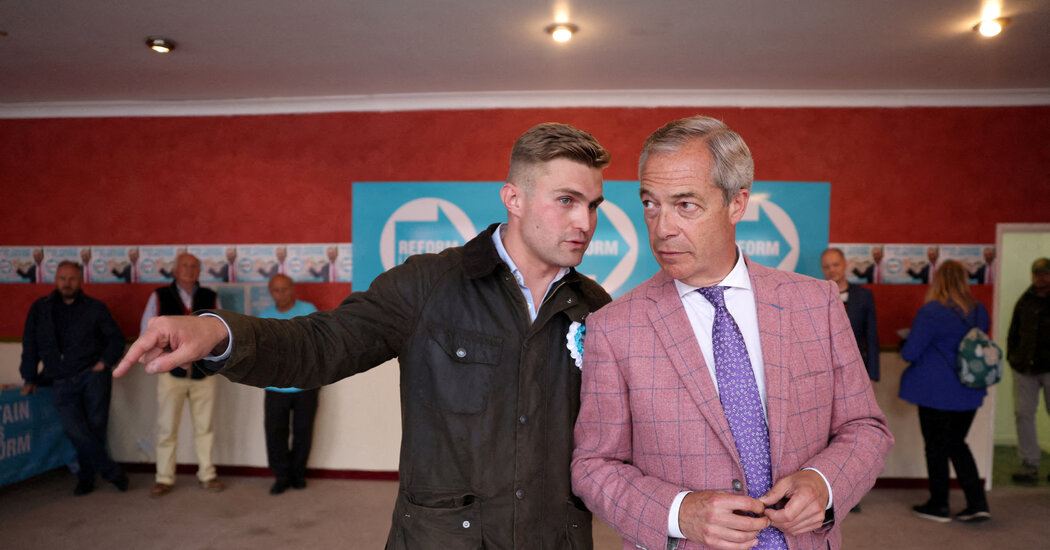
Two top aides to Nigel Farage, the pugilistic leader of Britain’s right-wing party, were secretly captured on film arranging what they appeared to think were political donations from an American businessman and his British son — a move Mr. Farage on Friday denounced as an “exercise in entrapment” by his enemies.
The aides, Dan Jukes and James Orr, are shown discussing over drinks how the contributions could be secretly funneled to benefit the party, Reform U.K., without disclosure, according to a report on the British TV network Channel 4. Another recording shows Mr. Farage thanking both the father and the son for their support.
In fact, Mr. Farage and his aides were speaking with a journalist and an actor who were posing as the donors, according to Channel 4, which published the report on the eve of Reform’s annual party conference in Birmingham, England.
”The establishment will do everything it can to stop us,” Mr. Farage, visibly angry, said during a news conference there with Jordan Bardella, the president of France’s right-wing National Rally party.
Mr. Farage insisted that Reform had “done nothing wrong, taken no illegal money,” even as the party announced that Mr. Jukes, who has worked with Mr. Farage for years, and Mr. Orr had both stepped down during an internal investigation.
British law requires all donations to be disclosed and prohibits political contributions from foreign sources. But Mr. Farage told reporters on Friday that Mr. Jukes and Mr. Orr had been taken in by “far-left activists.” He said they were guilty of nothing more than “loose pub talk, including a couple of boasts that simply were not true.”
The broadcast of the video was a stunning political blow for a party that has been seeking to turn significant public support into a governing coalition. It forced Mr. Farage and other party leaders to respond to a barrage of news reports even as they tried to remain on message for an estimated 8,000 delegates who streamed into the cavernous conference center.
Keynote speakers pledged action on migration, lower taxes and less regulation for an audience that seemed rattled by what they had hoped would be a celebration of the party’s recent success in local and regional elections. Even the marquee speakers felt compelled to address Thursday’s news.
“We know the establishment will throw every lie, smear and desperate trick at us,” said Zia Yusuf, the party’s home affairs spokesman, as he vowed that Reform would close down Britain’s borders to illegal immigrants. “But we will prevail.”
Activists from a group called Climate Resistance briefly disrupted the conference on Friday by unrolling a banner that said “Resist Reform” near the entrance of the hall. Several activists also interrupted Mr. Farage’s keynote speech.
Channel 4 said that the discussions about donations involving Mr. Farage and his aides were filmed as part of an elaborate undercover operation conducted by Verbatim Investigations, a group founded by journalists from the Center for Climate Reporting, a nonprofit. The New York Times has not independently verified the actions in the videos.
Before the Channel 4 report on Thursday evening, Mr. Orr had spent the day on several high-profile panels during the start of the party conference. On Friday, Reform announced that the party had opened an internal investigation.
Mr. Orr posted a defense of his actions on social media, saying, “There’s absolutely no way that this could amount to a benefit or a donation in kind at all.” A spokesman for Reform did not immediately respond to a request for comment about Mr. Orr’s and Mr. Jukes’s actions on the video.
The news comes as the party is already dealing with separate investigations into other donations that Mr. Farage and Reform members accepted. The developments about the party’s finances have dragged down Reform’s popularity and threatened to undermine Mr. Farage’s leadership just as he tries to set the party on a path to government.
Mr. Farage is under parliamentary investigation over an undisclosed gift of 5 million pounds, about $6.7 million, from a British crypto-billionaire based in Thailand, while a separate police inquiry was opened into two donations from the mother of George Cottrell. Mr. Cottrell is another of Mr. Farage’s close aides.
In a statement, Bridget Phillipson, chair of the governing Labour Party, said, “Farage and Reform must cooperate with the authorities to establish the truth and prove just how deep this scandal goes.”
Last year, party supporters were almost giddy as they celebrated the rise of Reform. Mr. Farage was riding Europe’s wave of anti-immigrant, anti-establishment populism. His party was ahead in most polls, while the country’s Labour prime minister, Keir Starmer, was deeply unpopular. Mr. Farage described Reform as a “turquoise tide headed ever closer towards winning.”
Now, the future for Mr. Farage and his movement appears far less certain.
Reform’s popularity has been on a slow-but-steady, yearlong decline, even as it did well in municipal and regional elections in May. The Labour Party has a new leader and prime minister, and has begun to rise again in the polls. A new far-right party, Restore Britain, set up by a Reform defector, is causing Mr. Farage headaches. Even the Conservatives, who fell to a brutal defeat in 2024, are showing signs of political life.
In a BBC interview on Thursday broadcast before Channel 4 revealed the secretly recorded footage, Mr. Farage addressed the earlier allegations, saying that he had “broken no rules, done nothing wrong.” He also accused “people who hold positions of power, influence and money” of conspiring to politically damage him and his party.
But the scrutiny caused Mr. Farage to abruptly resign his seat in Parliament and then reclaim it last month. And he might be forced to face voters again within months if the parliamentary inquiry finds that he broke the rules by not disclosing the £5 million gift. The headlines about Reform’s victories in the 1,500 local elections in May have given way to persistent stories about his donors and the way that Reform is financed.
Reform officials had hoped to use the three-day conference to present the party as ready to govern. Speeches and sessions were set to be held in front of banners that read, “The First 100 Days,” a reference to what Mr. Farage has said would be aggressive, fast-paced changes if he becomes prime minister.
On Thursday, several members of the Reform leadership held forth at what the party called its “Business Day,” focusing on how they would lower taxes, strip away regulations, cut the size of government, harness artificial intelligence and increase spending on the military.
Robert Jenrick, a former Conservative minister who is now Reform’s representative on finance, pledged on Thursday that he would reassure financial markets by cutting £80 billion, about $108 billion, from government spending if the party wins power at the next general election, which must be held by 2029.
Mr. Jenrick has said that he sent a letter to major banks in Britain and the United States inviting top officials to round-table discussions in London and New York. “As chancellor, I will adopt sensible fiscal plans that shrink government borrowing relative to Labour’s plans,” he wrote in the letter, a copy of which was obtained by The New York Times.
In a group discussion on Thursday, Richard Tice, a former Conservative donor turned Reform lawmaker who now serves as Reform’s deputy leader, urged business leaders to participate in a months long “consultation” on how to stimulate the housing market if the party won power.
“Now, we’re not quite in government yet,” Mr. Tice conceded to the audience. But, he added, “Given how much we’re influencing government, sometimes it feels it.”
