


- Five new marine protected areas (MPAs) came into effect in Aotearoa New Zealand in July after more than a decade of grassroots and governmental work — and a sixth is expected to open in the near future.
- The MPAs are no-take marine reserves, areas where all extractive activities are banned, co-managed by the regional Māori tribe Kāi Tahu and the Department of Conservation.
- The reserves are the first in the country to be co-managed by Indigenous people and the government through shared decision-making and a joint ranger team.
- The reserves are the first part of a planned network, called Te Au Roa o Te Rakihouia, which is expected to have not only the reserves but also other types of protected areas that have less strict protections.
DUNEDIN, Aotearoa New Zealand — At a U.N. meeting in 2015, Aotearoa New Zealand’s then Prime Minister John Key made a major announcement that drew praise from international conservation groups: His administration would turn a swath of waters far larger than the country’s land mass into a marine protected area (MPA).
The Kermadec Ocean Sanctuary, planned for New Zealand’s northern waters, would have been one of the largest fully no-take MPAs in the world, but the sanctuary violated Māori fishing rights enshrined decades earlier. Key’s government had done relatively little to consult with Māori groups about the proposal, many of whom resisted the plan, calling for more recognition of their authority and their role in ocean governance. The sanctuary plan fell through.
Yet, even as Key’s top-down exercise drew criticism, a more bottom-up approach to marine governance was underway in the country’s far southeast.
There, Māori leaders helped develop a network of small MPAs, five of which became official on July 1, 2026, after more than a decade of grassroots and governmental work. A key aim is to protect seabed habitats, offshore canyons, rocky reefs, tidal lagoons and kelp forests. The network, called Te Au Roa o Te Rakihouia, is co-managed by the regional Māori tribe Kāi Tahu (Ngāi Tahu in standard Māori), and the Department of Conservation. The reserves are the first in the country to be co-managed by Indigenous people and the government using shared decision-making and a joint marine ranger team. The network name refers to the long wake of Te Rakihouia, a Kāi Tahu ancestor who explored the South Island’s waters.
“This is the only example of its type in the country and … could well be quite a good model going forward,” Edward Ellison, a Kāi Tahu leader and one of six governors of the network, told Mongabay. “It’s taking the best out of our legislation that we can and making it work in a way that carries the spirit of us exercising our rakatirataka [rangatiratanga in standard Māori], which is authority, and kaitiakitaka [kaitiakitanga in standard Māori], which is guardianship.”

Network history
The five new MPAs and the sixth potential one are no-take marine reserves. This applies to customary Kāi Tahu fishing, though Kāi Tahu educational work, such as traditional fishing workshops that may involve limited take, is allowed. The full network is expected to have the reserves alongside other types of protected areas with less strict protections: five mixed-use Type 2 MPAs and one kelp protection area. This makes 12 MPAs in total, six of which would be reserves.
New Zealand’s Department of Conservation set aside roughly 7 million New Zealand Dollars (about US$4 million) for the network from 2023 to 2027, drawing from conservation funds reprioritized from other conservation initiatives, according to Mel Lawless, marine reserves program lead at the agency.
The process began in 2014 with the formation of a roughly 15-member forum that included members from the fields of conservation, commercial fishing, recreational fishing, tourism and science. Ellison, the forum’s deputy chair, was one of three Kāi Tahu forum members, and there were three fully participating Kāi Tahu alternates, he said.
Ellison stipulated that all the early forum meetings needed to be held in marae, Māori gathering places, to help build an understanding in the forum of how Kāi Tahu work together.
“That set a really great base and people felt comfortable and understood,” he told Mongabay. “We were an important part of the forum as a result,” he added.
After nearly four years of planning and community consultation work, the forum submitted two alternate networks to the government. Neither was as ambitious or expansive as conservationists had hoped, but one, favored by most of the members, still covered more than three times as much area as the other. The three commercial fishing forum members supported the latter proposal, as did one of the two recreational fishing members. In 2019, the government opted to proceed with the larger of the two plans, which laid out the 12 MPAs. Years passed with discussions at various levels, including within Kāi Tahu, whose interests ranged from kaitiakitaka and conservation to commercial fishing.
Nine days before the October 2023 general election, New Zealand’s center-left government approved the six marine reserves. Despite power shifting to a center-right-led coalition that has faced criticism for policies affecting Māori rights and environmental protections, the new government continued the process of establishing the reserves.
A legal case has prevented one of the six reserves, Te Umukōau, from coming into effect. The Otago Rock Lobster Industry Association, which represents eight commercial fishers, challenged the government decision on the six reserves with a case centered on Te Umukōau.
Red rock lobster (Jasus edwardsii), also called crayfish locally, is one of the area’s highest-valued catches, with much of what is caught exported live to China. Chanel Gardner, the association’s executive officer, said that the planned reserves took away significant lobster fishing grounds and a more “surgical” approach was needed. She said that commercial fishers “tried extensively” to engage with the government, mainly the Department of Conservation, on the matter.
“When that again failed to work, we had to go down the path of judicial review, and the main thrust of that was that the department didn’t adequately consult with commercial fishing in respect to rock lobster and the impact that it would have on that industry,” Gardner told Mongabay.

A settlement was reached in December 2025 in which the boundaries of Te Umukōau Marine Reserve would be subject to “limited reconsideration.” So far, no final decision on the boundaries has been released, nor has an opening date for that reserve been set.
Likewise, no timetable has been set for the finalization of the five Type 2 MPAs or kelp protection area proposed as part of the network. These six areas, which are not reserves, are handled mainly by Fisheries New Zealand, the fisheries regulator. Reserves fall mainly under the remit of the Department of Conservation.
Asked why Fisheries New Zealand hasn’t yet brought the six areas into effect, Emma Taylor, the director of fisheries management, told Mongabay in an emailed statement that now that five of the reserves are in place, the agency “is updating information in relation to the five Type 2 MPAs and the kelp protection area.”
Though some critics of the new reserves have suggested that the government is simply looking for places to bolster its marine protection figures and meet international commitments, the reserves are too small to make much of an accounting difference.
New Zealand has one of the largest marine jurisdictions in the world. Together, the five cover 308 square kilometers (119 square miles), about 0.01% of New Zealand’s waters, Lawless told Mongabay. With this addition, 0.46% of the country’s waters are highly protected, and 20.38% have “some form of protection,” Lawless said.
These numbers have special significance because in 2022, the world’s nations agreed to ensure that 30% of land and sea is “effectively conserved and managed” by 2030, a framework known as 30×30. Each nation determines how much to contribute to the effort.
Ellison said “strong commercial interests” will make it difficult for New Zealand to reach such a target for oceans. But he expects the new reserves to provide strong baseline data, allowing comparisons to be made between those habitats that are commercially exploited and those that aren’t, for example, and to have positive spillover effects for fisheries.

Bottom-up, grassroots work
Alongside the network are several small, pre-existing customary management areas called mātaitai and taiāpure, which give Māori a leading role in fisheries decisions. These aren’t officially part of the network, nor are they included in New Zealand’s “30 by 30” accounting, but are closely associated with it. The network’s co-management model was inspired in part by the bottom-up governance work done in customary management areas in recent decades. For this reporter, attending a taiāpure meeting felt like a lesson in participatory democracy.
The Māori people descend from Polynesian settlers who migrated many hundreds of years ago and have a long tradition of guardianship of the sea. Several Kāi Tahu people told Mongabay they took that responsibility seriously regardless of whether there was formal recognition or pay. With the opening of the network, a team of marine rangers has been hired to do ecological monitoring, marine restoration such as reseeding pāua (abalone), surveillance related to the no-take rules, as well as education and outreach.
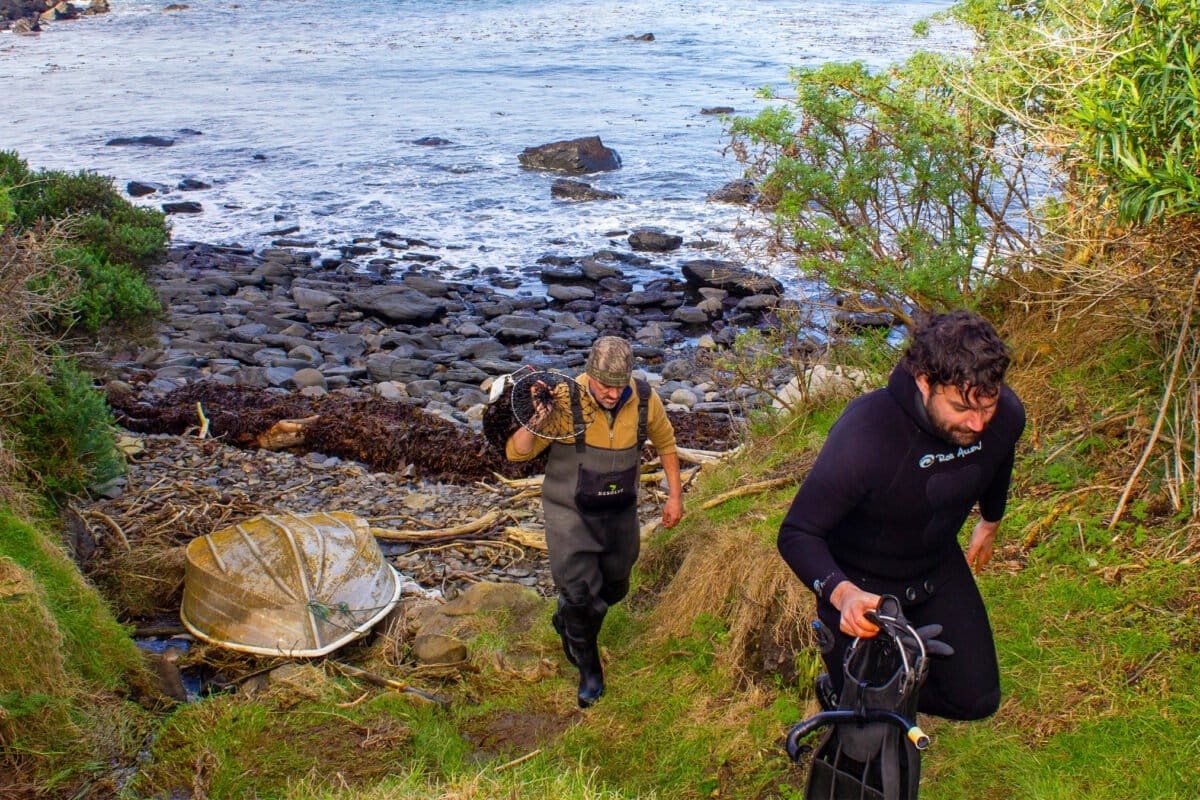
Brendan Flack, a tangata tiaki or customary fisheries guardian for a Kāi Tahu hapū (sub-tribe) called Kāti Huirapa who lives in the community of Puketeraki, leads the newly assembled team of marine rangers. The rangers are employed through the Kāi Tahu tribal council, working alongside the Department of Conservation. Not everyone on Flack’s team is Kāi Tahu or Māori — people are hired “based on skills” and on knowledge and experience, he told Mongabay. There is funding for six full-time rangers.
Suzi Flack, also a tangata tiaki for the hapū and Brendan’s wife, told Mongabay that the network’s establishment puts Kāi Tahu participants on more “equal footing” in marine management settings where other actors have often been “on the clock” while they have not.
On the day Mongabay joined the rangers, just weeks into their onboarding and training process, they were harvesting giant kelp (Macrocystis pyrifera) and working with a University of Otago researcher to package and heat-treat it to stop enzyme activity and prepare it for further study. They’ve also done work to remove wakame (Undaria pinnatifida), an invasive seaweed species. One aim is to test the seaweeds for bioactive compounds.
“If we can get high-value products from that, then that in turn can provide an income stream for ongoing funding of this team and also expansion of the team as well,” Brendan Flack said.
Chris Hepburn, director of the aquaculture and fisheries program at the University of Otago and co-coordinator of a research partnership called Te Tiaki Mahinga Kai, said the ranger positions provide “a pathway into research or conservation or restoration.” He said investment of this kind is crucial for local people who have limited employment options.
“There’s a lot of issues on this coastline,” he said, adding that many people work “night shifts on a mine or a chicken farm or a dairy farm or the meat works” to make ends meet.


The Flacks’ connection to the sea runs deep. Their work has included traditional Polynesian navigation, waka (canoe) building and multiple layers of marine management, including of a mātaitai and a taiāpure. The Flacks are leading figures in one of the three rūnaka (rūnanga in standard Māori) or local branches of Kāi Tahu that is most directly involved with the Te Au Roa o Te Rakihouia network, while Ellison is the senior leader of another.
Ellison said he has long opposed marine reserves, which, like no-take MPAs elsewhere in the world, can restrict Indigenous peoples’ access to customary waters and fishing practices. He called the 1971 act under which reserves are instituted “archaic”. (A Māori leader from the North Island told Mongabay it was “racist legislation.”)
Ellison said the planning processes have been flawed and not just in the case of the Kermadec Ocean Sanctuary. He said that Māori have generally been treated as just one of many stakeholders rather than as rights-holders and Treaty partners, referring to the Treaty of Waitangi, a founding document of New Zealand signed by the British Crown and Māori chiefs in 1840.
Yet Ellison and others expressed hope that a paradigm shift was underway. There’s a large body of research, mostly from terrestrial settings, showing that Indigenous participation improves conservation outcomes, especially when Indigenous people aren’t just consulted but have meaningful authority and decision-making power. For example, a 2024 systematic review in the journal One Earth found that the more authority Indigenous people and local communities were given, the better the chance a conservation initiative had of achieving positive outcomes.
For Ellison, the benefits of the new reserves go beyond marine management.
“The purpose is also to retain memory, location, kōrero associated with these places, and build on that going forward for future generations,” he said in an official launch video, using the Māori word for the stories and knowledge associated with a place.
“It’s a model that helps broker the way forward,” Ellison told Mongabay.
“There will be those who try and attack it from a negative point of view,” he added. “But when they have a close look at it … we’re exercising our rights and responsibilities, and doing it in partnership with the Department [of Conservation], so it’s conjoint and multiplies the learnings.”

Banner image: Members of the Kāi Tahu marine ranger team return from harvesting seaweed. Image by Edward Carver for Mongabay.
Māori knowledge shows climate change domino effects on forest food chains
‘This is what’s working’: Indigenous leaders on environment solutions in their communities
Citation:
Dawson, N. M., Coolsaet, B., Bhardwaj, A., Booker, F., Brown, D., Lliso, B., … Worsdell, T. (2024). Is it just conservation? A typology of Indigenous Peoples’ and local communities’ roles in conserving biodiversity. One Earth, 7(6), 1007-1021. doi:10.1016/j.oneear.2024.05.001
Feedback: Use this form to send a message to the author of this post. If you want to post a public comment, you can do that at the bottom of the page.

