


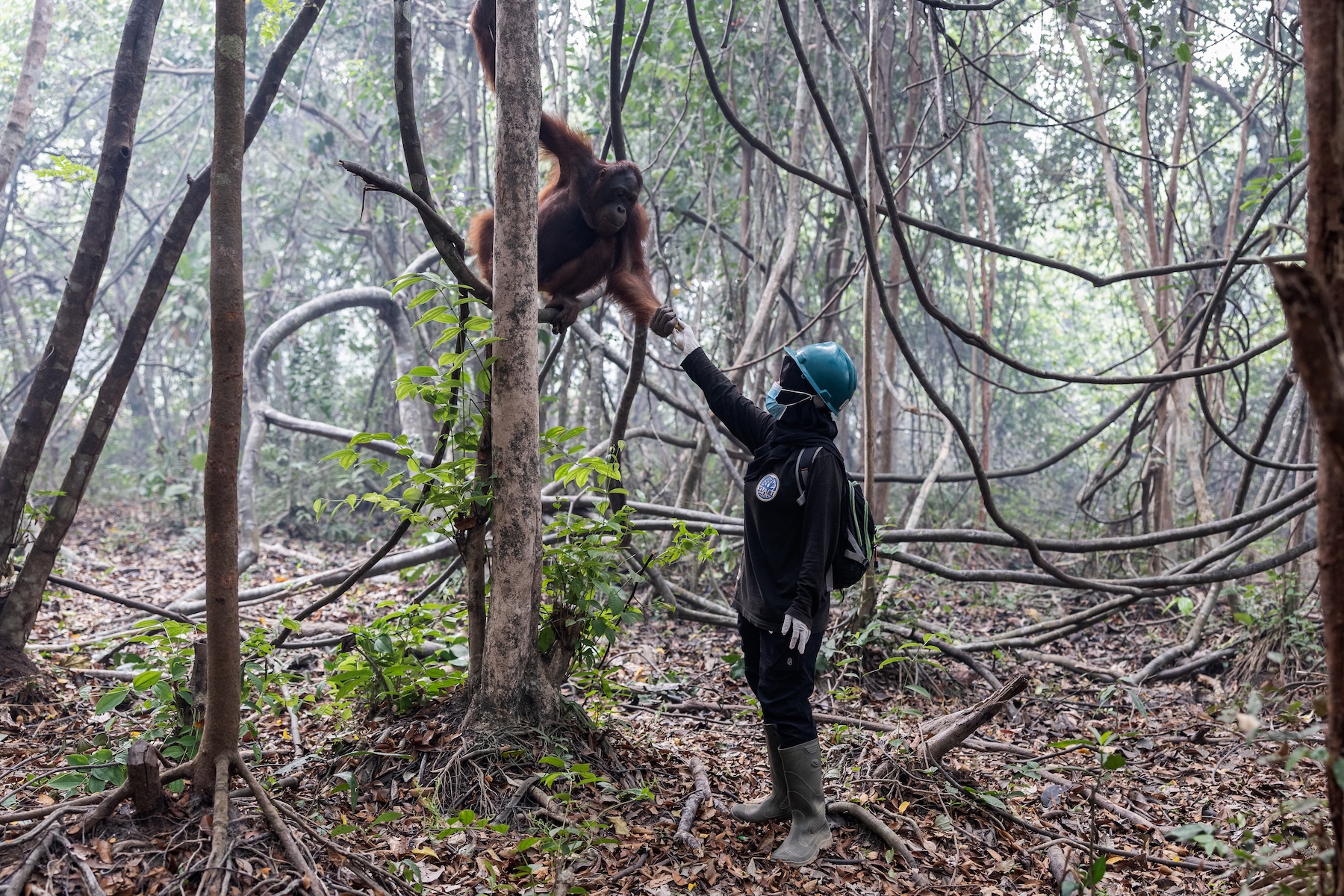
- As forest and peatland fires engulf Indonesian Borneo, orangutans and other endangered wildlife are losing habitat and food, as well as being caught directly in the fires.
- In 2026, more than 48,500 hectares (120,000 acres) have burned in Indonesia’s West Kalimantan province, an area larger than Vienna.
- More than 50 orangutans have been rescued this fire season, through joint operations involving the NGO YIARI and local environment authorities.
Thick smog covers the forest canopy in Ketapang, West Kalimantan, dimming the sun. On the front lines, forest and land fires are not just destroying habitats; they are pushing local primates close to extinction.
In the middle of this crisis, Veterinarian Komara and the Yayasan Inisiasi Alam Rehabilitasi Indonesia (YIARI) team stay alert.
Between Aug. 1 and Oct. 21, 2026, 53 Bornean orangutans (Pongo pygmaeus) were rescued from fires through joint emergency operations by the West Kalimantan Natural Resources Conservation Agency (BKSDA) and YIARI.

Fires are an increasingly deadly threat to orangutans. The flames not only kill the animals but also destroy their homes, reduce their food and cut off the paths they use to move between groups.
The scale of forest and land fires in West Kalimantan makes the impact clear: 48,536 hectares (119,935 acres) have burned in the province in 2026, an area around the size of Vienna. Ketapang district was hit hardest, with 12,443 hectares (30,747 acres) burned as of September.

A medical tragedy behind the smog
Komara and his colleagues have faced a sharp increase in medical cases this season, and not all have happy endings.
As fire approaches, orangutans’ instincts push them to climb higher and farther away from the people trying to save them, Komara says. “This makes it very hard to use the dart safely and creates serious risks when the animal falls.” Teams aim to stabilize apes in the field, giving fluids and oxygen and treating burns.


The full extent of the animals’ suffering only becomes clear once they are on the clinic table. “The physical condition of the rescued animals varies a lot, but many come in very thin from lack of food and covered in injuries,” Komara notes.
While veterinarians work in recovery rooms, a tough fight is happening at the fire’s edge. Suherman, the field operations commander, leads a firefighting team of 38. They work in extreme heat, pulling heavy hoses up to 100 meters (328 feet) long through thick forest. At night, the team flies a thermal drone to spot hotspots from the air and map underground fires, while others watch from fire towers or boats.


“It is very difficult to extinguish peatland fires because the fire is below the surface of the ground,” YIARI Director Karmele Llano Sanchez says. “We cannot see the flames, but the combustion continues, and a small gust of wind is enough to reignite the fire.”

Cultivating hope
While recent fire victims are in quarantine, other orangutans are being cared for at the YIARI rehabilitation center, including animals rescued before this season’s fires.
This season has tested the rehabilitation team’s strength, as smoke from the fires has spread into the center and its enclosures. And a growing problem looms: Orangutan’s peatland homes have burned down, so conservationists must find them new places to live.
“We cannot just release the animals we’ve rehabilitated back where we found them, because those forests have already burned down,” Komara says. “In the end, we have to work hard to find new forest habitats that are truly safe, away from fire and free from human threats so that the orangutans can live their lives again.”

Deadly wildfires leave Borneo wildlife scrambling for fresh water
FEEDBACK: Use this form to send a message to the editor responsible for this story. If you want to post a public comment, you can do that at the bottom of the page.
Cite this article
Garry Lotulung (2026). Scorched sanctuaries: The race to save Borneo’s orangutans from fires. Mongabay Conservation news. DOI: https://doi.org/10.66709/news-333592

