


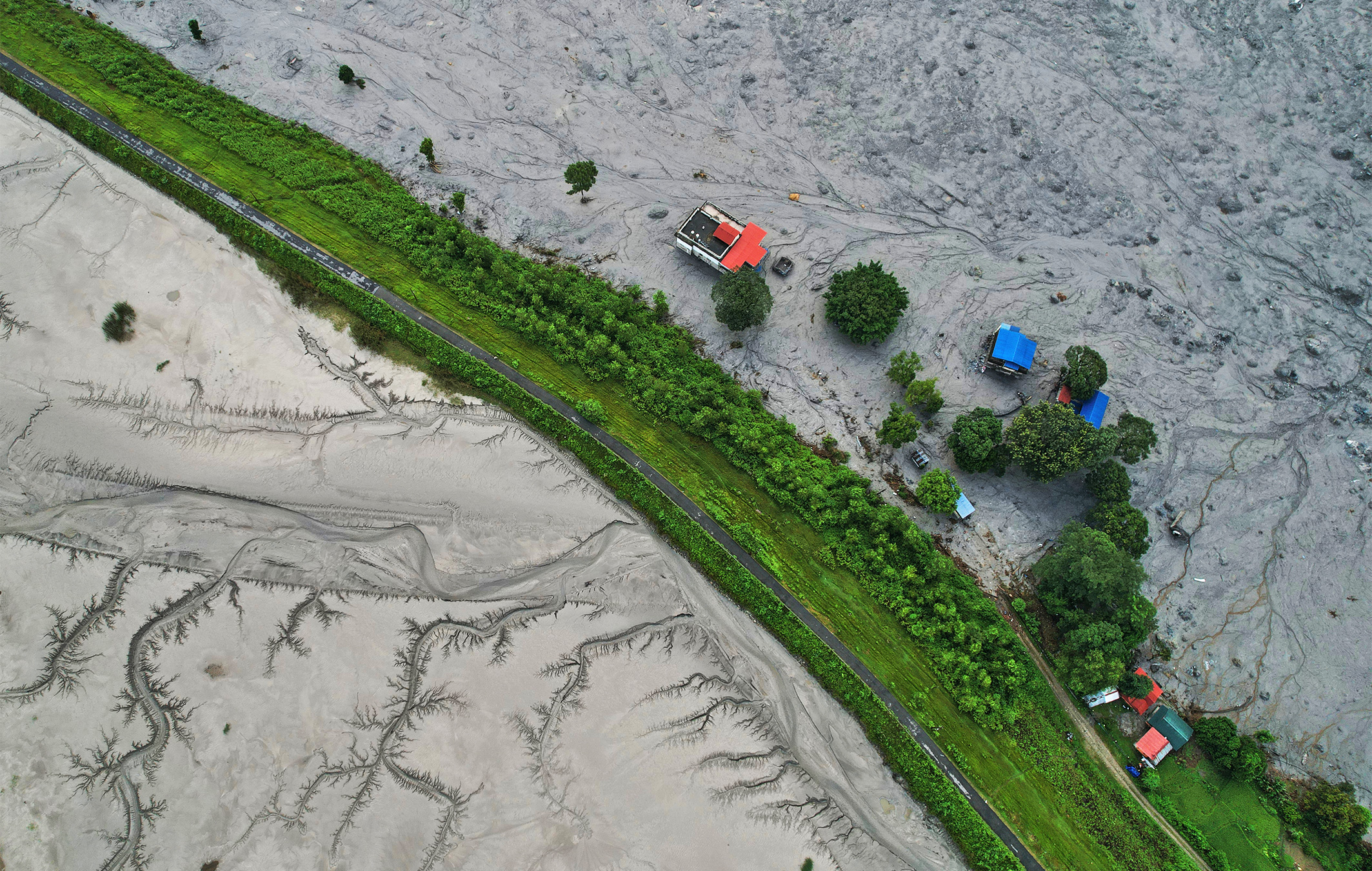
- ● The Aug. 26 flash floods on the Nepal-China border wiped out or badly damaged 281 megawatts of installed capacity and damaged 388 MW under construction in Nepal, with losses estimated to be hundreds of billions of Nepali rupees. With transmission lines on the Trishuli riverbank washed away, another 150 MW of power is cut off from the national grid.
- Surface-built powerhouses, dams and desanders near the riverbed suffered the worst damage, while underground powerhouses held up well, pointing to project locations, longer access tunnels, and early-warning systems as key resilience factors, though these upgrades could raise project costs by 10-12%.
- Some experts argue the flood should prompt Nepal to prioritize domestic consumption over its export-driven hydropower strategy, citing both physical disaster risk and falling electricity prices in neighboring India.
- The disaster threatens Nepal’s newly achieved net-exporter status (18.75 billion rupees, or $142 million in Financial Year 2025) heading into winter’s low-flow season, and is accelerating calls to scale up solar power.
KATHMANDU — Nepal’s long-held policy of harnessing hydroelectricity and using it for economic growth has met new challenges: potential catastrophic floods in the snow-fed rivers amid rising global temperatures.
The Aug. 26 floods that originated on the Nepal-China border, and which knocked out around 10% of installed power from the national grid, has prompted a debate on whether Nepal should rethink its overall strategy or just adopt better-engineered plants. Amid this, the flood could jeopardize the country’s clean energy targets and push it to adopt more solar power.
Immediate impacts
The flashflood crippled a combined installed generation capacity of 281 megawatts, including a solar power plant, and damaged four other under-construction projects, totaling a capacity of 700 MW. One of the oldest hydroelectric plants, the 14.1-MW Devighat Hydroelectric Plant, commissioned 42 years ago, was wiped out. Further downstream, the flood badly damaged a 25-MW solar power plant, according to data compiled by Mongabay from official sources. Similarly, with a hub of a transmission line washed away on the Trishuli River’s banks, another 150 MW of power from different power plants is cut off from the national grid system.
Transmission lines, including a substation on the Trishuli riverbank, were also destroyed. While officials are assessing the damage, estimates put losses at hundreds of billions of Nepali rupees, according to media reports. They say they can’t yet provide timelines for when the affected projects will resume generation.
Around 983 engineers and workers are feared trapped inside the tunnels or power houses and they are listed as people out of contact in the government records, according to the latest press release issued by IPPAN on Tuesday, Sept. 1. But the government records have counted only 639 missing people from the hydropower projects.
The exception: Super Trishuli
Not every project in the basin was swept away. The 100-MW Super Trishuli Hydropower Project endured the flood without major impact, even as the flood washed away several bridges upstream. The project sits about 100 kilometers (62 miles) downstream of Betrawati Bazar, one of the hardest-hit towns along the river.
For those skeptical that, due to the floods, Nepal requires to reconsider its export ambitions rather than just its engineering standards, Super Trishuli offers clues to make hydropower plants resilient within the existing hydropower-for-export model, not a reason to abandon it. In a Facebook post, project surveyor Laxman Devkota pointed to several design factors behind its survival: The project’s location away from the river, and the flood-probability assessment carried out before construction.
The state-owned power utility, for its part, has struck a notably calmer tone than some of the policy voices below. The Nepal Electricity Authority (NEA) says supply was restored in most affected areas within two days and has assured households nationwide that supply remains adequate despite the damage elsewhere. Mongabay reached out to the NEA for comments on long-term impacts of the flood on the power sector. They didn’t respond to the query, saying that their priority now was to rescue those trapped inside the tunnels of hydropower projects.

Design lessons: Surface vs. underground
The flood exposed a clear pattern. The worst damage hit powerhouses built on the surface, and dams and desanders located on or near the riverbed. Newer plants with underground powerhouses and desanders held up comparatively well.
Kulman Ghising, who headed Nepal’s electricity utility for about eight years and later served as the energy minister, called the flood a once-in-a-century event that nonetheless carries major lessons for project design and site regulation. “We need to design the plants resilient to floods and, most importantly, adopt early warning systems as well as robust emergency evacuation measures, and make longer access tunnels to the powerhouse to save it from floodwater,” he said.
Shailendra Guragain, former president of the Independent Power Producers Association of Nepal (IPPAN), echoed the point, saying that surface-built powerhouses and dams were wiped out or damaged, while underground construction paired with emergency rescue planning could help future projects withstand similar floods. He noted that these surface structures were originally built with cost, not resilience, in mind.
In an article in Nepal’s Spotlight magazine, Mohan Das Manandhar, chair of the Nepal Energy Foundation (NEF), framed the lesson this way: Hydropower projects shouldn’t just be built “away from the river,” but designed around the possibility that the river can become extraordinarily destructive. Current project designs rely on just 20 to 30 years of water discharge data, according to the Department of Electricity Development. Manandhar argued that critical infrastructure along snow-fed rivers should be approved only after assessing maximum credible floods, debris flows and cascading hazards. Both Manandhar and Bibek Kandel, advisor to the minister for energy, water resources and irrigation, estimate such design changes would raise minimum project costs by 10 to 12%.

Policy rethink: Is export-driven hydropower still viable?
Shree Raj Shakya, head of the center for energy studies at Tribhuvan University’s Institute of Engineering in Lalitpur, said the increased risk to hydropower on snow-fed rivers should prompt Nepal to reconsider its policy of generating and exporting hydroelectricity. “The need of the hour is to put the strategy of electricity for domestic consumption in a more pragmatic way rather than aiming to export it, because there is no alternative to the generation of hydroelectricity in the country amid rising prices of fossil fuel,” he said. He warned the damage could reduce power supply this coming winter and delay Nepal’s clean energy transition plans through 2030 and 2035. According to Nepal’s Long-term Strategy for Net-zero Emissions, the country will need 14,300 MW of electricity under an additional-measures scenario by 2030.
Shakya argued export-focused strategy carries a double risk: The physical risk of disasters — like this one — and a market risk, since electricity prices have fallen sharply in neighboring India even as the flood pushes up the cost of generation at home.
With a technically and economically feasible capacity 43,000 MW Nepal has aimed to export more electricity than it consumes domestically and narrow its trade deficit with India by 2035 — targeting 15,000 MW of hydroelectricity exports on top of 13,500 MW for domestic consumption, according to the Energy Development Roadmap, 2025. Notably, as of this writing, the government has not revised or walked back these targets in response to the flood. Nepal’s energy transition goals also include electrifying 25% of household kitchens and converting 30% of industrial boilers to electric power by 2030, making 90% of new passenger vehicles electric by 2030, and converting 100% of iron and steel furnaces to electricity-powered ones by 2035.
Manandhar, of NEF, took a more measured view than Shakya. Export, he argued, remains essential for balancing seasonal supply-demand gaps, and domestic consumption should simply be prioritized within that model, not instead of it. He also said he fears the scale of loss of life in the flood could discourage clean-energy adoption and push some consumers back toward fossil fuels.
The question is not limited to a single hydropower project and its safety, but to consider each river basin, said Arjun Dhakal, environment and climate change economist. Dhakal has been publicly expressing concern over the unplanned proliferation of hydropower in the Trishuli region. More than 30 projects are either in operation or under construction in the river basin. “The scale of damages, particularly on hydropower projects occurred, because of haphazard permissions to build hydropower projects in the river basin without considering the possible natural risks including glacial lake outburst flood originating from Tibet,” he told Mongabay. He said that the government should prepare basin-level plans to designate where power plants should be located.

Economic fallout
The flashflood is set to make electricity costlier by at least 10-12%, according to hydropower engineers and energy experts. Kandel said Nepal can no longer rely on low-cost engineering: “We need to work on strengthening all kinds of infrastructure we are making, including hydropower projects, to withstand disasters like the recent flood.”
Ram Prasad Dhital, chairman of the Electricity Regulatory Commission (ERC), said developers will have to build stronger infrastructure, with the added cost ultimately passed on to consumers: “It’s obvious that someone has to pay for it.” Dhital has proposed a loss-and-damage fund specifically for hydropower projects to help pay for recovery from this flood and future damage elsewhere. The added generation cost comes on top of a 5% value-added tax on household electricity consumers, which has been in effect since mid-July.
The timing compounds the pain. In the fiscal year ending mid-July, Nepal achieved net-exporter status for the first time in nearly a decade of electricity trade with India, netting 18.75 billion rupees (roughly $142 million) from sales to India and Bangladesh, according to the NEA report for 2026.
That status is now at risk: while the damage hasn’t yet significantly affected supply and Nepal is currently in its surplus generation season, the picture changes in winter, when flow in snow-fed rivers dwindles just as demand peaks. The country will likely need to import more electricity from India to meet peak winter demand, reversing last year’s export gain.

Solar opportunity
The flood has opened space to promote the less risky solar power as part of the energy mix. Solar currently makes up less than 3% of Nepal’s total electricity generation, according to government data.
A total of 12 solar projects with a combined capacity of 89 MW are already under installation stages and 83 projects of varying capacities are under preliminary study, according to government licensing data.
Shakya suggested solar power contribution could be scaled to as much as 20%, citing falling installation costs and advances in battery storage: “The cost of solar installations is cheaper today, and technological advancement of battery storage may also provide an opportunity for promoting it up to 20%.” During winter, when river flow drops, solar could compensate for demand during daylight hours and preserve hydropower reserves for peak morning and evening loads, he said.
Banner image: A drone view shows a major section of Pasang Lhamu highway washed away along swollen Trishuli river by recent flash floods. Image by AP Photo/Rajesh Kumar Singh.
Nepal Indigenous leaders refile writ petition against hydropower project
Multilateral development banks must prioritize clean & community-led energy projects (commentary)
Reporting confirms alleged Indigenous rights violations in Nepal hydropower project
Cite this article
Rudra Pangeni (2026). Nepal’s flood disaster puts its hydropower-first strategy, exports to the test. Mongabay Conservation news. DOI: https://doi.org/10.66709/news-328384

