


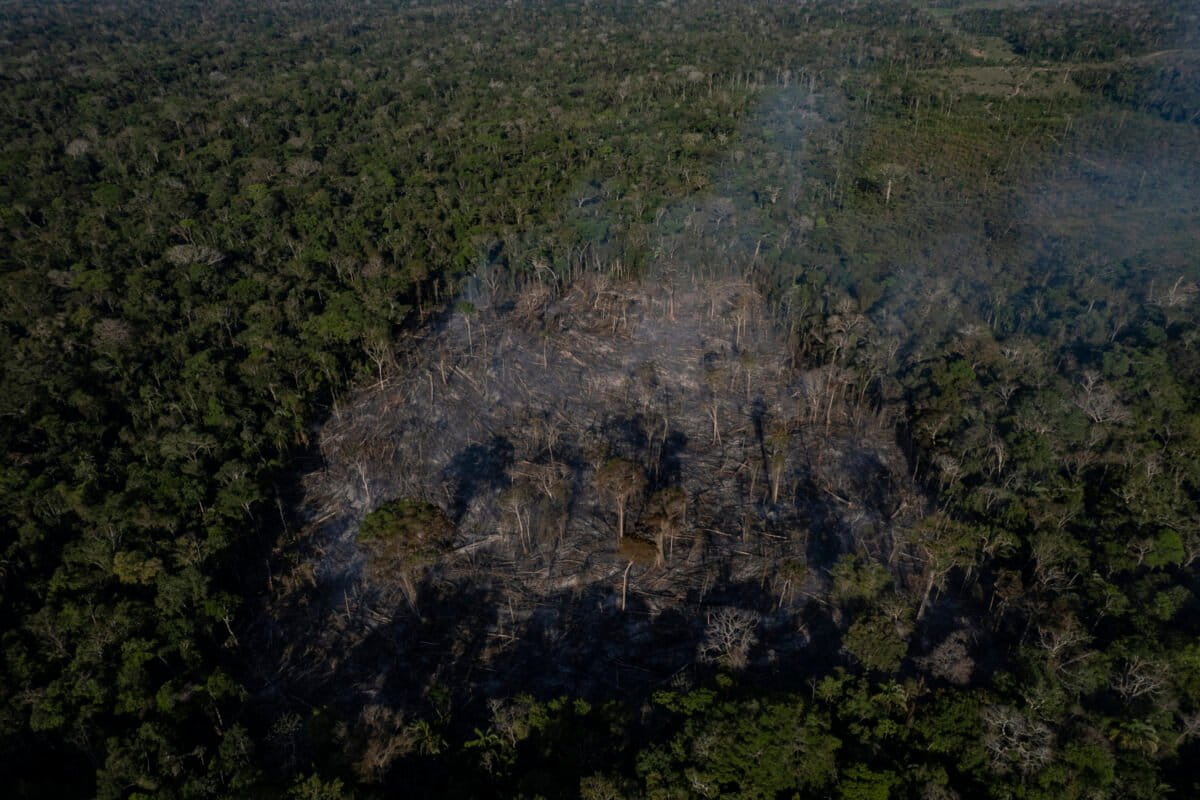
As Brazilians head to the polls to vote in a runoff election, Amazon deforestation is also on the ballot. New data from Brazil’s National Institute for Space Research (INPE) find that incumbent President Luiz Inácio Lula da Silva presided over the lowest deforestation levels ever recorded in both the Amazon rainforest and Cerrado savanna.
Between August 2025 and July 2026, deforestation fell to 3,335 square kilometers (1,288 square miles), registering a drop of nearly 42% from the previous year and the lowest rate of deforestation since satellite monitoring began in 1988.
“In 2021, deforestation peaked under far-right President Jair Bolsonaro to its highest level since 2008. More than 13,200 km2 (5,097 mi2) of forest was cleared — nearly four times the 2025-26 figure.
“Without a doubt, what we are seeing is very positive,” University of São Paulo climate scientist Carlos Nobre told Mongabay in an audio message. “I am also sure that this is the lowest deforestation in the Amazon’s history since the military dictatorship began heavily deforesting the Amazon in the mid-1970s.”
Brazil was ruled by a military dictatorship from 1964 till 1985. The nation did not keep year-on-year deforestation data during that period, but INPE estimates suggest an average of 21,130 km2 (8,158 mi2) of forest were cleared every year between 1978 and 1988.
The Cerrado, a tropical savanna and one of Brazil’s main agricultural regions, also recorded its lowest deforestation level last year since monitoring began for that biome in 2001.
Between August 2025 and July 2026, deforestation fell to 5,516.69 km2 (2,130 mi2), a 24% drop from the previous year, according to INPE’s data.

“The reduction in deforestation is not an isolated episode, nor is it the result of luck,” João Paulo Capobianco, Brazil’s environment and climate change minister, said in a statement.
Capobianco attributed the sustained decline to the use of science to guide policy decisions and cooperation between federal, state and municipal governments.
The Amazonian states of Pará, Mato Grosso and Amazonas, which have historically recorded some of Brazil’s highest deforestation rates, each saw significant declines. Deforestation fell by 45.3% in Pará, 46.7% in Mato Grosso and 46.4% in Amazonas.
Banner image: Aerial view of burned Amazon rainforest in Acre state, Brazil. Image courtesy of Victor Moriyama/Climate Visuals.

