


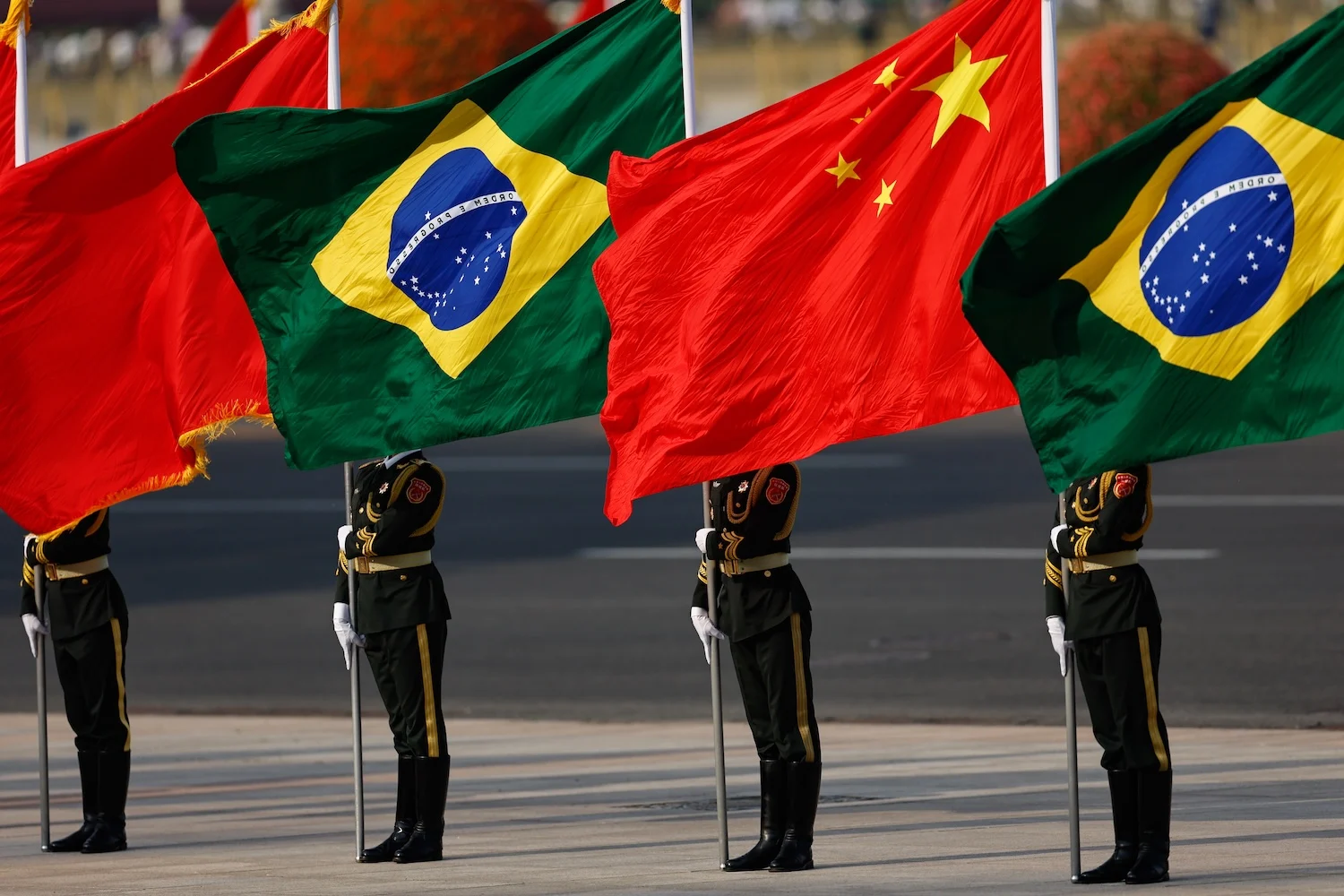
Brazil’s October presidential election offers sharply different visions of the country’s place in the world. Incumbent President Luiz Inácio Lula da Silva sees China as a partner in development and a counterweight to Western power. His principal challenger is Sen. Flávio Bolsonaro, the son of Lula’s right-wing predecessor, who promises closer alignment with Washington.
Yet either outcome is likely to leave Brazil’s economic reliance on Beijing largely intact. Neither candidate offers a convincing strategy for managing the risks that dependence increasingly carries. Those risks have grown as China’s global engagement has become more powerful and assertive, its presence in Brazil has expanded from commodity purchases into strategically sensitive industries, and its rivalry with Washington has intensified.
Brazil’s October presidential election offers sharply different visions of the country’s place in the world. Incumbent President Luiz Inácio Lula da Silva sees China as a partner in development and a counterweight to Western power. His principal challenger is Sen. Flávio Bolsonaro, the son of Lula’s right-wing predecessor, who promises closer alignment with Washington.
Yet either outcome is likely to leave Brazil’s economic reliance on Beijing largely intact. Neither candidate offers a convincing strategy for managing the risks that dependence increasingly carries. Those risks have grown as China’s global engagement has become more powerful and assertive, its presence in Brazil has expanded from commodity purchases into strategically sensitive industries, and its rivalry with Washington has intensified.
Brazil needs a China strategy adapted to all three changes. The election debate remains organized around competing preferences for Beijing and Washington, with too little attention to the economic and diplomatic capabilities Brasília needs to preserve its freedom of action.
Lula’s approach has a coherent political logic. His electoral program prioritizes closer relations with the BRICS grouping and the global south, while he advocates greater use of national currencies in international transactions. China offers markets, investment, and technology, alongside support for a more influential Brazilian role in global governance. In this conception, cooperation with Beijing advances economic development and loosens the constraints of an international system shaped by Western power.
The practical agenda reflects that ambition. Lula’s May 2025 visit to Beijing produced 20 agreements, including cooperation on artificial intelligence. His government also seeks U.S. technology: In August, it announced separate supercomputing projects, one involving Huawei and iFlytek, another expected to attract Nvidia. Lula’s objective is to draw resources from several partners while retaining discretion over Brazil’s choices. China occupies an especially privileged position because its economic contribution reinforces his diplomatic ambitions.
That approach also encourages a forgiving interpretation of Beijing’s geopolitical conduct. Lula’s chief foreign-policy advisor, Celso Amorim, has presented China and BRICS as defenders of the global order amid the U.S. retreat from multilateralism. He made these comments after the grouping had expanded to include more illiberal states, with Russian President Vladimir Putin hosting its annual summit two years into Russia’s full-scale invasion of Ukraine.
Treating China as a corrective to U.S. power leaves insufficient room to consider how Chinese power itself might constrain Brazil. An additional Lula term would likely deepen the partnership through the same assumptions that have guided its expansion. Maintaining the status quo now means granting Beijing leeway as it threatens democracy across the Taiwan Strait and challenges regional sovereignty in the South China Sea.
Bolsonaro begins from a different reading of Brazil’s interests. He has condemned the country’s “submission to China,” considered leaving BRICS, and proposed a closer strategic relationship with the United States. In May, he met with U.S. President Donald Trump at the White House behind closed doors. His proposals include preferential cooperation with Washington on critical minerals, joining Trump’s “Shield of the Americas” counternarcotics alliance, and a bilateral free trade agreement. The underlying wager is that political affinity with the United States would unlock investment, technology, and diplomatic support, giving Brazil an alternative to Lula’s emphasis on the global south.
His formal program is more cautious than his rhetoric. His 76-page government plan, released last month, promises pragmatic negotiations with China, stating, “What guides our diplomacy is the interest of the Brazilian producer and worker, not sympathy or antipathy toward this or that government.” His camp has called for preserving economic opportunities while reducing dependence and scrutinizing Chinese involvement in sensitive sectors. These qualifications reflect an unavoidable constraint: A president seeking closer relations with Washington would still have to protect the revenues and investments generated by China. Announcing a diplomatic realignment is considerably easier than building alternative markets and supply chains.
His father’s presidency supplies a useful test. Jair Bolsonaro campaigned against Chinese influence in 2018, but by October 2019, he was in Beijing, inviting Chinese participation in Brazil’s offshore oil auction. Trade continued to expand despite diplomatic friction. Research on his presidency finds that changes in Brazil’s foreign-policy stance coexisted with the resilience of the broader relationship. Established commercial ties and growing asymmetry between the two countries limited the effects of ideological hostility.
Those constraints have become more substantial. China bought $100 billion in Brazilian goods in 2025, nearly 29 percent of total exports. Producers and the governments that depend on their earnings have powerful reasons to resist disruption. Chinese investment in infrastructure and technology creates further interests in continuity. Washington would have difficulty replacing that demand, particularly in agricultural markets where U.S. producers compete with Brazilian exporters.
For Flávio Bolsonaro, the constraint reaches into his own political constituency. Agribusiness, an important source of support for the Brazilian right, depends heavily on Chinese buyers. Under his father, its lobbying helped contain diplomatic damage. Confrontation with Beijing could therefore impose immediate costs on supporters he must accommodate. Lula faces a different coalition but similar demands for growth and investment. Both would inherit commercial arrangements accumulated over decades, with few readily available substitutes.
The candidates’ contrasting proposals therefore offer limited prospects for changing the foundations of Brazil’s relationship with China. Lula’s pursuit of closer political coordination with Beijing and Bolsonaro’s preference for Washington could produce differences in diplomatic tone and emphasis while leaving Brazil’s underlying dependence largely intact. Both approaches leave unresolved the harder task of developing a strategy that preserves the benefits of cooperation with China, strengthens Brazil’s freedom of action, and defends the international rules that protect its sovereignty.
That task has become urgent because the geopolitical environment has changed. China’s commercial ascent in the 2000s gave Brazil opportunities to diversify beyond its traditional partners. Beijing now has greater capacity to impose its preferences, illustrated by its December 2025 military exercises rehearsing a blockade of Taiwan’s major ports. Its competition with Washington increasingly reaches into Brazil’s development choices, including infrastructure ownership, technological standards, and export market access. Basing China policy on outdated assumptions leaves Brazil exposed to three growing risks that will outlive political cycles.
The first is economic overdependence. In 2025, China purchased 79 percent of Brazil’s soybean exports, 67 percent of its iron ore exports, and 45 percent of its petroleum exports. A Chinese slowdown, changes in demand, or conflict in East Asia could transmit losses through export earnings, investment, and public revenue. Geographic distance would provide limited protection.
Dependence also creates opportunities for coercion. Australia experienced that danger when deteriorating relations with Beijing brought restrictions on its exports, including wine tariffs exceeding 200 percent. China’s own need for Brazilian commodities would complicate similar action against Brazil, but particular industries could become targets. Diversifying markets before a crisis emerges would provide insurance against both economic shocks and political pressure.
The second problem is growing pressure from Washington. Telecommunications already demonstrates its bipartisan foundations: The Trump administration warned Brazil over Huawei’s participation in 5G, and Jake Sullivan, national security advisor to former President Joe Biden, raised similar concerns. The strategic competition will likely outlast Trump.
Critical minerals are extending its reach. In February, the U.S. International Development Finance Corp. agreed to $565 million in financing for Brazilian rare-earth producer Serra Verde, including an option for Washington to acquire a minority stake. U.S. efforts to build alternatives to Chinese supply chains will increasingly influence Brazil’s choices of investors and technology partners. Lula pursuing cooperation with both powers and Bolsonaro promising privileged access to Washington will each face demands that complicate continued business with Beijing.
The third problem concerns Brazil’s geopolitical interests. As a middle power, Brazil benefits from rules that constrain stronger states and protect weaker ones. Strategic equidistance can become an empty and risky objective, accommodating Chinese and Russian challenges to those rules. Measuring autonomy primarily by distance from Washington obscures the costs of that accommodation. A Flávio Bolsonaro administration could face the corresponding temptation to excuse U.S. coercion in return for political support. Selective defense of sovereignty weakens the principles on which Brazil relies.
Ukraine exposes the tension. Brazil supported a U.N. resolution demanding Russia’s withdrawal in February 2023. Its joint peace initiative with China in May 2024 omitted that demand, risking acceptance of conquest for settlement. The principle also applies to China’s violations of Philippine maritime rights and Trump’s tariffs to pressure Brazil over Jair Bolsonaro’s prosecution. Consistency requires defending international restraints regardless of which power violates them.
Brazil needs to preserve the benefits of relations with China while reducing excessive dependence and defending the rules that protect its sovereignty. That requires broader export markets, stronger domestic capabilities, and greater cooperation with other middle powers. Negotiations should widen commercial opportunities, while clear criteria for sensitive investments should help Brazil judge competing offers against its own development and security priorities. These efforts require sustained work beyond the election cycle.
Whoever wins in October will inherit the challenge of turning Brazil’s considerable resources into durable freedom of action. The candidates’ competing diplomatic preferences offer an incomplete answer to that common task.
