


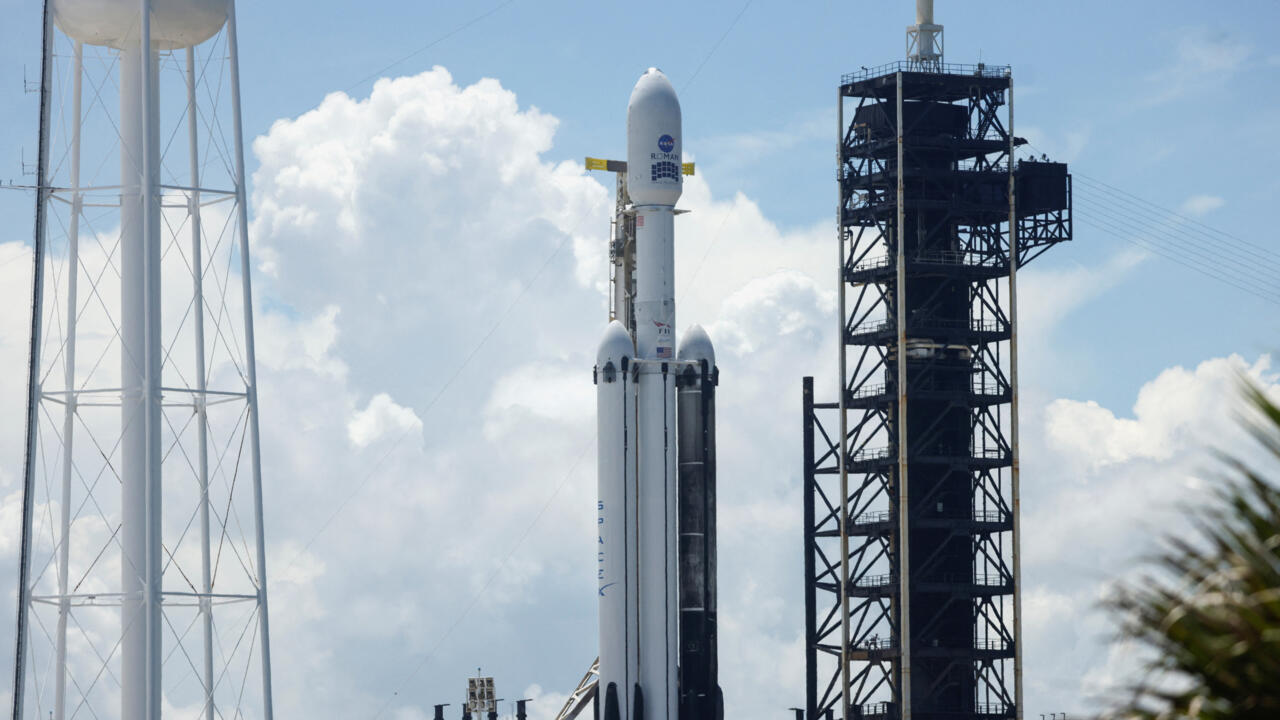
NASA‘s new flagship astronomical observatory was launched into space from Florida on Sunday on a mission to probe some of the biggest mysteries in astrophysics and cosmology.
The Nancy Grace Roman Space Telescope, a roughly $4 billion project, was carried aloft from NASA’s Kennedy Space Center aboard a SpaceX Falcon Heavy rocket.
The telescope is designed to investigate cosmic enigmas such as dark energy and dark matter, while also testing gravity at vast scales and searching for exoplanets, as planets beyond our solar system are called.
There were some weather concerns ahead of the launch but the rocket carried the telescope into space through blue skies and some scattered clouds.
Roman will travel through space toward an orbital location called Lagrange Point 2, situated about a million miles (1.6 million km) from Earth. Its mission is planned for five years, though the US space agency said the telescope may have enough fuel for five additional years.
Roman will build on the capabilities of other orbiting observatories such as the James Webb Space Telescope, launched in 2021, and the Hubble Space Telescope, launched in 1990.
“It will be as if Hubble and James Webb kind of peered through a keyhole at the universe, while Nancy Grace Roman will kick the door down,” Nicola Fox, chief of NASA’s Science Mission Directorate, told reporters on Saturday.
“Roman has broadly the same sensitivity and sharpness of vision as Hubble, but we survey the sky much faster,” Julie McEnery, Roman’s senior project scientist at NASA’s Goddard Space Flight Center in Maryland, told reporters at a briefing in July.
McEnery said one month of Roman observations can survey our entire home galaxy.
Read moreExclusive – French astronaut describes climate change as seen from space
“One month of observations to survey our Milky Way galaxy would take about a century with Hubble,” McEnery said.
Wide angle and Zoom lenses
Webb has provided a new understanding of the early history of the universe, finding among other things that primordial galaxies formed sooner and were bigger than previously known.
Webb is capable of looking across vast distances and back into deep time, because of the time it takes light to travel.
Roman instead is able to take panoramic views. NASA likens Roman to a camera’s wide-angle lens and Webb to a zoom lens.
“Webb is designed to be able to probe very deeply and with exquisite sensitivity into the universe, so we can find rare things in the early universe,” McEnery said, while Roman offers “the large vision that complements the deep views that Webb provides.”
Roman will help in the understanding of two mysterious cosmic components – dark energy and dark matter – by creating the most comprehensive 3D map of the universe to date. Its main survey, to take more than a year to complete, will cover more than two billion galaxies.
The Big Bang event roughly 13.8 billion years ago initiated the universe, and it has been expanding ever since. Scientists in 1998 disclosed that this expansion was actually accelerating, with an invisible force called dark energy as the hypothesized reason.
The universe’s contents include ordinary matter – stars, planets, gas, dust and all the familiar stuff on Earth – as well as dark matter and dark energy.
Ordinary matter represents perhaps 5% of the contents. Dark matter, known through its gravitational influences on galaxies and stars, may represent about 27%. Dark energy may represent about 68%.
Using Roman to gauge dark matter’s pull and dark energy’s push across the universe will bring scientists closer than ever before to solving both mysteries, according to NASA.
Roman also will conduct one of the most comprehensive searches ever for exoplanets. It is expected to discover thousands of new ones and provide the first statistical census of planetary systems similar to our own.
“One of the most exciting aspects of Roman is its discovery potential. Historically, major astronomical observatories have often made their most important breakthroughs in areas that scientists did not anticipate before launch,” cosmologist
Mustapha Ishak of the University of Texas at Dallas, a member of Roman’s scientific collaboration, told Reuters.
President Donald Trump‘s administration tried during both his first and second terms to reduce or eliminate funding for Roman, but Congress preserved it. Roman’s launch comes nine months ahead of schedule, according to NASA.
(FRANCE 24 with Reuters)
