


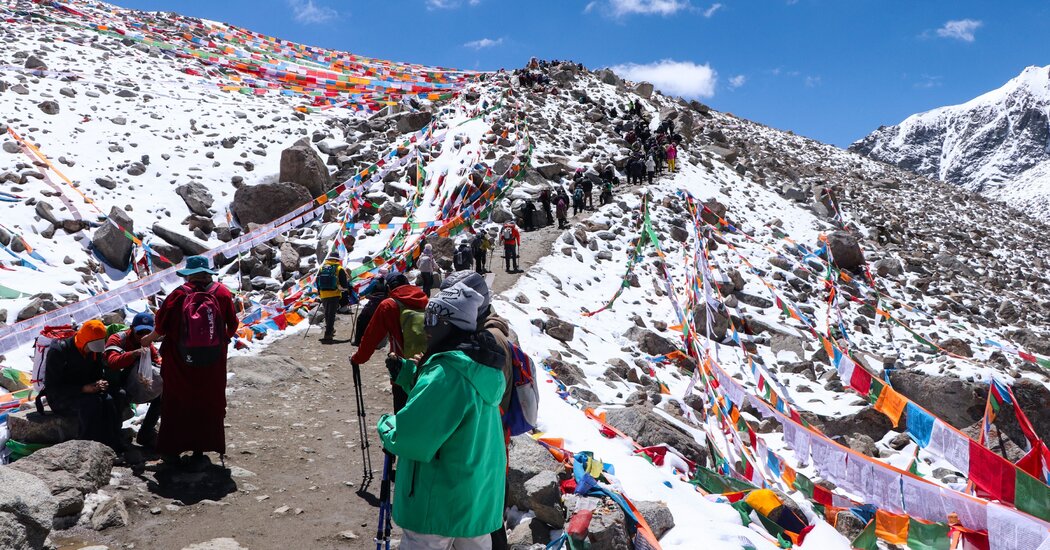
Mount Kailash, a peak of snow and granite in the Himalayas, is a spiritual site revered by followers of four religions that attracts thousands of pilgrims a year.
People heading to or from the mountain make up a significant number of the hundreds missing in the floods that devastated parts of Nepal and Tibet this week. At least two groups, totaling about 130 people, were near the Gyirong border crossing between Nepal and China when the floods struck, according to tour organizers and relatives.
The peak is sacred to Hindus, Buddhists, Jains and those belonging to the pre-Buddhist Bon religion.
The mountain rises to roughly 22,000 feet, towering over a remote landscape close to where India, Nepal and Tibet meet.
The pilgrimage involves a 33-mile trek around the mountain, rather than climbing it.
For Tibetan Buddhists, the journey around the mountain, known as a kora, cleanses sins and brings a person closer to nirvana.
Tibetan Buddhists call it the “precious snow” mountain and believe it is the center of the universe, home to a deity that represents supreme bliss.
Hindus believe that Mount Kailash is the spiritual home of Shiva, the god of destruction and transformation.
In Jainism, it is believed that one of the religion’s early prophets visited the mountain and received salvation there. And in the ancient Tibetan Bon tradition, it is a source of spiritual power.
Hindus and Buddhists walk around the mountain clockwise, while followers of the Bon faith walk counterclockwise. Completing the pilgrimage typically takes several days.
Through their varying traditions, all pilgrims seek similar things: purification, blessing and transformation, according to Jamyang Tsering, a Tibetan tour guide.
“In Tibet we have a saying: If you touch something sacred, a piece of it stays with you forever,” Mr. Tsering says in a video on his YouTube channel. “I have touched Mount Kailash again and again with my own hands. And still, after all these years, the mountain lives in me.”
Mount Kailash is “among the most difficult, yet highly venerated, pilgrimage sites for several religions,” according to the International Center for Integrated Mountain Development, an intergovernmental organization for Himalayan nations.
It says the mountain and the nearby Lake Manasarovar have “historically fostered a great transboundary fluidity of movement, linkages of trade, pastoralism, politics, culture and religion among communities living in the landscape.”
