


Spanish Prime Minister Pedro Sánchez has built a brand as one of Europe’s most vocal critics of the United States and Israel, recognizing Palestinian statehood over Gaza and denying the U.S. military the use of its Rota and Morón bases during the war against Iran. And while he seems perfectly comfortable playing hardball with governments worlds apart from his own ideology, when it comes to Spain’s fraught relations with Morocco, Sánchez has folded far more than his reputation suggests.
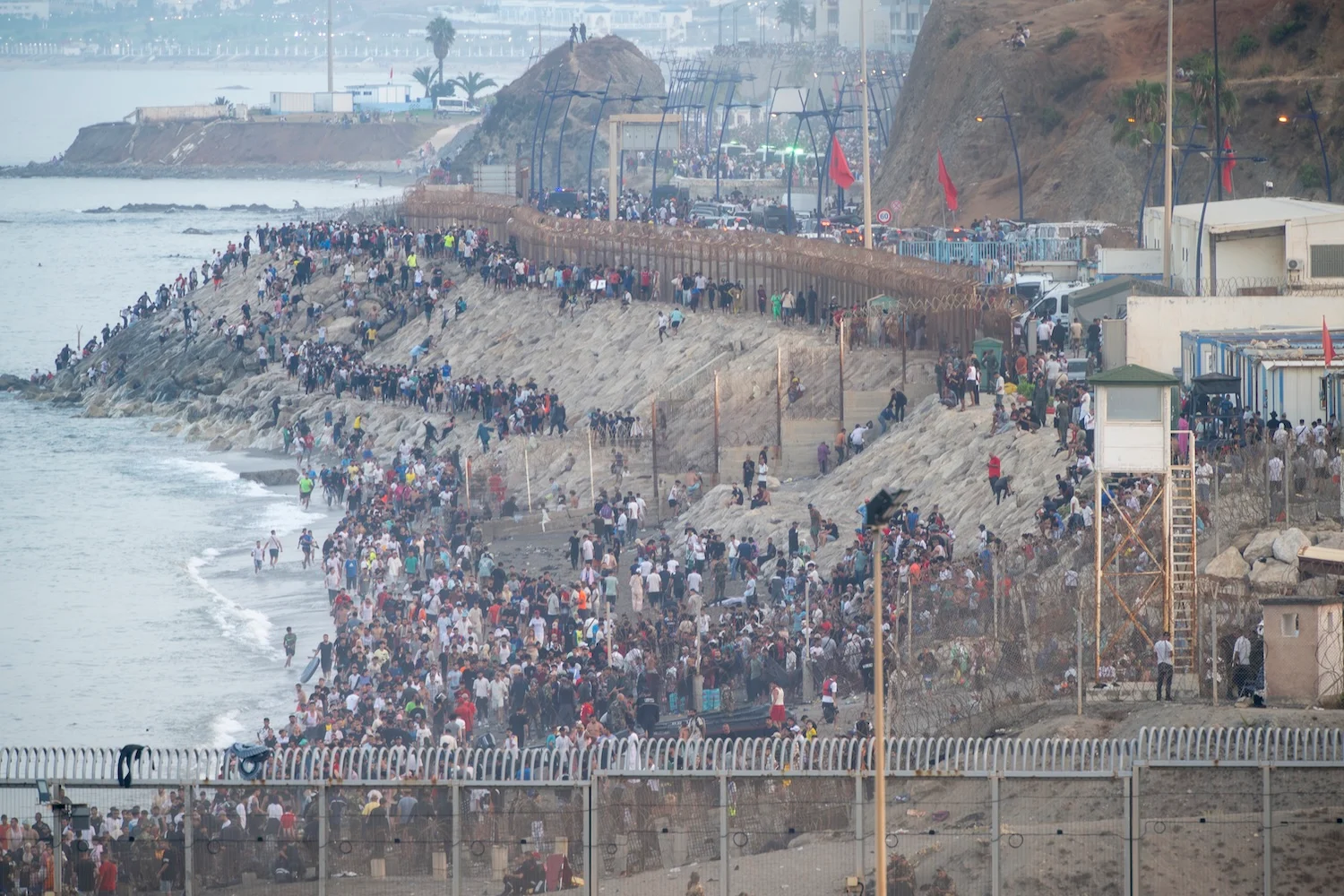
Nowhere was that clearer than in his handling of the recent crisis in Ceuta. On July 30, around 70,000 migrants crossed from Morocco into Ceuta, the small Spanish exclave in North Africa, a city of little more than 80,000 inhabitants. The sudden increase in arrivals caught security forces off guard, and local shelters and social services were soon overwhelmed. Lacking food, shelter, or a clear legal path in Spain, most of the migrants headed back to Morocco within a day, their disappointment standing in stark contrast with the joy and chants of “Viva España” upon their arrival. At least 88 migrants have died, and more bodies might be recovered from the water.
Spanish Prime Minister Pedro Sánchez has built a brand as one of Europe’s most vocal critics of the United States and Israel, recognizing Palestinian statehood over Gaza and denying the U.S. military the use of its Rota and Morón bases during the war against Iran. And while he seems perfectly comfortable playing hardball with governments worlds apart from his own ideology, when it comes to Spain’s fraught relations with Morocco, Sánchez has folded far more than his reputation suggests.
Nowhere was that clearer than in his handling of the recent crisis in Ceuta. On July 30, around 70,000 migrants crossed from Morocco into Ceuta, the small Spanish exclave in North Africa, a city of little more than 80,000 inhabitants. The sudden increase in arrivals caught security forces off guard, and local shelters and social services were soon overwhelmed. Lacking food, shelter, or a clear legal path in Spain, most of the migrants headed back to Morocco within a day, their disappointment standing in stark contrast with the joy and chants of “Viva España” upon their arrival. At least 88 migrants have died, and more bodies might be recovered from the water.
Sánchez deployed the military and traveled to Ceuta, where he called the crossings “a violation and attack of Spain’s territorial integrity.” Yet he never mentioned who had attacked Spain. For decades, Morocco has claimed sovereignty over Ceuta and Melilla, Spain’s second exclave in North Africa. It’s been the biggest friction point between Madrid and Rabat. But in this case, Sánchez instead highlighted the collaboration with Moroccan authorities in sending the migrants back.
It is not clear why Sánchez is absolving Morocco. Evidence collected by the New York Times and other outlets shows that, shortly before the crossings on July 30, Moroccan guards had ceased to control the crowds that had been building up in the border town of Fnideq for weeks prior. News from a recent ruling from the Spanish Supreme Court saying that migrants arriving by sea could not be returned on the spot prompted thousands of people, many of them young, to travel to the border and eventually cross into Ceuta. This was accompanied by numerous posts and videos on social media that said the border was open and could be crossed easily.
Morocco’s use of migrants as tools of leverage fits tactics of hybrid warfare that have been previously used by Europe’s autocratic border neighbors, such as Turkey and Belarus. Sánchez should know the playbook. After all, he was Spain’s prime minister when Morocco helped around 8,000 migrants cross into Ceuta in 2021, triggering a crisis that looks remarkably similar to this one.
At the time, Morocco used migration as reprisal for Spain allowing the leader of the Polisario Front, Western Sahara’s independence movement, to receive treatment for COVID-19 on Spanish soil. This plunged relations with Morocco into a crisis, and mending ties took more than diplomatic pleasantries. Sánchez only restored full relations with Morocco in 2022 by abandoning a decades-old policy of supporting self-determination for Western Sahara and backing Rabat’s plan for autonomy over the region instead. Spaniards learned about this massive pivot in foreign policy after a letter sent to King Mohammed VI leaked in the Moroccan press.
A former colony of Spain, Western Sahara was occupied by Morocco as Madrid withdrew from the territory in 1975. The International Court of Justice and, until recently, most of the international community do not recognize Moroccan claims of sovereignty over the territory, which is why Spain, until recently, backed a plan for Western Sahara’s self-determination. The pivot also tanked relations with Algeria, Morocco’s regional rival and a guarantor of the Sahrawi peoples’ independence movement. In retaliation, Algeria cut off its natural gas supply to Spain just as Europe needed it most.
This new era of rapprochement with Morocco allowed Sánchez to put bitter chapters such as the Ceuta crisis from 2021 behind him and enter an era of cooperation with Morocco on several matters, including migration. Or so he thought.
This isn’t the first time that Sánchez has turned a blind eye to Morocco’s actions. In 2022, the government disclosed that the mobile phones of Sánchez and Defense Minister Margarita Robles had been tapped with Pegasus, an Israeli-made spying software. Despite investigations by the European Parliament and journalistic reports pointing in that direction, no Spanish official—including either Robles or Sánchez himself—has acknowledged that Morocco could be behind the hacking. In fact, just a year ago, Spain’s interior minister awarded a medal to Morocco’s intelligence chief, Abdellatif Hammouchi, a man who has been linked to the Moroccan security services’ use of Pegasus.
No one knows for sure why Morocco let the crossings happen this time around. One explanation could just be that it wished to show Madrid its power to wreak havoc in Ceuta. This is in line with what the Moroccan press has published on the issue. According to outlet Le 360, the crisis shows “the untenable status of the occupied enclaves of Sebta [the Arabic name for Ceuta] and Melilla,” which they consider to be “geographic, political, and security anomalies.”
Spain’s sovereignty over Ceuta and Melilla, which dates back centuries, is not questioned by international law or any other country beyond Morocco, although there are signs that this might change. Just a few weeks ago, the U.S. House of Representatives approved a bill directing $40 million to Morocco in security funding. Attached to the bill was a report by Republican Rep. Mario Díaz-Balart which describes Ceuta and Melilla as “located in Moroccan territory” and asks Secretary of State Marco Rubio to mediate their future.
The United States has already acknowledged Morocco’s sovereignty over Western Sahara. It did so in 2020, in exchange for Morocco normalizing ties with Israel under the Abraham Accords. Since then, Morocco has been one of Israel’s most reliable partners in the Muslim world.
There is also evidence of at least one high-ranking Israeli official questioning Spain’s control over Ceuta and Melilla. Danny Danon, Israel’s ambassador to the United Nations, said in the wake of the crisis that it was time that Spain “explained to the world why it still maintains colonial enclaves in Africa,”—though Israel’s ambassador to Spain, Dana Erlich, made it clear that this was not Israel’s official position.
Another possible explanation behind Morocco’s motivations is that Spain is starting to mend its ties with Algeria after they were strained over the Western Sahara pivot. On July 20, Sánchez made his first visit to Algeria in four years, meeting with President Abdelmadjid Tebboune to discuss cooperation on energy, investment, and migration.
Other analysts point to a law granting Spanish citizenship to Sahrawis born under Spanish colonial rule and their direct descendants, which has been introduced in the Spanish parliament and could pass soon.
We may never know exactly what message Morocco was sending, but the tragedy which resulted reveals that Spain is in an increasingly tenuous position geopolitically. Sánchez’s rapprochement with Morocco failed to prevent a crisis even larger than the one in 2021. European states can no longer count on U.S. support. And furthermore, while Spain issued an arms embargo against Israel over Gaza, Morocco has been signing lucrative arms deals with Israel.
Rather than treating the crossings as a security emergency, the U.S. State Department posted on X blaming the crossing of migrants on “the direct result of the Spanish Government’s deliberate efforts to enable and facilitate mass illegal migration into Europe.” The crisis also saw some European allies snap at Spain. Italy, led by far-right Prime Minister Giorgia Meloni, temporarily suspended Schengen, the EU’s free border agreement. Finland and Denmark backed the move.
Could this “triple entente” between Morocco, Israel, and the United States threaten Spain’s control of Ceuta and Melilla? Only time will tell. Yet Sánchez is known to always have some ace up his sleeve. Following an invitation from Madrid in 2023, Morocco joined Spain and Portugal’s bid to host the 2030 FIFA Men’s World Cup, which ultimately proved to be successful. Morocco has greeted the prospect with genuine excitement, investing more than $20 billion in preparation. Sánchez may have bought himself some temporary breathing room. Once again, soccer brings Spain some joy.
