


For several hours last month, the fate of the Nigerien junta hung by a thread. At midnight between Aug. 28 and Aug. 29, hundreds of rebel soldiers stormed the capital, Niamey. The attack, which began as an outpouring of frustration over battlefield setbacks and poor welfare benefits, quickly morphed into an attempt to overthrow President Abdourahamane Tchiani, who seized power in the West African state in a coup three years ago.
After a 24-hour standoff between the mutineers and government forces, Africa Corps—a Russian paramilitary organization and successor of the now-defunct Wagner Group—came to the state’s aid by dispatching airborne assets, which allowed forces loyal to the junta to regain control.
For years, Russia has drawn criticism for using counterterrorism deals to prop up client state regimes, including those of former Sudanese President Omar al-Bashir and Central African Republic President Faustin-Archange Touadéra. This year alone, the Africa Corps helped Mali’s junta thwart a large-scale jihadi offensive on the capital city, Bamako; in Niger itself, the group was instrumental in foiling terrorist attacks in January and June.
Russia’s role in Niger’s failed mutiny marks the first time that the Africa Corps has intervened to save an African regime from an internal rebellion. Russia’s presence in West Africa has evolved from a security partnership to a literal praetorian guard for hire, ensnaring Niger in a dependency trap that could transform the country into a de facto Russian protectorate instead of a sovereign state.
As the dust settles, Russia’s evolving Sahel playbook is further redrawing the balance of power in a region where Western influence has already diminished. In the short term, Moscow’s position will be strengthened in Niger, as will its appeal across the region.
But Russia’s strategy is not without danger. By positioning itself as a regime protector without investing in economic growth and humanitarian aid, Moscow is staking its credibility on a counterterrorism mission that no foreign power has yet been able to control—which could open a crucial window for Western powers eager to regain authority in the region.
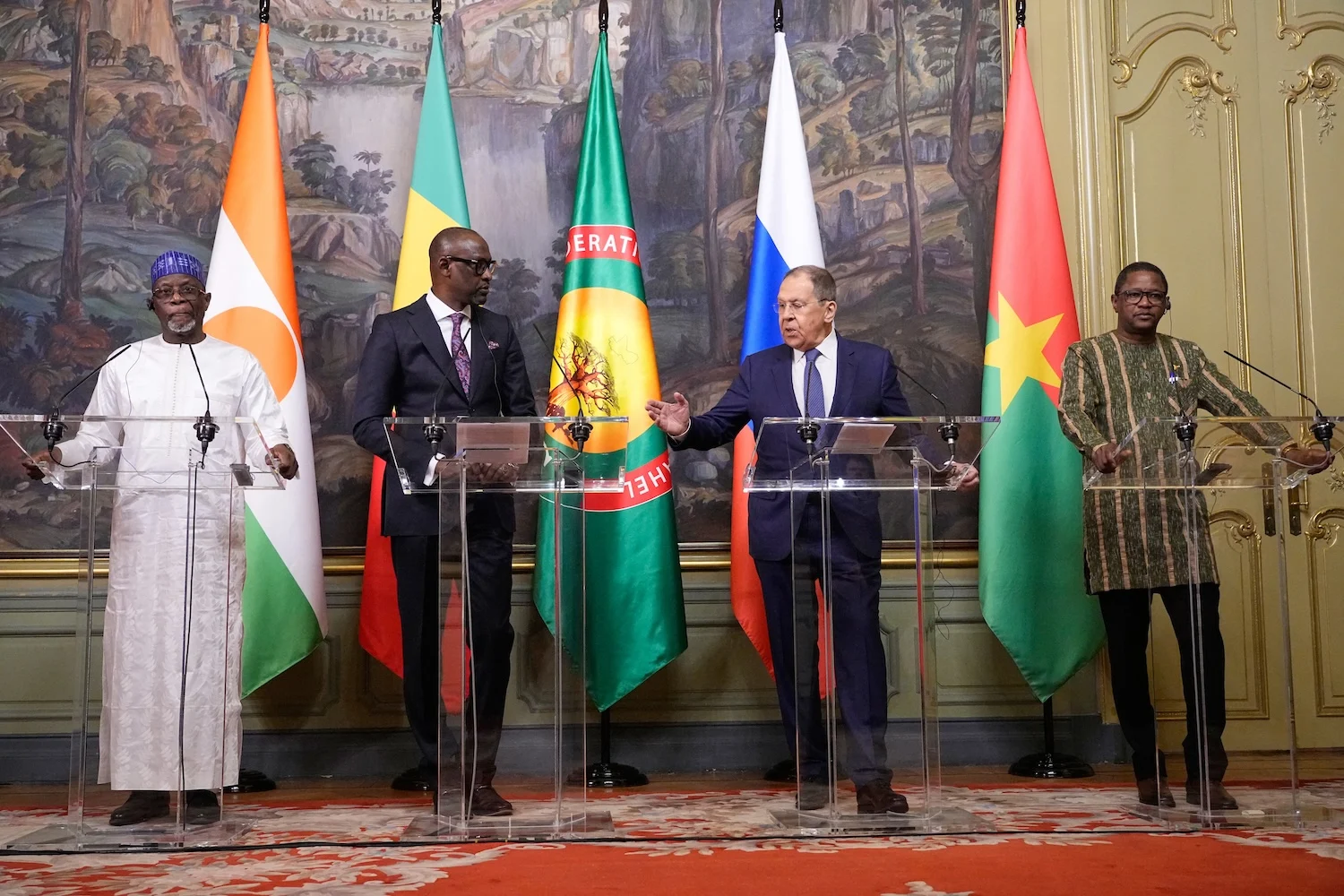
Western presence in the Sahel deteriorated rapidly between 2020 and 2023, when France and the United States lost most of their military bases after a wave of coups brought military juntas into power in Mali, Burkina Faso, and Niger. Riding a wave of popular resentment toward France’s overbearing role in its former colonies, the juntas revoked defense pacts with Western partners and switched allegiance to Russia. They also broke with the Economic Community of West African States and formed a rival regional bloc, the Alliance of Sahel States (AES).
Save for a few verbal proclamations, that latter bloc—which binds member states to come to each other’s aid in the event of an internal or external threat—was conspicuously missing in action on Aug. 29. This underscores a critical vulnerability for the Sahelian confederacy, which is, in essence, a collection of isolated and weak states tied together by their shared reliance on Moscow.
African dictators are more comfortable partnering with Russia than Western powers because Moscow lacks the colonial baggage of the West. Russia’s security partnership also eschews any preachment of respect for human rights and democracy—although it comes at the price of handing over critical mineral assets to Moscow.
This post-West Sahelian reality has exerted considerable pressure on U.S. policymakers who are anxious to reverse Washington’s waning influence in the region. At stake in this scramble for influence are the Sahel’s mineral reserves, including uranium, gold, and lithium. Washington considers access to these materials to be a national security priority to secure its technology supply chain and break an increasingly untenable reliance on China.
U.S. President Donald Trump’s administration has recalibrated its National Security Strategy in Africa by shifting from aid tied to democratic and human rights benchmarks to a more pragmatic, transactional approach focused on trade and investment. High-profile State Department officials have visited AES states to pledge Washington’s support for counterterrorism operations and health initiatives.
Under this new rapprochement, Burkina Faso and Niger benefited from Trump’s “America First” Global Health Strategy to the tune of $147 million and $128 million, respectively. In May, Niger received an additional $2.3 million worth of U.S. military equipment to support counterterrorism operations; the U.S. Treasury also lifted sanctions on senior Malian defense officials this year.
But Washington’s diplomatic overture pales in significance to Russia’s posturing in the region. After thwarting the Nigerien uprising and thus projecting Africa Corps as a guarantor of power in the Sahel, Moscow has put forward a value proposition that the United States and China will struggle to outbid. In a troubled landscape dotted by weak, unstable regimes whose real authority barely extends beyond their capital cities, a reliable foreign bayonet unrestrained by moral considerations is priceless.
Indeed, Niger’s failed mutiny may have placed enlisting the Africa Corps on the to-do-list of every African dictator. Last year, Togolese President Faure Gnassingbé, who has been in power since taking over his father’s 38-year rule in 2005, welcomed about 300 Africa Corps personnel to the country following a security cooperation deal with Russia. Togo is Moscow’s first foray in the Gulf of Guinea. It is not likely to be the last, as Russia, already eyeing neighboring Benin, seeks to expand its influence into the West African littoral states.
However, the Africa Corps remains embarrassingly inept at stemming the jihadi insurgency plaguing the region. Under its watch, the Sahel has remained the global epicenter of terrorism, with the AES borderlands accounting for more than half of all global terrorism-related deaths in 2024. In April, the Africa Corps was forced to retreat from the northern Mali stronghold of Kidal by a jihadi insurgent group and Tuareg rebels—an astonishing battlefield reversal that exposed the strategic weakness of a security model built around mercenaries as a substitute for a coherent national counterinsurgency strategy.
Further, aggressive military campaigns bolstered by brutal tactics have led to widespread civilian abuses, which have fostered resentment and could drive surges in extremist group recruitment.
This puts the Sahelian juntas in quite the fix. A swift end to extremist violence was the raison d’ être for their rule and the justification for the pivot to Russia in the first place. Failure to deliver on that promise makes the juntas vulnerable to increased internal threats. As their support bases gradually erode, all three juntas within the AES have intensified crackdowns on press freedoms while increasing arbitrary arrests of citizens and opposition figures.
Niger’s junta is particularly vulnerable. The other Sahelian juntas consist of lower-ranking military officers who rose to power by harnessing anger within the military and broader society against the status quo. The Nigerien junta, however, lacked any real support within the armed forces because Tchiani’s primary goal for seizing power in July 2023 was to protect his role as the head of the Presidential Guard, an elite military unit.
In this context, every insurgent attack further threatens the feeble loyalty of a national army whose rank is already deeply divided over Niger’s political direction. It was precisely this accumulated frustration, after all, that triggered last month’s failed coup: The mutineers were reportedly driven by anger over mounting casualties in the fight against jihadis, as well as perceived favoritism for members of Tchiani’s original Presidential Guard.
Now, the junta is diverting state resources and manpower from counterterrorism operations toward purging the army of surviving threats, which will undoubtedly exacerbate the deteriorating security situation that prompted the rebellion in the first place.
While the Africa Corps’ bailout may have bought the junta valuable time, the underlying structural drivers of the uprising remain unresolved. By relying on Russian bullets to crush the failed mutiny, the Nigerien junta has outsourced its survival and entered a classic dependency trap.
At the same time, the moment that Russia begins to be perceived as an occupying force could mark the start of the unraveling of its influence in the region. While foreign security aid is welcomed and loss of mineral assets tolerated, no one—not least in postcolonial West Africa—loves an army of occupation.
In this sense, while Russia’s strategy of regime protection has proved successful in expanding its footprint across the Sahel, it also contains the seed of its own exhaustion. As was the case with the failure of French-led counterterrorism operations, the failure of the Africa Corps to deliver any tangible security improvements could instigate a backlash against Russia. Western actors must be ready to take advantage.
For Washington, the insurrection in Niamey is both a warning and an opportunity. Maintaining pragmatic ties with authoritarian African governments may help the United States compete with Russia in the short term, but doing so carries a cost: namely, a region increasingly devastated by chaos and a constant stream of refugees onto European shores.
Moscow’s economic ties and investment in the Sahel remain marginal. Bogged down by its military misadventure in Ukraine, Russia has neither the commercial capital nor economic leverage to foster any real long-term regional development. By partnering with African governments through transparent trade and investment agreements focused on reciprocal growth, the United States has an opportunity to fill this economic vacuum and displace Russia’s influence.
Washington’s reframed African strategy is a good start. However, a responsible Sahel strategy must also reinforce human rights and press freedom while respecting African states’ sovereignty, including by restoring at least some humanitarian aid flows and withdrawing tariffs. To avoid stoking anti-colonial resentment, Washington must frame democracy promotion as key to stability, prosperity, and fighting the global war on terrorism—not as a moral imperative or requirement for qualification for vital aid and support.
Amid the growing jihadi insurgency, Washington must also commit to helping the juntas’ counterterrorism efforts via arms sales, intelligence, and training. The United States must also learn from previous missteps; counterterrorism through military operations alone has long failed the West. Through strategic dialogue aimed at fostering a political solution, the United States can distinguish itself as a pragmatic security partner interested in the region’s future, as opposed to Russia, which exploits the region’s instability to expand its short-term footprint.
The ultimate solution to the Sahel’s multifaceted crisis is the enthronement of stable, democratic governments that derive their mandate directly from the people, not puppet regimes propped up by foreign bayonets—whether of the Western or Russian variety. Russia’s Sahel strategy may have succeeded up to this point, but it’s only a matter of time before the Kremlin is forced to realize that underwriting fragile military dictatorships is an unsustainable strategy.
