


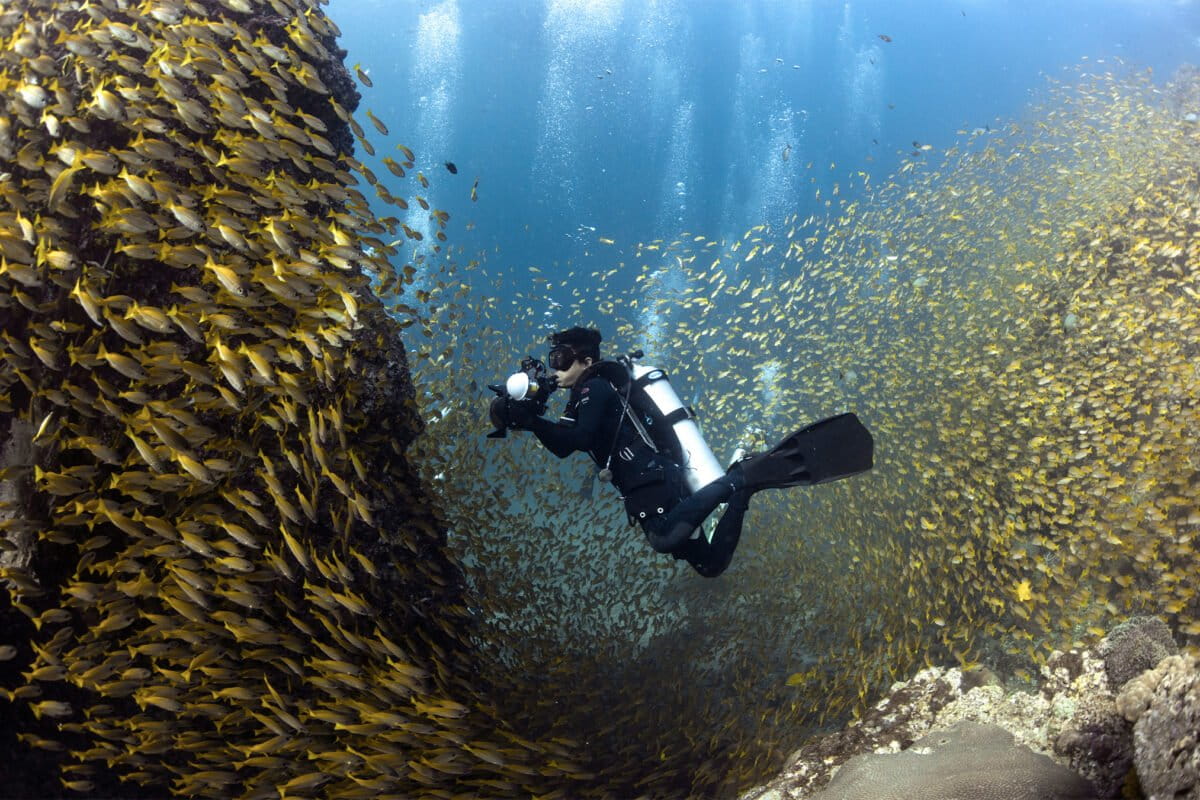
- Trained as a marine biologist, Thai photojournalist Sirachai “Shin” Arunrugstichai has taken photos that capture issues pertinent to marine conservation, from beached coral reefs to beaches polluted by oil spills.
- He co-authored a study on necrophilia in squids after photographing a squid engaging in the behavior while retrieving ghost fishing nets in Myanmar.
- While saying he is not a campaigner, Shin believes photography can help draw public attention to environmental issues and help initiate change.
- Shin spoke to Mongabay about his career journey, scientific study and photography work.
BANGKOK — Marine biologist and photojournalist Sirachai “Shin” Arunrugstichai has taken many notable photographs in Thailand, from white bleached coral reefs to beaches blackened by oil spills. He shot the viral, award-winning photo of orphan baby dugong (Dugong dugon) Marium being hugged by her carer.
Many of Shin’s works have ignited public awareness of marine conservation in Thailand. He recently took part in a scientific study on necrophilia behavior in squids, which was inspired by his photographs.
In an interview with Mongabay, Shin, 39, talks about his career journey, recent research and how his work can make a difference.
Mongabay: Can you tell me how the research about necrophilia behavior in squid began?
Sirachai Arunrugstichai: I was working at Mergui Archipelago in Myanmar from 2019 to 2020. We found ghost fishing nets wrapped around an entire reef. So, our team went diving to retrieve the net.
I caught a glimpse of what appeared to be two squids mating. I thought it was strange, so I swam closer. I found that one squid was trapped in the net while another was outside, mating with it.
I felt it was very unusual that a dying squid would still be mating. However, after I finished photographing them, I noticed that the trapped squid was actually already decaying. Its tentacles were completely severed, and there were visible signs that other animals had already fed on it. It had clearly been dead for quite some time.
This was necrophilic behavior, which has been observed in certain animal species. I had never seen something like this in squids before. So, I took photos and sent them to [marine zoologist] Jaruwat Nabhitabhata of Prince of Songkla University. He suggested that we turn this into a short research paper.
Mongabay: What were the key findings from the research?
Sirachai Arunrugstichai: First of all, the abandoned fishing net had a direct impact on local aquatic animals.
Second, we could not yet determine the exact cause behind this necrophilic behavior. In the paper, we only used two case studies: The case I encountered in the wild and the case Associate Professor Jaruwat observed in captivity.
Nevertheless, we believe this helps us gain a better understanding of squids’ reproductive behavior, specifically how they select their mating partners. To mate, animals rely on signals rather than acting blindly. The deceased squid might fail to send signals that the living male squid could interpret correctly, leading it to initiate mating. This topic is particularly intriguing because no one had ever studied it before.


Mongabay: What sparked your interest in marine research?
Sirachai Arunrugstichai: When I was young, I loved reading books about fish, marine animals, and watching a lot of documentaries.
However, my actual journey in this field started during my bachelor’s degree. Initially, I studied biomedical science. But after taking courses related to the environment and having opportunities to work in the field, I loved it. So I switched.
I started diving during high school in New Zealand, but back then, it was more about diving for food and fishing to eat. However, when I went diving in Thailand, I was stunned by the beauty of the undersea world here.
Mongabay: How did you become interested in conservation work?
Sirachai Arunrugstichai: At first, I did not intend to work in conservation. I just wanted to do field work or scientific research. I started working with local communities on Koh Tao, joining coral reef conservation efforts and building artificial reefs during school breaks. I stayed and slept at dive shops, working alongside friends there.
In my fifth year, I did my thesis on coral reefs and stayed on Koh Tao for another year to collect data on coral restoration techniques using electrical currents. Every two weeks, I would dive to install instruments measuring coral photosynthetic activity.
After graduating, I wrote a proposal to apply for a social enterprise project grant to continue working on Koh Tao with my friends. We carried out a project to raise awareness about coral reef conservation among tourists.
I received a scholarship to pursue a master’s degree at Prince of Songkla University in Hat Yai, researching sharks. It led to an internship in Australia, where I learned to shoot photos and collect data on sharks. National Geographic Thailand took interest in my work and published my very first feature.

Mongabay: As a photojournalist, how do you think your media work supports and enhances your conservation efforts?
Sirachai Arunrugstichai: I know how to tell stories, I know the data, and I understand the narrative, but I do not position myself as a campaigner.
Photography alone cannot accomplish everything. A single photograph cannot change policy or solve an environmental crisis. However, it can make viewers interested, curious, and eager to learn more or care about something they never cared about before. Some of these individuals might be in positions where they can create actual change.
My role is to direct the right message to the target groups capable of making a difference. If we want to communicate with the general public, we present it one way. If we want to reach policymakers, we serve them another way. It is not just about taking photos.
Mongabay: How have you seen the impact generated by your work?
Sirachai Arunrugstichai: I have seen changes at the policy level. For example, the photos of Marium the dugong led to the establishment of marine protected areas in Trang Province. This was driven by public interest rather than a single photograph.
However, some efforts were still unsuccessful. While establishing protected areas and implementing the National Dugong Conservation Plan had positive outcomes, I am not sure if they had a tangible, lasting impact. The concurrent effort to push for a policy banning single-use plastics fell short.
In fact, three years after Marium died, I returned to the area and found that management issues had not significantly improved. Today, Thai dugongs are disappearing due to oceanographic conditions and climate change, causing seagrass beds to die off.

Mongabay: What changes have you observed in Thai seas?
Sirachai Arunrugstichai: I feel that the Thai seas have actually improved. Everyone who dives in Thailand agrees that the seas were at their worst around 2010 during the massive coral bleaching event. By 2017, Thailand elevated its management of marine protected areas.
The most impactful factor was the enforcement of IUU [illegal, unreported, and unregulated] fishing laws. After that, fish populations recovered. While these certainly [negatively] impact fishers and we empathize with them, we must admit that our fishing activities were extremely exploitative.
However, threats still remain, as we are currently facing El Niño, and I am worried about whether the corals will survive.
Looking at the future, I hope the government will strictly manage commercial fisheries. We need to revolutionize the commercial fishing industry so that it truly aligns with the recovery of marine resources. There are many issues the government needs to manage much better.
Banner image: Sirachai Arunrugstichai takes a photo of a school of bigeye snappers at Hat Noppharat Thara – Mu Koh Phi Phi National Park, a marine park in Krabi province, Thailand, in 2018. Image courtesy of Tanakit Suwanyangyuan.
Citation:
Nabhitabhata, J., Arunrugstichai, S., Hongjamrassilp, W., Tuanapaya, S., Tongtherm, K., … Hwai, A. T. S. (2026). Necrophilia in Benthic Decapodiformid Cephalopods. Venus (Journal of the Malacological Society of Japan), 84(1-4), 75-80. doi:10.18941/venus.84.1-4_75
Thai island community rallies to protect beloved dugongs, revive declining seagrass
Coast-to-coast coral assessment reveals Thailand’s reefs losing complexity
Cite this article
Pratch Rujivanarom (2026). Shedding light on the sea: Interview with Thai photographer Sirachai Arunrugstichai. Mongabay Conservation news. DOI: https://doi.org/10.66709/news-332379

