


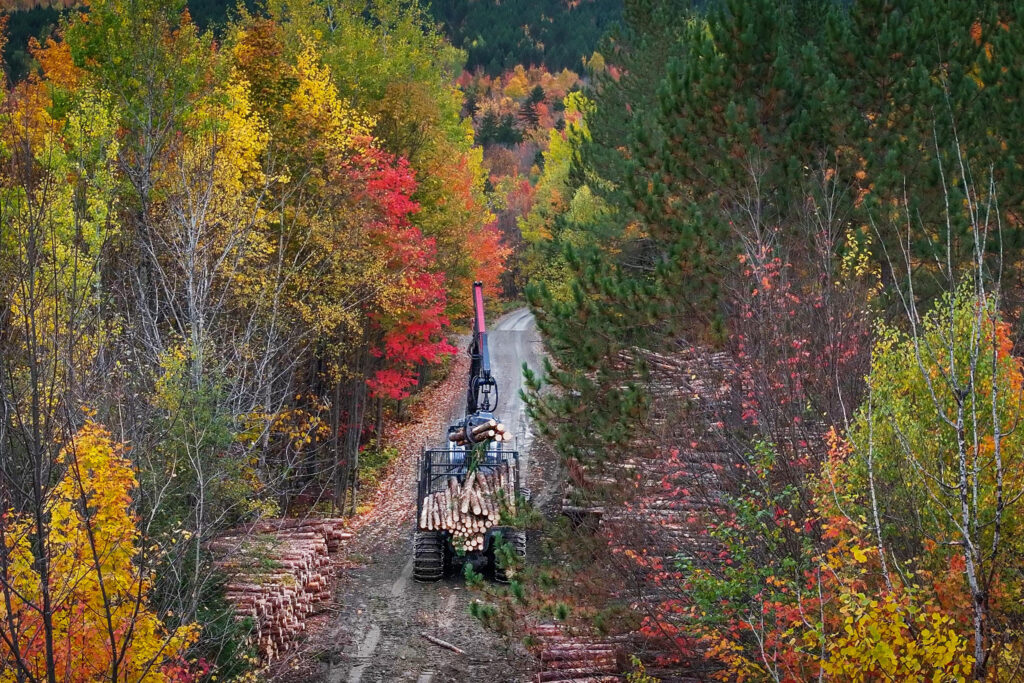
As the most heavily forested state in the country, about 94 percent of Maine’s forests are privately owned, so focusing on their carbon benefits has both immediate ecological and economic effects.
By creating specific programs and collaborations, the state has been strategic in using its resources to reach its climate goals and has made thoughtful partnerships for years ahead. The story of Maine demonstrates how individuals can collectively make a greater impact and how international alliances can contribute toward global stewardship.
In a four-year climate action plan called “Maine Won’t Wait,” the state sets out four pillars to focus on: drastically reducing greenhouse emissions, strengthening resiliency by adaptation, protecting jobs at risk from climate change and creating clean energy jobs and supporting all of Maine’s residents, even in rural communities.
On the economic side, Maine’s Forest Products Council reported that in 2024 the state’s timber industry produced $8.3 billion for Maine’s economy, representing 3.45 percent of the state’s GDP. Maine’s paper and timber industry also accounted for 29,000 jobs across 16 counties.
But Maine’s 18 million acres of forests also protect the watershed, soil and biodiversity as the largest unfragmented tract across the eastern United States, essential for species migration.
One thing is certain: Maine’s forests are indispensable. In 2021, the state created the Forest Carbon Task Force and implemented a range of programs and legislation to support Maine’s forests and build climate resiliency. Now, as reporting deadlines are approaching, the state can see exactly how successful these conservation efforts have been.
In March, the Maine Forest Service introduced the WoodsWISE Resilience Program, which supports private woodland owners and encourages climate-focused stewardship. The program, which works alongside an existing program called the WoodsWISE Incentives Program, is now funded by two grants totaling $9 million from the Inflation Reduction Act and the U.S. Forest Service Landowner Support Program. One grant requires documentation of pre- and post-treatment inventory and carbon modeling.
Nicole Rogers, formerly the Maine Forest Service landowner outreach forester, said that through the WoodsWise program, landowners can apply for eight approved practices that have climate or carbon benefits. To participate, woodland owners need 10 to 1,000 acres of forest and must agree to work with a practice plan focused on the area of practice implementation that meets their forest’s specific needs for 10 years.
“Our program is a tool for landowners wanting to take action in their own forest,” Rogers said in an email. “By offering financial incentives, landowners have the opportunity to do thoughtful silviculture with a reduced financial burden.”
According to Rogers, since March, more than 150 landowners have participated in the WoodsWISE Resilience Program. Through this program, a trained consulting forester works with each landowner on a plan specific to their forest’s needs so they can gain support while navigating the changes from climate change.
The program focuses on good stewardship, which can mean many things, depending on the forest. It can range from invasive species removal and thinning an overcrowded, young forest; to removing specific trees to encourage regeneration, or removing trees that carry disease or fungus.
“These practices can be costly for a private landowner, so the program aims to reimburse 60 to 90 percent of the financial burden for landowners based on their underserved status by creating an indiviudalized plan the woodland owner agrees to follow for the next 10 years. This could result in up to $20,000 per participant and another program is set to open later this year with a higher landowner cap. With programs like these, the state of Maine could see a collective benefit.”
By purposefully using landowners’ forests, Maine has an advantage in reaching carbon neutrality. According to research by the University of Maine, the state’s forests offset at least 60 percent of overall greenhouse emissions annually. Philip Bartlett II, the former chair of the Maine Public Utilities Commission, said that electricity generation in Maine is already fairly clean, with a mix of renewables in use throughout the state.
Bartlett said it’s important to look long-term when meeting climate goals, and agrees that good forest management practices are key for Maine. He said that, to his knowledge, no fast clear-cutting is being done, and forests are managed for growth and harvesting, creating opportunities for carbon sequestration.
The challenge, he said, is the state’s vastness, which makes residents rely on fuel for transportation and oil to heat their homes. Bartlett said recent international dynamics have emphasized the need for a diversified portfolio of renewable resources to stabilize electricity prices.
“I think what we’re seeing now is that reliance on fossil fuels is really what is driving a ton of volatility and really high prices during certain parts of the year. So the only way you’re going to tackle that is to figure out how to diversify that portfolio,” he said.
Catherine Wolfram, a professor of energy economics at the Massachusetts Institute of Technology’s Sloan School of Management, said Maine’s implementation of carbon markets aligns with how Europe and other countries are operating.
She said that while compliance markets run by governments in which polluters are essentially taxed for carbon emissions are “extremely robust and extremely effective,” much of the criticism of carbon markets comes from the voluntary markets where companies buy and sell carbon offsets without formal monitoring, with corruption and manipulation sometimes a factor.
While Wolfram said these potential problems are solvable, she said the issue of large areas of forests being used as carbon sinks is more complex when businesses are also dependent on the area for timber.
“Even if Maine protected all of its forest, then maybe the timber companies will just go to Vermont, and then what have you done? You’ve just displaced where they do their forestry, and you haven’t preserved a carbon sink; you’ve just rearranged things,” said Wolfram.
She said ideas such as global governance of what counts could solve issues like this, and that ultimately clean energy can insulate consumers from the market instability of fossil fuel markets.
“With climate change, it’s a global problem,” said Wolfram, “so what really matters is how what we do in the United States translates to what other countries are doing. China is 30 percent of global emissions, and they’ve made a lot of progress, thankfully, but I think we need to keep things in proportion.”
This story is funded by readers like you.
Our nonprofit newsroom provides award-winning climate coverage free of charge and advertising. We rely on donations from readers like you to keep going. Please donate now to support our work.
Maintaining a global perspective is exactly what Maine is doing. In 2019, Maine began a formal collaboration with Finland, encouraging an interchange of sustainable stewardship strategies to build strong bioeconomies. After years of working together informally, Gov. Janet Mills signed the partnership at the 2019 Arctic Circle Conference in Reykjavik.
Dan Berger, director of the Maine North Atlantic Development Office for the Maine International Trade Center, said that since the two regions share a similar profile in which heavily forested lands are economic cornerstones, this “peer exchange” makes sense.
Finland, known for a bioeconomy that makes up 16 percent of its GDP, has focused specifically on the role its forests play. Maine also has research initiatives, including a $20 million award from the U.S. Economic Development Administration to the University of Maine’s Tech Hub to support converting low-value wood into everyday necessities such as fuel and packing materials.
Berger said this focus on Maine’s bioeconomy can “strengthen domestic manufacturing and supply chains, and displace conventional, carbon-intensive materials and fuels.” He said three areas of particular interest are where Maine’s forests can make a sustainable impact on the local economy.
First is construction, replacing petroleum-based materials with lower-carbon alternatives such as mass timber and wood-fiber insulation; second, replacing conventional plastic packing materials with nontoxic ones, such as cellulose nanofiber, which has been developed at the University of Maine. Companies like Poland Spring Bottling Company are already considering biobased packing alternatives. Thirdly, Berger points to replacing fossil fuels used to heat homes in the winter months with low-value wood that is already a byproduct of Maine’s timber companies.
“We measure success in concrete terms,” said Berger in an email. “Investments attracted, jobs created, companies launched or scaled, and Maine businesses reaching new markets, all in a way that is sustainable, science-based, and advances Maine’s economic and climate goals alike.”
Claire Hawkins, director of natural resource markets and economic development for the Maine Department of Agriculture, Conservation and Forestry, agrees that a strong bioeconomy balances thoughtful stewardship with a local, sustainable economy.
Because Finland has a globally renowned, robust bioeconomy that supports innovation, the alliance has provided valuable insights into Maine’s current practices and helps anticipate long-term results. “For every facet of Maine forestry, there’s an equal or a parallel example in Finland,” said Hawkins. “One of the benefits of working with the Finns is that they’ve been doing it longer; they’re an older country, so their bioeconomy is a little bit further down the road in terms of its evolution than ours.”
This summer, about 100 delegates came to Maine. They included Finnish government officials, researchers and forest and conservation workers.
In describing the Maine-Finland collaboration, she said, “We have a lot in common, but Maine and Finland are still their own creatures, so it’s less of the copy and paste and more of the, ‘You have a problem with this pest, we had a problem with this pest. This is the way we dealt with it.’”
Hawkins said that research and development, the commercialization of forest products, forest and exchange policy, and encouraging continuity in the forestry workforce are other topics the two partners frequently discuss.
“Circular economics is something we hear a lot about in the context of bioeconomy, but if not circular, then certainly sustainable, right?” Hawkins said. “So, I think it’s recognition that there has to be a more holistic approach to managing and propelling these natural resource-based economies, but I also think they’re sort of a future-oriented bend to the definition too … the definition of bioeconomy is evolving.”
Maine has taken both an introspective and extrospective approach in thinking about the role its forests play in climate change. By recognizing the connection of sustainability and economics both the individual and world community are considered and asked to take part in effecting change.
About This Story
Perhaps you noticed: This story, like all the news we publish, is free to read. That’s because Inside Climate News is a 501c3 nonprofit organization. We do not charge a subscription fee, lock our news behind a paywall, or clutter our website with ads. We make our news on climate and the environment freely available to you and anyone who wants it.
That’s not all. We also share our news for free with scores of other media organizations around the country. Many of them can’t afford to do environmental journalism of their own. We’ve built bureaus from coast to coast to report local stories, collaborate with local newsrooms and co-publish articles so that this vital work is shared as widely as possible.
Two of us launched ICN in 2007. Six years later we earned a Pulitzer Prize for National Reporting, and now we run the oldest and largest dedicated climate newsroom in the nation. We tell the story in all its complexity. We hold polluters accountable. We expose environmental injustice. We debunk misinformation. We scrutinize solutions and inspire action.
Donations from readers like you fund every aspect of what we do. If you don’t already, will you support our ongoing work, our reporting on the biggest crisis facing our planet, and help us reach even more readers in more places?
Please take a moment to make a tax-deductible donation. Every one of them makes a difference.
Thank you,
