


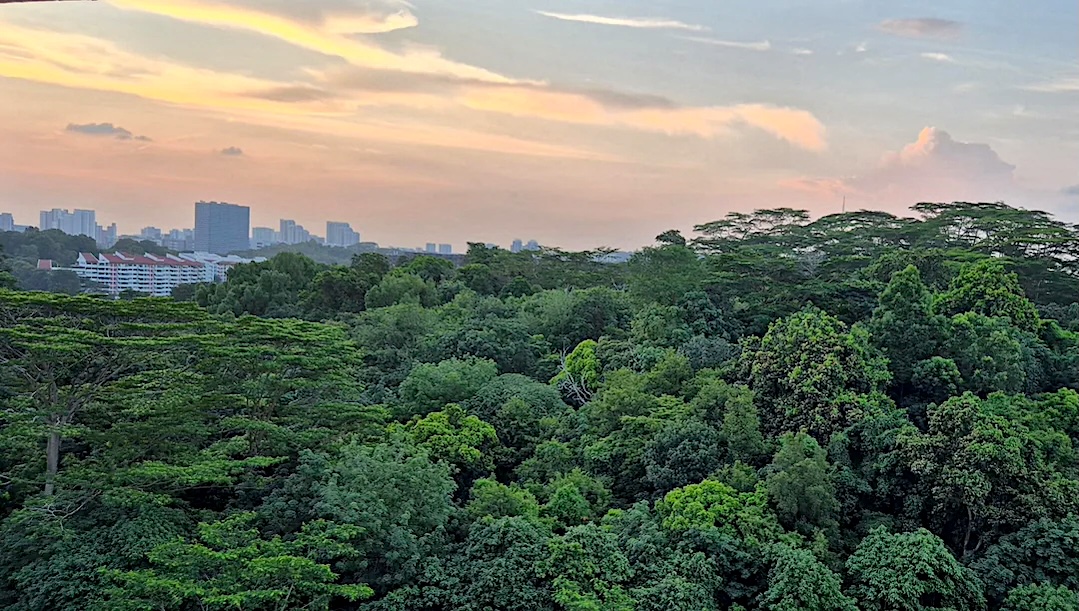
- A 23-hectare (57-acre) forest in the Singaporean neighborhood of Clementi that provides stress relief and community enjoyment for residents plus habitat for urban biodiversity has been proposed for development, sparking a public debate.
- Although Singapore has earned recognition for integrating nature into this, one of the world’s most densely populated urban environments, the proposal would convert most of it into public housing.
- A new op-ed argues that urban forests are essential public health infrastructure and that this debate reflects a challenge that cities increasingly face: how should we value mature ecosystems in an era of climate change, urbanization and rising health challenges?
- This article is a commentary. The views expressed are those of the author, not necessarily of Mongabay.
Every city faces difficult choices about how to use its land. As populations grow, governments must provide homes, transport and other essential infrastructure while protecting the natural ecosystems that make cities liveable. These decisions are often framed as a trade-off between development and conservation, with forests viewed primarily as reservoirs of biodiversity or stores of carbon.
What if we have been overlooking one of their most important contributions?
As climate change intensifies, urban heat worsens and chronic diseases associated with sedentary, high-stress lifestyles continue to rise, a growing body of research suggests forests are far more than wildlife habitat. They are living public infrastructure that helps keep people physically healthy, mentally resilient and socially connected. Mature forests cool neighborhoods, encourage physical activity, provide opportunities for stress relief, strengthen community cohesion and support biodiversity, which is fundamental to many of these benefits.
This perspective is particularly relevant in Singapore. The city-state has earned global recognition for integrating nature into one of the world’s most densely populated urban environments. Yet many of its remaining forests – including the 23-hectare (57-acre) Maju Forest in Clementi – are increasingly under pressure from development. Current plans would retain about one-third of the forest and convert approximately 15 hectares (37 acres) into public housing.
Singapore undoubtedly needs more homes, but the debate over Maju Forest raises a broader question that cities around the world will increasingly face: How should we value forests in an era of climate change, urbanization and rising health challenges?
If we assess forests only by the land they occupy or the species they contain, we risk overlooking the everyday benefits they provide to millions of urban residents. The question is no longer whether cities need nature, but whether we fully understand the value of the nature we already have.
Forests as public health systems
When people think about forests, they often think about wildlife. But forests also support our health. Increasingly, research shows that biodiverse natural ecosystems function as preventive public health infrastructure. As my research with colleagues has revealed, they encourage physical activity, reduce exposure to heat, decrease symptoms of depression, anxiety and stress and strengthen social cohesion.
Singapore illustrates both the challenge and the opportunity. Although the city is celebrated as a “City in Nature”, increasingly urban lifestyles mean many daily experiences of nature have become limited. In a comparison between Singapore and Brisbane, my team found that Singapore residents spent only about half as much time interacting with nature each week, with most interactions occurring indirectly: through a window rather than in forests or parks.
Yet urbanization does not inevitably lead to an “extinction of experience”. In Clementi, home to Maju Forest, we found that residents’ connection with nature had actually strengthened over two decades. Bird diversity had also increased, suggesting that maintaining biodiverse habitats within cities can help sustain meaningful relationships between people and the natural world.
These relationships matter because they influence health. Our research in Singapore found that people with a stronger connection to nature consistently reported lower levels of depression, stress and anxiety. We also found that people who frequently visited gardens reported stronger neighborhood trust, social cohesion and sense of community.

This lowers the risk of developing mental health conditions in the long-term. Nature is therefore not only a place for recreation, but also provides nature-based settings where more communities can stay connected and enjoy good health for a longer time.
The benefits extend beyond mental and social well-being. Forests and other green spaces provide opportunities for everyday movement that support healthier lifestyles. Specifically, different types of natural environments encourage different forms of physical activity, from walking to team sports. In a country facing rising rates of chronic ailments such as diabetes and cardiovascular disease, these nature spaces need to be viewed as part of a broader preventive public health strategy.
None of this suggests that forests should never be developed, but it does suggest that forests should no longer be regarded simply as reservoirs of biodiversity. They are living infrastructure that supports healthier, more resilient populations. Once we recognize forests as part of the public health system, the question is no longer whether they have value; it is whether we have been valuing them enough.
Not all green spaces are equal and not all forests can be replaced
As cities expand, the response to forest loss is often reassuring: New trees will be planted and parks will be created. While these measures are important, they can create a misleading impression that all green spaces deliver the same benefits — they do not.
A newly planted park and a 40-year-old regenerating forest may both appear green, yet they differ profoundly in their ecological complexity and the services they provide. Mature forests have developed over decades, accumulating diverse vegetation, soils, fungi and wildlife that interact to regulate local climates, support biodiversity and create rich opportunities for people to experience nature. These are not qualities that can be recreated overnight.
One of the clearest examples is heat. As Singapore experiences rising temperatures and a stronger urban heat island effect, extreme heat becomes an increasingly important public health challenge. Mature forests are remarkably effective at cooling the environment. Research I also helped conduct shows forests can substantially reduce human heat stress during hot weather, with the greatest cooling provided by tall, structurally complex forests. While newly planted trees also provide shade, many of the cooling benefits associated with mature forests take decades to develop.

A different way of valuing cities
As cities grow denser and the climate becomes hotter and more unpredictable, the question is no longer whether we need nature, but what kind of nature we choose to keep. Mature forests are not simply collections of trees or refuges for wildlife; they are living infrastructure that cools neighborhoods, supports biodiversity, encourages physical activity, fosters psychological restoration, strengthens social connections and builds resilience to a changing climate.
It is essential to recognize the full value of mature forests relative to urban development. Too often, planning decisions account for the costs of conservation while overlooking the health, social and climate benefits that forests quietly provide every day.
The debate surrounding Maju Forest is, therefore, about more than a single patch of woodland. It reflects a challenge that cities around the world increasingly face: How should we value mature ecosystems in an era of climate change, urbanization and rising health challenges? If forests are recognized not simply as biodiversity reserves but as essential public health infrastructure, the way we plan our cities and the choices we make may look very different.
A newly planted park is an investment in the future. A mature forest is an inheritance from the past and borrowed from our children. One can eventually become the other, but only if we are willing to wait decades.
In a hotter, denser and more uncertain future, that is a decision we can no longer afford to take.
Rachel R. Y. Oh is an assistant professor at the National University of Singapore and works at the intersection of biodiversity conservation and human health.
Banner image: Sunset over the 23-hectare Maju Forest in Singapore, most of which is being proposed for conversion to public housing. Image courtesy of Reddit user kcinc82.
See related coverage:
Singapore’s population of Raffles’ banded langur has doubled
Reforestation and wild pig decline spark surge in miniature deer in Singapore
Citations:
Gillerot, L., Landuyt, D., Oh, R., Chow, W., Haluza, D., Ponette, Q., … Verheyen, K. (2022). Forest structure and composition alleviate human thermal stress. Global Change Biology, 28(24), 7340-7352. doi:10.1111/gcb.16419
Oh, R. R., Fielding, K. S., Carrasco, R. L., & Fuller, R. A. (2020). No evidence of an extinction of experience or emotional disconnect from nature in urban Singapore. People and Nature, 2(4), 1196-1209. doi:10.1002/pan3.10148
Oh, R. R., Fielding, K. S., Chang, C., Nghiem, L. T., Tan, C. L., Quazi, S. A., … Fuller, R. A. (2021). Health and wellbeing benefits from nature experiences in tropical settings depend on strength of connection to nature. International Journal of Environmental Research and Public Health, 18(19), 10149. doi:10.3390/ijerph181910149
Oh, R. Y., Fielding, K. S., Nghiem, T. P., Chang, C., Shanahan, D. F., Gaston, K. J., … Fuller, R. A. (2021). Factors influencing nature interactions vary between cities and types of nature interactions. People and Nature, 3(2), 405-417. doi:10.1002/pan3.10181
Oh, R. R., Zhang, Y., Nghiem, L. T., Chang, C., Tan, C. L., Quazi, S. A., … Carrasco, R. L. (2022). Connection to nature and time spent in gardens predicts social cohesion. Urban Forestry & Urban Greening, 74, 127655. doi:10.1016/j.ufug.2022.127655
Tan, C. L., Chang, C., Nghiem, L. T., Zhang, Y., Oh, R. R., Shanahan, D. F., … Carrasco, L. R. (2021). The right mix: Residential urban green-blue space combinations are correlated with physical exercise in a tropical city-state. Urban Forestry & Urban Greening, 57, 126947. doi:10.1016/j.ufug.2020.126947

