


- Indigenous communities in Malaysia’s Upper Baram Forest Area say a planned conservation area is being eroded by the existence of an active timber concession within the forest area.
- A new report by civil society groups questions the legality of how the concession was granted, and presents evidence of ongoing logging of primary forest.
- The Sarawak forest department says the Upper Baram Forest Area was intended from its outset to allow areas for both conservation and timber harvesting, and that the concession was granted legally.
A conservation park that Indigenous communities from the Malaysian state of Sarawak believed they could co-manage and self-govern has been transformed into a timber concession and stripped of critical tree cover, according to a recently published report.
A group of civil society organizations based in Malaysia and abroad launched the report, “Plundering the Baram Peace Park,” with a press conference in Kuala Lumpur on Aug. 27, calling on other NGOs and the Malaysian government to recognize the logging of primary forest as well as alleged irregularities in the process of granting the concession and informing affected communities.
The report, led by Swiss-based nonprofit Bruno Manser Fonds with participation from other NGOs, also raises concern that the International Tropical Timber Organization (ITTO), an international organization that aims to promote sustainable use of forests, has continued funding projects in the region, even after the 2024 collapse of a coalition between Indigenous community members, the Sarawak government, and civil society.
A fragile coalition
The Upper Baram Forest Area was initially proposed as a community-led conservation project, an idea going back more than 15 years. From 2009 to 2024, the area was proposed to be conserved as the Baram Peace Park, with Indigenous villages and the Sarawak forest department working together to protect the forest.
The project gained steam in 2021 after the forest department submitted a project proposal to the ITTO and raised a total of $1.4 million to develop a park program in cooperation with 32 Indigenous Penan, Kenyah, Kelabit, and Saban villages across 283,500 hectares (about 700,500 acres). But Indigenous residents and NGOs started raising alarms after a 170,000-hectare (420,000-acre) timber concession was granted to a company called Borneoland Timber Resources Sdn. Bhd. in 2024.
The concession overlaps with what conservationists consider to be key environmental and cultural sites within the Baram Peace Park project. When news of the plans went public, key funders left the project, including Bruno Manser Fonds and the Swiss city of Basel, where the NGO is based. The Sarawak forest department eventually decided to withdraw the larger Baram Peace Park project, and the ITTO instead continued another community-focused project in the region with a smaller budget.
Hamden Mohammad, the forest department director, told Mongabay by email that Bruno Manser Fonds had a “misunderstanding — or misrepresentation — of the project’s original concept and objectives.” The project, Mohammad said, was intended from its outset to be an “integrated landscape management area” rather than a fully protected area, meaning it could include some park elements, community use areas, and also a timber license.
He also questioned whether the Swiss NGO was representing most Indigenous communities’ opinions on what’s happening in the Upper Baram area — echoing a statement by the forest department in 2024 when it cancelled the Baram Peace Park project in response to criticism from Bruno Manser Fonds and other NGOs.
“The issue with BMF and its associates is their unwillingness to accept that they could not secure broad-based support from most communities in Upper Baram for their proposed approach,” Mohammad wrote. “Equally, they have failed to acknowledge that the termination of the UBFA project was ultimately a consequence of their own actions and their inability to work constructively towards a mutually acceptable solution with the Government and other stakeholders.”
However, Komeok Joe, the CEO and founder of Penan Indigenous rights organization Keruan, disputed this, adding that Indigenous residents of the Upper Baram Forest Area were increasingly paying attention to threats to their land and forests, including logging company Borneoland.
“Now we have a network” of Indigenous communities engaged in environmental issues and land rights in Sarawak, Joe said. “Every day everyone is sharing. When something happens they share very fast.”
The report from Bruno Manser Fonds compiles data from communities, satellite imagery, and other sources to show evidence of continued logging around the Borneoland concession.
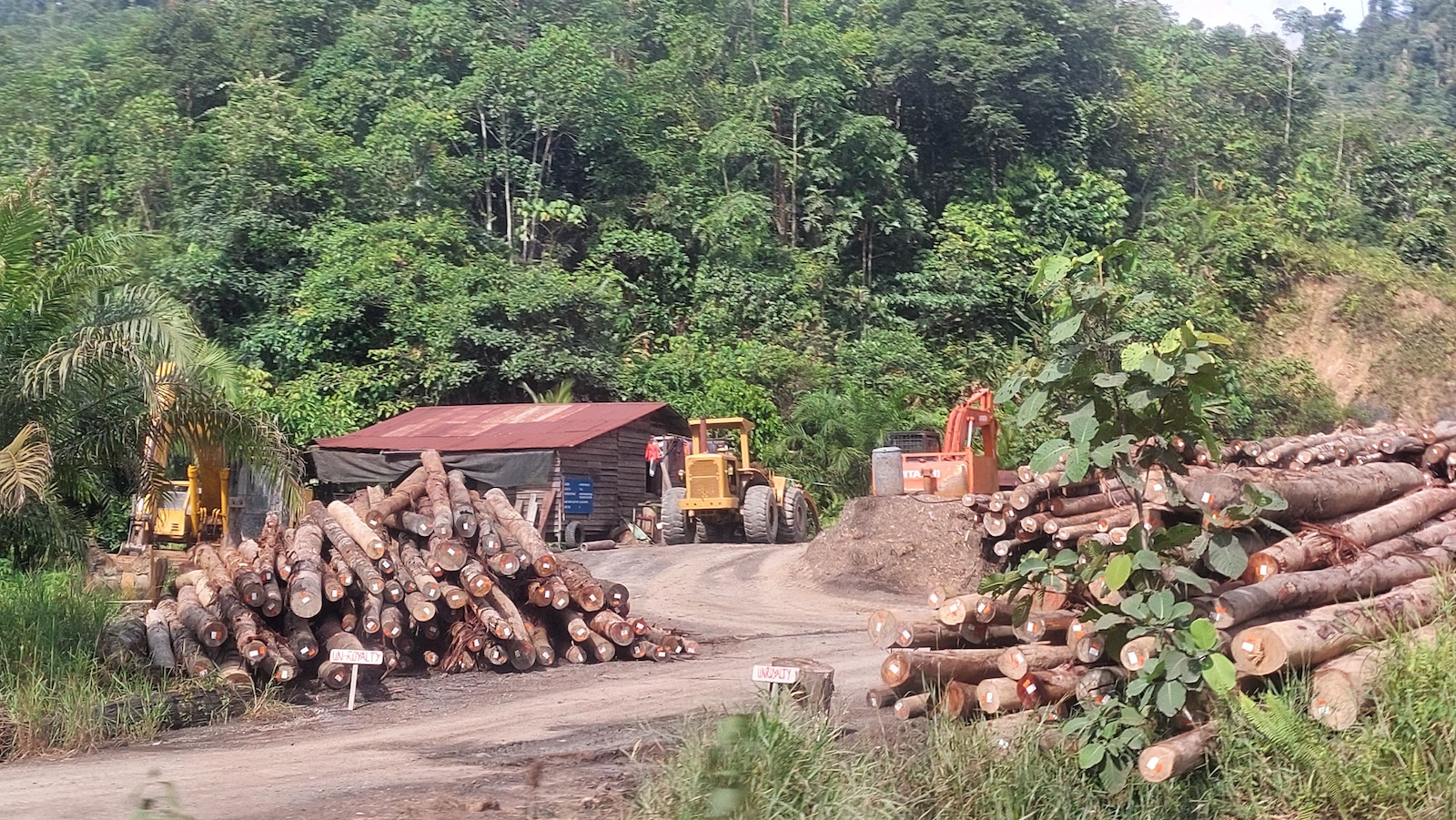
Community observers tallied more than 160 logging trucks exiting the forest monthly between March and May 2025, a fleet the report estimates could haul 10.5 million ringgit ($2.6 million) worth of wood per month.
Observers also detected extensive logging at a 1,626-meter (5,335-foot) mountain peak called Gunung Murud Kecil, a landmark for its view as well as its role in Penan heritage stories. Via satellite imagery and community testimonies, the report documents an increase in logging paths into the core primary forest of the Baram Peace Park area, threatening protected species including helmeted hornbills (Rhinoplax vigil), sun bears (Helarctos malayanus), and Sunda clouded leopard (Neofelis diardi).

Though much of the evidence in the report is from 2024 and 2025, Joe said the logging by Borneoland is ongoing, expanding from Ba Data Bila, a village where logging began, into other nearby villages including Ba Sebateu, Ba Ole, and Sawa Ali.
“If the logging doesn’t stop this year, the forest might be finished in those two areas,” he said.
Joe said he hasn’t lost hope, however, as the case has become a “big concern for the communities” around the village. He said other Indigenous residents of the Upper Baram Forest Area appear to be uniting over the loss of forest, saying residents feel fearful over the project’s future.
“They promised to build roads and a longhouse” for Ba Data Bila village, he said. “But until today there’s no good road, it’s worse than before.”

Ongoing projects
Though Bruno Manser Fonds and the city of Basel withdrew their financial support for the Baram Peace Park project after learning of Borneoland’s activity nearby, the government of Japan still has about $139,000 invested in the project, and Sarawak state another $150,000, according to the ITTO.
Joe said he’s aware of ITTO documentation on its website and meetings with two communities early in the project scope, but said he isn’t sure what the remaining project is doing. For this reason, he called the ITTO project “suspicious” because of the lack of disclosures this year. According to the disclosures currently online from the ITTO, the project team compiled a list of requested infrastructure improvements from representatives of 16 villages in the project area in early 2025 and conducted mapping with two communities in late 2025.
“There is a lot of money [for this project] by the Forest Department Sarawak and ITTO, but we don’t know how they spend it, and where is the project in those two communities,” Joe said.
Borneoland Timber Resources has no publicly available contact information. When asked how civil society groups seek comment from the company, Celine Lim, managing director of Sarawak-based NGO SAVE Rivers, said they hand-deliver letters to an office in the city of Miri.
The report noted that 60% of Borneoland Timber Resources is owned by Hii King Chiong, a Malaysian national who has run for office in Sarawak under the Sarawak United People’s Party. Hii also serves as an adviser to the Sarawak Chinese Association, and traveled with the Sarawak premier in a delegation to China’s Yunnan province in October 2025.
Mongabay attempted to contact Hii via a website listed under his name discussing his previous roles in Miri. A website for Borneoland Timber Resources could not be found; nor were records for the T/9246 concession, the site within the Baram forest, available on the Sarawak forest department website.
When asked for a copy of the T/9246 concession area, Mohammad from the forest department told Mongabay that they could not disclose details about the concession without consent from the concession holder.
A case of national importance
According to the Bruno Manser Fonds report, several residents alleged that Borneoland loggers had violated native customary rights in the area, by disturbing the land and cutting down fruit trees that Penan and Kenyah people had cultivated over generations.
Joe said that residents of Long Siut village had held blockades as recently as the end of August, ahead of the report launch, demanding Borneoland stay off their land.
The report also notes that many community members have tried to engage with Borneoland or the local government in multiple ways, largely without success.
Notably, in early 2025, Indigenous residents filed a request for legal review of the decision by Sarawak state to grant the concession to Borneoland. While the forest department provided documentation, the company did not produce the requested information, and the High Court of Sabah and Sarawak subsequently dismissed the case a year later.
Mohammad said the court’s decision to dismiss the case was an indication there were no irregularities with the timber concession.
“Accordingly, assertions that the concession was improperly granted solely because it was not subject to a public tender process are not supported by the relevant legal requirements or the Court’s findings,” he said.
At the same time, he acknowledged the blockades were a sign that Indigenous communities were frustrated with the concession, but he also said that feelings about Borneoland were not “uniform” among residents of Upper Baram.
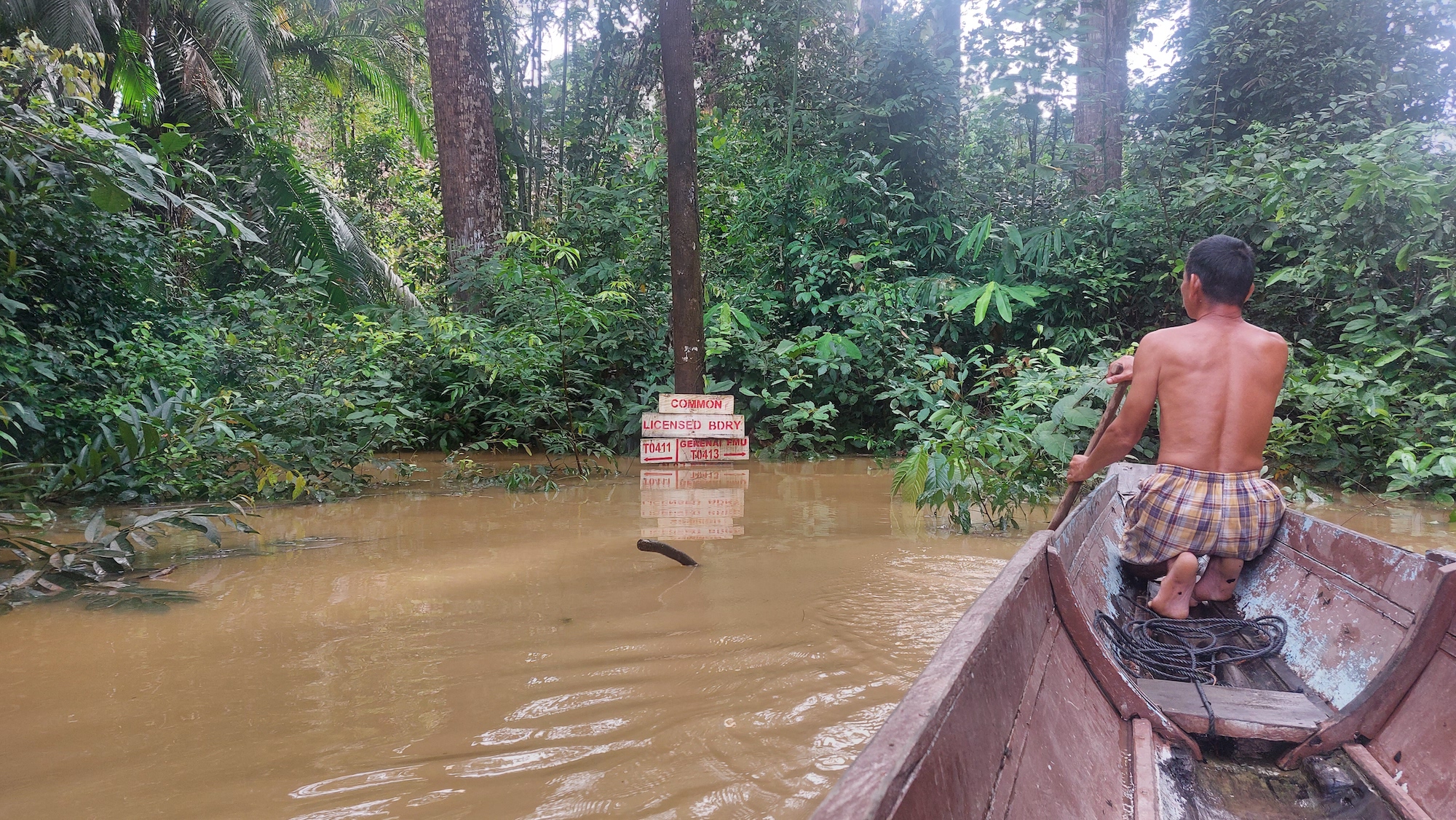
Banner image: A man steers his motorboat near sign demarcating the border of two timber concessions near Long Moh village on August 26, 2023. Image by Danielle Keeton-Olsen) for Mongabay.
NGOs, officials trade blame as Malaysian forest conservation project is scrapped
Revealed: Biomass firm poised to clear Bornean rainforest for dubious ‘green’ energy
FEEDBACK: Use this form to send a message to the editor responsible for this story. If you want to post a public comment, you can do that at the bottom of the page.
Cite this article
Danielle Keeton-Olsen (2026). Logging still threatens Bornean forest once envisioned as an Indigenous-led peace park. Mongabay Conservation news. DOI: https://doi.org/10.66709/news-330551

