


- A new Current Biology review says rewilding large animals like elephants and whales is critical for stemming species decline and extinction, but the authors caution that pitching it as a climate strategy is “high-risk.”
- These animals store, release, and move carbon in ways that vary by species and ecosystem, and right now, it’s unclear how much, where, or when.
- The climate benefits could be decades away, as the effects of animal restoration unfold over 50 to 100 years, and overpromising risks “false confidence,” according to the authors.
- But experts say they’re more aligned than not with rewilding advocates on the need for greater certainty in this growing field of science.
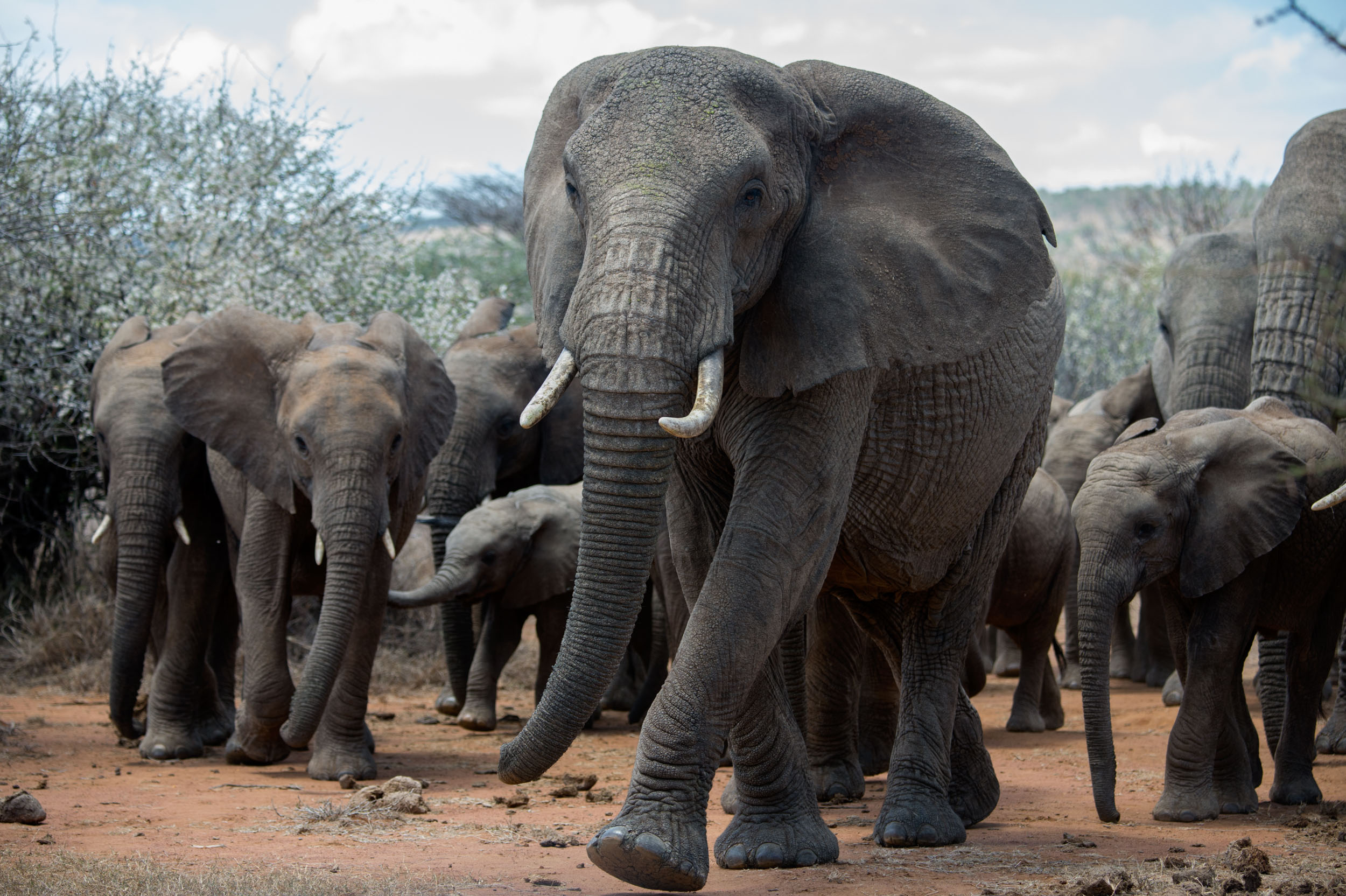
Great herds of elephants once crisscrossed Africa, and scientists have no doubt that they shaped the landscape, ecosystems and — as recent science has shown — the balance of carbon. Though it’s difficult to be certain of exact numbers, some scientists muse that over the past five centuries, humans have driven a loss of 98% of the continent’s elephants. A more recent, often-cited figure from the IUCN, the global wildlife conservation authority, put the continent’s elephant population at 1.3 million in the 1970s. Research since then has suggested that overall numbers of savanna elephants (Loxodonta africana) have dropped by 70%, driven by hunting and habitat loss. Their forest cousins, Loxodonta cyclotis, have likely slid by 90%.
As scientists have begun to uncover the interactions between carbon and big animals like elephants, there’s a been a push to “rewild” landscapes for the benefit of the climate.
The ocean’s massive whales similarly offer that potential. As the largest animals that have ever existed on Earth, their bodies alone serve as substantial reservoirs that could keep climate-warming carbon out of the atmosphere over the course of the decades (or more) that they live. Other research has sketched out a whale pump: Whales’ nutrient-rich waste also supports phytoplankton, which absorb large amounts of carbon dioxide. Cetacean contributions to carbon sequestration continue even after they die, as their bodies sometimes sink to the ocean floor, where a range of deep-sea organisms feed on them, keeping that carbon out of the atmosphere.
Centuries of hunting have cut many species’ populations to a fraction of what they once were, but whale conservation is sometimes presented as a way to tackle climate change.
“It’s quite alluring to try and bring these things together, and the science has really put these things on the map,” Andrew Abraham, a research associate at Northern Arizona University in the U.S., tells Mongabay.
Abraham is the lead author of a study published Oct. 19 in the journal Current Biology, in which he and his colleagues lay out the current research on how much restoring animals like whales or elephants can really help address climate change.
“Where, when and how can this actually be an effective part within broader climate mitigation strategies?” Abraham says.
Much of the conversation around the movement of carbon between terrestrial ecosystems and the atmosphere has revolved around plants. This has prompted the well-publicized efforts to protect and restore forests, including through tree planting, to limit and draw down carbon from the atmosphere. Forests, especially in the tropics, hold enormous amounts of carbon. The estimated 65 billion metric tons held in the Congo Basin, for example, is equivalent to more than six years’ worth of CO2 emissions from industry and fossil fuel use worldwide.
Then, a little more than a decade ago, a rising tide of research began to investigate the complex influence that animals — especially the largest ones — can have on the cycling of carbon through ecosystems: Think species that start at 45 kilograms, or about 100 pounds, like wolves, chimpanzees, and orangutans, all the way up to the multiton heft of an elephant or a bus-sized blue or fin whale.
How tantalizing, then, that these iconic animals whose numbers have been ravaged by habitat loss, hunting, and other human impacts might also be allies in the push to limit human-caused warming on Earth — that returning them to the places where they once lived in vast numbers might spur further carbon uptake from the atmosphere.


Restoration first
The study by Abraham and his colleagues, which reviews the blossoming research in this field, cautions against overselling investments in animal restoration expressly for climate gains, an approach the authors deem “high-risk.” They raise concerns about the potential linking of the climate benefits of animal restoration to controversial tools like carbon credits and offsets.
The authors are adamant that restoring animal populations is primarily critical as a long-term solution to the global decline and extinction of species.
“We all want money to go towards wildlife conservation,” co-author Ethan Duvall, the executive director of the Amazon Research and Conservation Collaborative, tells Mongabay. “We want elephants to be restored. We want whales to be restored.”
Abraham, Duvall, and their colleagues are more circumspect about strategies promoting wildlife restoration expressly because it will help the climate. They point to the widely varying and complex ways in which animals affect the carbon cycle — many of which still aren’t well-understood — in their review, which focuses on whale and elephant research.
And they note that the impacts of these long-lived animals on the landscapes they occupy can take decades and centuries to manifest.
That timescale is in stark contrast to the urgent need to halt and reverse humanity’s carbon emissions — most notably, by ending fossil fuel use — bringing global temperatures back down to healthier levels.
The researchers raise concerns about the knock-on effects of overly optimistic portrayals of animal restoration as a climate lever. That led the team to a key question, Duvall says: “Are we using the science to guide how we’re approaching both the biodiversity crisis and the climate crisis the best way possible?”

‘Animating’ the scientific debate
Oswald Schmitz, the lead author of an early keystone paper titled “Animating the Carbon Cycle,” published in 2014, agrees that “the science isn’t settled” when it comes to how restoration efforts of one or another animal species will sway the capture of carbon from the atmosphere.
“They make a good point that we need to really calculate the uncertainty, which we haven’t been doing,” says Schmitz, the Oastler Professor of Population and Community Ecology at Yale University in the U.S., who wasn’t involved in the recent research. “We didn’t have the data until now to really start doing that.
“Overall, I think the article is a good representation of what we have to pay attention to if we want to do this right,” he adds in a video interview with Mongabay.
As Abraham, Duvall and their colleagues note in their paper, animals like elephants and whales can have far-reaching effects on the movement of carbon. Both store carbon in their bodies throughout their lives. But they also exhale CO2 and release carbon through digestion.
African elephants’ influence on carbon dynamics varies widely across their home continent. Forest elephants play critical roles as seed dispersers across the Congo Basin, encouraging forest growth and recovery. At the same time, both forest and savanna elephants live up to their roles as ecosystem engineers and wreak havoc on vegetation. On the one hand, this penchant can destroy carbon-sequestering trees. On the other hand, however, by keeping the growth of woody biomass in check, they’re potentially reducing the risk of catastrophic, carbon-releasing fires.
Schmitz and his colleagues, as well as other scientists, have shown that, over time, the movement of animals over the land can instigate long-term carbon storage in the soil — if conditions are right, such as the number of animals in the landscape. The array of roles that elephants can play led the team to call them “dynamic engineers in carbon cycling.”
In line with that complexity, the authors caution against pinning a static role as a carbon sink or source to an elephant — or a financial value to a whale or an elephant, as a team led by researcher Ralph Chami from the International Monetary Fund did in a 2020 report, pegging a forest elephant’s value to the fight against climate change at $1.75 million. A whale is worth $2 million in that report’s estimation.

The intent of the report, says Schmitz, who wasn’t involved with that paper, was to show that each animal in an ecosystem has value. “This is real dollars and cents,” he adds, even if the precise figures aren’t exact. “The numbers are huge enough that we actually have to pay attention.”
“It’s interesting to explore,” Abraham says, “but we just need to make sure that these things have full backing [of science] before we go all in on them.”
The risks, Abraham and his co-authors say, include “false confidence” in animal restoration as a climate solution, or “perverse” outcomes resulting from that faith. For example, the pursuit of funding for carbon might change the management approaches for wildlife in ways that prioritize climate benefits instead of overall ecosystem health.
“It’s unfortunate, but there are many occasions where the science tells you this isn’t the best strategy,” Duvall says. “You face the risk of potential blowback within the next decade of people coming back and saying, ‘Well, now the science shows that none of these benefits are actually happening.’”
With their fresh assessment of how megafauna affect the carbon cycle, Duvall, Abraham, and their colleagues say they want to bring to light just how much uncertainty exists around these calculations right now.
And Schmitz acknowledges the importance of experiments that tease apart how different numbers of animals on the landscape impact carbon storage. “We haven’t done that,” he says. “Knowing the density of animals and their impacts is crucial.”

The paper’s authors also point out that animal restoration is unlikely to scale to the point at which it could meaningfully help reach the goal of reaching net-zero carbon emissions by 2050 as agreed by governments who signed on to the 2015 Paris climate agreement.
Schmitz agrees and notes the importance of monitoring and measuring over long-term scales. “They are making a hugely valid point that we need to look at a 50- [or] 100-year time horizon, not a five-year or 10-year time horizon with these animals,” he adds. “You’re not going to see the effect over that time.”
Ongoing research suggests that over decades, the sustained return of large animals like elephants may stabilize carbon dynamics, he says. And this, he says, points to the need to pursue rewilding to address both biodiversity loss and climate change.
Schmitz, Abraham, and Duvall were among more than 350 experts from across the spectrum of views on embracing animal restoration who came together in June to lay out a “Scientific Consensus on Wildlife and Climate.”
Schmitz notes that the group found consensus centered on a qualitative assertion about the role wildlife play. “The thing with carbon and carbon investments is you need to know how much. How much, where, and when [and] over what timescale. That’s where the uncertainty still remains,” he says.
“We don’t know for an individual animal species in this kind of ecosystem how much carbon will they control in terms of capture and storage, and that really needs to be better quantified.”
Banner image: African savanna elephants in Kenya (Loxodonta africana). Image courtesy of Julie Larsen/Wildlife Conservation Society.
John Cannon is a staff features writer with Mongabay. Find him on Bluesky and LinkedIn.
Citations:
Douglas-Hamilton (1979). Elephant Survey and Conservation Programme: final and annual report 1979. IUCN/WWF.
Edwards, C. T. T., Gobush, K. S., Maisels, F., Balfour, D., Taylor, R., & Wittemyer, G. (2024). Survey-based inference of continental African elephant decline. Proceedings of the National Academy of Sciences, 121(48), e2403816121. doi:10.1073/pnas.2403816121
Abraham, A. J., Roman, J., Pearson, H. C., le Roux, E., Kristensen, J. A., Malhi, Y., & Duvall, E. S. (2026). Large animal restoration and carbon storage across climate-relevant timescales, Current Biology (2026), doi:10.1016/j.cub.2026.09.016
Worden, S., Fu, R., Bloom, A. A., Bauters, M., Verbeeck, H., Fatoyinbo, T., . . . Ordway, E. M. (2026). Congo Basin Carbon Cycle Responses to Global Change. Global Change Biology, 32(1), e70688. doi:10.1111/gcb.70688
Pearson, H. C., Savoca, M. S., Costa, D. P., Lomas, M. W., Molina, R., Pershing, A. J., . . . Roman, J. (2023). Whales in the carbon cycle: can recovery remove carbon dioxide? Trends in Ecology & Evolution, 38(3), 238-249. doi:10.1016/j.tree.2022.10.012
Schmitz, O. J., Raymond, P. A., Estes, J. A., Kurz, W. A., Holtarieve, G. W., Ritchie, M. E., . . . Wilmers, C. C. (2014). Animating the Carbon Cycle. Ecosystems, 17, 344-359. doi:10.1007/s10021-013-9715-7
Schmitz, O. J., Sylvén, M., Atwood, T. B., Bakker, E. S., Berzaghi, F., Brodie, J. F., . . . Ylänne, H. (2023). Trophic rewilding can expand natural climate solutions. Nature Climate Change, 13(4), 324-333. doi:10.1038/s41558-023-01631-6
Chami, R., Connel, T. C., Berzaghi, F., Español-Jiménez, S., Marcondes, M., & Palazzo, J. (2020). On Valuing Nature-Based Solutions to Climate Change: A Framework with Application to Elephants and Whales. ERID Working Paper Number 297, 1. doi:10.2139/ssrn.3686168
Roberts, N. J., Atwood, T. B., Bello, C., Berzaghi, F., Emogor, C. A., Goodall, E., . . . Svenning, J.-C. (2026). “Wildlife and Climate” Scientific Consensus on the Roles of Wild Animals in the Global Carbon Cycle and Natural Climate Solutions. Global Change Biology, 32(9), e71115. doi:10.1111/gcb.71115
FEEDBACK: Use this form to send a message to the author of this post. If you want to post a public comment, you can do that at the bottom of the page.
Cite this article
John Cannon (2026). Large animals are living carbon stores. Does that make saving them a climate solution?. Mongabay Conservation news. DOI: https://doi.org/10.66709/news-332957

