


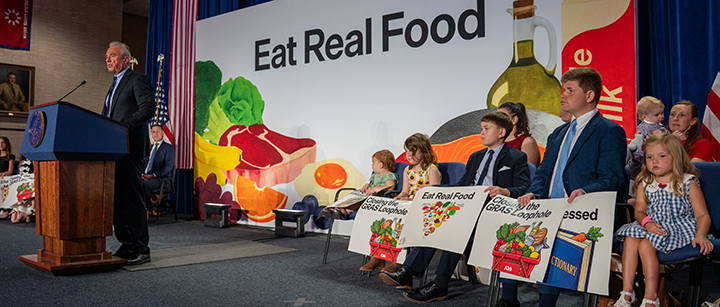
In recent public appearances, Health and Human Services Secretary Robert F. Kennedy Jr. has said obesity dropped 3% “in the last year” and suggested the Trump administration deserves at least some of the credit. One poll shows obesity falling by about that much — but the decline happened over several years and began well before President Donald Trump’s current term.
And there’s little evidence it’s because of Kennedy’s focus on chronic disease prevention or his push to get Americans to eat better, experts told us.
According to Gallup polling, the rate of obesity among U.S. adults peaked in 2022 and has fallen every year since. The decline started during the Biden administration and has continued under Trump.
Experts also told us that, if obesity is declining, there’s little evidence it’s due to changes in diet or lifestyle. Some said it may be related to a factor Kennedy isn’t highlighting — the rise of new GLP-1 weight loss drugs.
Kennedy — who has made eating “real foods” a core part of his Make America Healthy Again movement and sometimes disparaged GLP-1 drugs in recent years — has trumpeted the purported decline in obesity several times in recent months.
“This year, obesity rates dropped in this country, for the first time in 40 years, by about 3%,” Kennedy said during an Aug. 24 event on childhood nutrition. “Consumption of real foods went up by 7 to 10% this year. And there are many, many other indicia [that] show that what we’re doing is actually working.”
He referenced the same stat while speaking at a community health center in California on Aug. 13.
“Obesity has now dropped, for the first time, 3% in the last year,” he said. “People are starting to eat good foods and that’s part of it. But a big part of it is dealing with primary care and getting rid of — getting away from the perverse incentives of just ordering test after test after test and pharmaceutical interventions.”
Kennedy made similar claims about the obesity rate at least twice in June. He told a produce industry conference that obesity rates were “down almost 2%” this year and called it a “huge win,” according to trade publication The Packer. And during a panel in Michigan hosted by a conservative think tank, he said, “Since President Trump came into office, obesity rates in this country have dropped by 2.5%. That’s the first drop in 50 years.”
We asked the Department of Health and Human Services where Kennedy got those numbers and haven’t received a response. But he’s likely referring to the data from Gallup, which was the only publicly available source we could find reporting a roughly 3 percentage point decrease in obesity.
The data, however, don’t support Kennedy’s claims that the obesity rate fell by that much in a single year. Gallup’s numbers show a total decline of 3.5 percentage points between 2022 and the first half of 2026. About two-thirds of that came between 2022 and 2024, when Joe Biden was in office.
More broadly, experts told us there’s still some uncertainty about whether obesity is in fact falling and, if it is, whether that trend will continue. The U.S. obesity rate has dipped or plateaued before, according to government data, only to keep rising in subsequent years.
As for why obesity may be declining, several experts told us they’re not aware of any evidence that Americans have made major changes to their diets, as Kennedy suggested. Some pointed to increasing use of GLP-1 drugs like Ozempic as a more plausible explanation, though that remains a topic of debate.
“There is no evidence I am aware of that suggests Americans have made major improvements in their engagement in lifestyle interventions or dietary practices,” Elizabeth Selvin, a professor of epidemiology and medicine at Johns Hopkins University, told us in an email. “As the world is aware, there has, however, been a revolution in the effectiveness and availability of pharmacological interventions (namely, GLP1 medications) that are highly effective for weight management.”
Apparent Drop in Obesity Began Before Trump
Gallup’s National Health and Well-Being Index, which surveys about 5,000 Americans every quarter, is one of a few different sources for tracking obesity rates over time. Since Gallup started asking about weight in 2008, obesity among U.S. adults has mostly trended upward, hitting a peak of 39.9% in 2022 before falling every year since. As of earlier this year, the adult obesity rate stood at 36.4%, according to Gallup.
Gallup’s approach has the advantage of a large sample size and turning results around quickly, making it a more up-to-date measure than government surveys. But it also has some limitations, including using self-reported height and weight to calculate body mass index. Because people sometimes underreport their weight or overstate their height, that can lead to underestimating the prevalence of obesity.
Dan Witters, the index’s research director, told us Gallup’s obesity-rate estimates tend to be a few points lower than government estimates based on more objective measurements, but generally follow the same trends.
The CDC’s National Health and Nutrition Examination Survey is generally seen as more authoritative, as its estimates of population-level obesity are based on actual measurements of height and weight, not self-reported data. But it’s slower to release data.
The most recent NHANES data put the adult obesity rate at 40.3% for 2021-2023. That was down from 41.9% in 2017-2020, but the change was within the margin of error and not considered statistically meaningful.
Separately, some analyses of patient records or insurance claims have found evidence of modest declines in obesity. An analysis released this spring by Epic Research, a subsidiary of the electronic health records company, found that the share of U.S. adults categorized as obese dropped from 42.3% in the second quarter of 2021 to 40.7% by the first quarter of 2026. The rate of GLP-1 prescriptions grew substantially during the same timeframe.
Solveig Cunningham, a professor of global health at Emory University, said the Gallup data may be picking up on a real trend, but it will take more data to confirm that. She also cautioned that even if the obesity rate has declined, that’s no guarantee it will continue to fall.
“I think there may be a small decline,” she said, but we’ll “need to see how it develops in the future. There have been small declines before. Like in 2008, in 2012, there were similar declines, and then things picked up again.”
Little Evidence of Healthier Diets
Kennedy, in his speeches on Aug. 13 and 24, suggested that people eating more “good foods” or “real foods” was partly responsible for the drop in obesity.
We asked HHS about the basis for that claim and did not get a response. Several experts we contacted said they’ve seen little if any evidence that Americans have made major changes to their diets.
“I don’t know where he’s getting his data,” said William McCarthy, an adjunct professor of health policy and management at the University of California, Los Angeles who has studied strategies to encourage healthier eating. “Maybe he has access to data that I don’t. But based on what I’ve seen, I would not agree” that American diets have gotten much healthier in recent years.
Cunningham said the best source of data on Americans’ dietary habits is the CDC’s NHANES, the same survey that tracks obesity trends. But the most recent NHANES data is for the 2021-2023 period.
“At that stage, we weren’t seeing major changes in diet,” she said. “So I think it would be amazing if there were, but we don’t have any evidence that such changes in diet are occurring.”
Gallup’s National Health and Well-Being Index, in addition to tracking obesity trends, also asks respondents several questions about diet, exercise and overall activity levels. Witters, the research director, said those metrics generally worsened during the pandemic and, for the most part, haven’t bounced back.
While there was a “modest improvement” in the share of people reporting they had eaten at least five servings of fruits and vegetables on four of the last seven days — from 42% in 2023 to 45.2% in 2026 — it’s still lower than in 2019, and other questions about diet and exercise showed no statistically significant changes.
“We don’t see evidence in our data that people, that Americans, are suddenly living healthier lives,” Witters said.
In his Aug. 24 speech, Kennedy claimed that “real food” consumption “went up by 7 to 10% this year.” He’s cited a version of this figure before to make the case that Americans are choosing “real” foods over highly processed ones. This comes from an analysis by the bank BNP Paribas, which reportedly found that, between June 2025 and June 2026, sales of unprocessed or minimally processed foods in certain categories grew 7% faster than sales of ultraprocessed foods in the same categories.
But experts told us those findings, on their own, don’t prove that Americans are eating significantly better.
The study, as described in an article in the industry publication Food Business News, compared products in only a handful of categories — yogurt, nut butters, frozen meals/vegetables, fruit snacks/candy and cereal/granola. (We asked BNP Paribas for a copy of the original study but haven’t heard back.) For example, in the yogurt category, sales of minimally processed products (like plain yogurt) were up 15%, while sales of ultraprocessed yogurt products (like sugary, flavored varieties) were up only 2%.
Cunningham noted that most foods in those categories “would largely be considered processed by nutritionists,” and that the report doesn’t show ultraprocessed food sales declining — only growing slower than less processed foods.
McCarthy added that the report says nothing about whether Americans are consuming, say, more fresh fruits and vegetables. And without more detail, he said, it’s hard to know whether shifting from, say, one kind of peanut butter to another has a meaningful impact on health.
“Generally, it takes a multi-year campaign to get Americans to consume less saturated fat, or fewer trans fats or lower sodium,” he said in an email. “I remain skeptical that Secretary Kennedy’s food-related initiatives have already had a measurable impact on the overall healthfulness of the U.S. population’s daily food choices.”
Marion Nestle, a food policy expert and professor emerita at New York University, wrote on her blog Food Politics that the sales data “could indicate a trend toward healthier diets, depending on what else people are eating.”
Nestle told us in an email that a decline in obesity would suggest that people are eating fewer calories. But because several things that could affect dietary trends are happening at once, it’s hard to tease out the cause. Along with Kennedy’s “eat real food” push and recent overhaul of federal nutrition guidelines, GLP-1 use is increasing and food prices are rising.
“Most evidence for causality points to GLP-1 drugs,” she said, noting that the drugs reduce food intake and can also prompt people to make other dietary changes. “Inflation is also making people think twice about buying expensive junk food. Dietary advice helps, but rarely is enough to change eating behavior.”
Potential Role of ‘Pharmaceutical Interventions’
Kennedy also said “a big part of” declining obesity rates has to do with “getting away from the perverse incentives of just ordering test after test after test and pharmaceutical interventions.” We asked HHS what specifically Kennedy meant by this and have not received a response.
McCarthy said Kennedy may have been referring to the administration’s efforts to get medical schools to offer more nutrition education and otherwise move primary care toward a greater focus on food and chronic disease prevention. While McCarthy said those changes are welcome and could eventually make a difference, it will be some time before they’re fully implemented and having a measurable effect on health outcomes.
“I applaud Secretary Kennedy’s initiative,” he said. “But it’s going to take a while before we have educated physicians who know how to have an impact on the food choices that the patients are making.”
It’s also worth noting that one possible explanation for the apparent decline in obesity is, in fact, a “pharmaceutical intervention” — GLP-1 medications — though the drugs’ effect on the population-level obesity rate is still a matter of debate.
According to Gallup’s survey data, the share of adults reporting they take the medications for weight loss has shot up from 3% in 2024, when Gallup started asking about it, to 11% this year.
In an analysis published last year, Gallup found that the age groups that saw the biggest drops in obesity between 2022 and 2025 — adults age 40-49 and 50-64 — were also the groups with both the highest rates of GLP-1 use and the biggest increases in GLP-1 use from 2024 to 2025.
While that “doesn’t prove anything,” Witters said, it suggests a potential link. “What we found was really a pretty close correlation.”
Cunningham, the Emory professor, said “there’s still a lot of debate” about why obesity might be falling.
“There’s a lot of interest in the possibility of weight-loss drugs of all sorts to decrease weight at the population level,” she said. “That’s still very much in the early stages. So I don’t think we can make any kind of definitive finding about that.”
GLP-1s are clearly effective at reducing weight at the individual level, she said, but the population-level effect is less clear for a few reasons.
For one, some people drop off the medications due to side effects or cost, and people with lower incomes, who tend to be at higher risk for obesity, may not be able to afford them. Some people taking GLP-1s may already be below the cutoff for clinically defined obesity; others may start with high enough BMIs that losing 10% to 20% of their body weight doesn’t bring them below the threshold for obesity, even if it improves their overall health.
Cunningham said another theory about population-level obesity is that a certain share of the adult population is susceptible to obesity in the current environment, and the obesity rate is leveling off as we reach a kind of “saturation point.”
But, she cautioned, we don’t have definitive answers at this point. “Obesity is complex.”
Editor’s note: FactCheck.org does not accept advertising. We rely on grants and individual donations from people like you. Please consider a donation. Credit card donations may be made through our “Donate” page. If you prefer to give by check, send to: FactCheck.org, Annenberg Public Policy Center, P.O. Box 58100, Philadelphia, PA 19102.
