


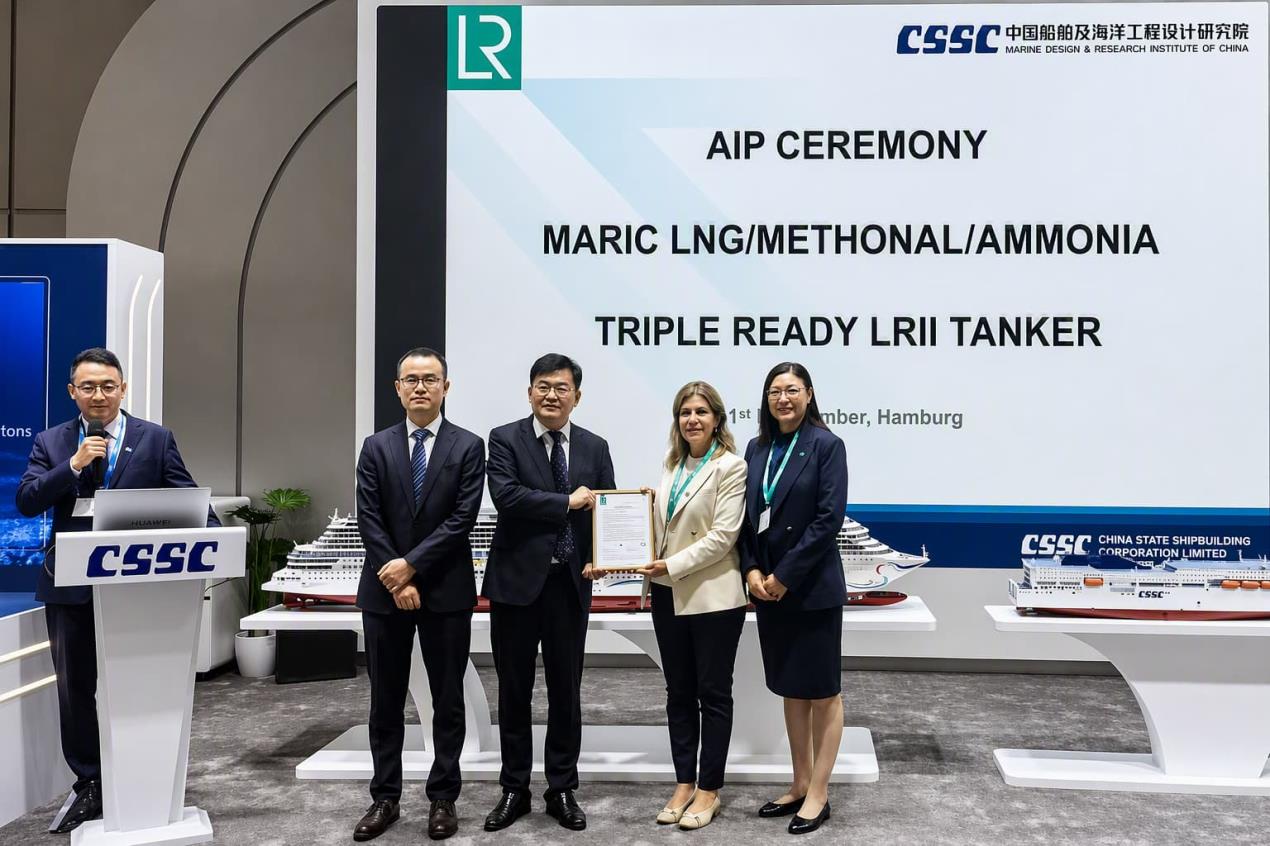
Lloyd’s Register (LR), the UK-based classification society, and the Marine Design and Research Institute of China (MARIC) have unveiled a tri-fuel-ready tanker concept designed to give owners flexibility to pursue liquefied natural gas (LNG), methanol, or ammonia as fuel technologies, infrastructure, and regulations evolve, while uncertainty over future marine fuels continues to shape investment decisions.
Lloyd’s Register and MARIC have secured approval in principle (AiP) for a new 114,000 DWT product and crude oil tanker designed to accommodate future conversion to LNG, methanol, or ammonia, giving owners the flexibility to leverage multiple fuel pathways.
This tanker concept has been designed as a product and crude oil carrier that can accommodate future conversion to LNG, methanol, or ammonia as technologies, regulations, and fuel supply chains mature.
LR emphasizes that the concept aims to reduce future retrofit complexity, providing owners with greater confidence when planning long-term fleet investments, by incorporating conversion readiness at the design stage.
Theo Kourmpelis, Global Business Director for Tankers, Lloyd’s Register, commented: “Shipowners are being asked to make major investment decisions today despite continued uncertainty around which fuels will dominate in the decades ahead.
“Alternative fuel solutions each offer potential pathways to compliance, but fuel infrastructure, regulation and economics continue to evolve at different speeds around the world. Designs that preserve flexibility will be critical in helping owners manage risk while preparing for multiple future scenarios.”
The design concept was reviewed against LR’s July 2026 class rules and regulations, including requirements relating to ships using gases and other low-flashpoint fuels, alongside relevant IACS Common Structural Rules for oil tankers. Final classification and statutory approval remain subject to full compliance with all applicable rules and regulations.
The concept addresses one of shipping’s biggest investment challenges, which is the need to develop vessels and capabilities that can support a range of alternative fuel options and pathways in the fast-evolving shipping market landscape.
While LNG is already a mature fuel pathway, LR underlines that methanol and ammonia remain at an earlier stage of development, with questions around global fuel availability, infrastructure development, economics, and long-term adoption.
Si Nan, Marine & Offshore Marketing Department Vice Director, MARIC, said: “As the industry explores different decarbonisation pathways, shipowners need vessel designs that can adapt alongside technological and regulatory developments.
“This concept was developed specifically to provide greater fuel flexibility and long-term resilience, allowing owners to respond to changing market requirements without being locked into a single fuel strategy.
“Receiving Approval in Principle from Lloyd’s Register is an important milestone that validates the design concept and supports its future development.”

Power Your Brand With Offshore Energy ⤵️
Take the spotlight and anchor your brand in the heart of the offshore world!
Join us for a bigger impact and amplify your presence at the core hub of the offshore energy community!
