


Unlock the Editor’s Digest for free
Roula Khalaf, Editor of the FT, selects her favourite stories in this weekly newsletter.
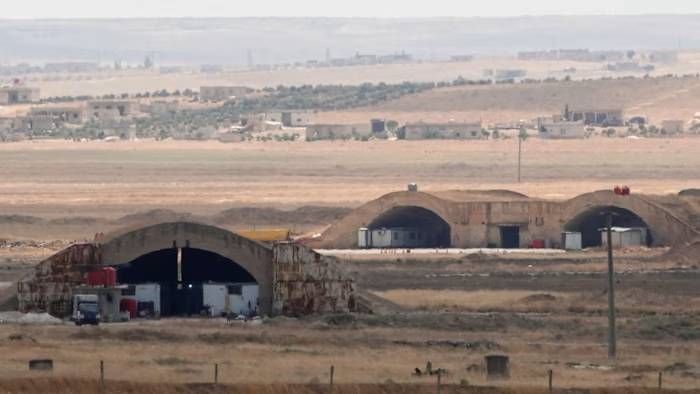
Damascus and Ankara strongly condemned Israeli air strikes on the Abu al-Duhur military air base in north-western Syria on Tuesday, calling it a “violation” of the country’s sovereignty.
Tom Barrack, US ambassador to Turkey and President Donald Trump’s envoy for Syria, also criticised the attacks, saying Washington was “deeply concerned” that what he described as “confirmed Israeli air strikes” were “an unnecessary escalation that does not advance regional stability”.
The Israeli military declined to comment.
Eight strikes hit the runway and storage facilities at Abu al-Duhur early on Tuesday, according to Syrian state media, causing material damage but no casualties. The base lies in Idlib province, about 70km from the Turkish border.
The attack is likely to sharpen tensions between Turkey and Israel over Syria, where Ankara has emerged as the principal foreign backer of the government that replaced the Bashar al-Assad regime in 2024.
The Syrian Observatory for Human Rights, a UK-based war monitor, said Turkey had been rehabilitating Abu al-Duhur and a Turkish delegation had recently visited the base. The base had ceased operating as a dedicated military airfield during Syria’s civil war, which left half a million people dead.
The Observatory said Turkey’s forces had also been installing radar systems on Syria’s Mediterranean coast as part of what appears to be a broad effort by Ankara to rebuild the country’s air defences.
Turkey’s foreign ministry said the attack “violated [Syria’s] territorial integrity and unity”, adding Israel needed to be held to account “for these actions that completely disregard international law”.
Israel has sought to prevent an expanded Turkish military presence in Syria, particularly of air-defence systems that could restrict Israel’s freedom of action in Syrian airspace. Turkey and Israel established a “deconfliction” mechanism in Azerbaijan last year to prevent unintended clashes between their forces.
Israel has launched a barrage of strikes in Syria since Assad was overthrown in December 2024, saying it wanted to destroy assets belonging to Syria’s air force and army to prevent the new government from being able to use them, as well as seizing a buffer zone inside that country that adjoins the Israeli-occupied Golan Heights.
Israel has also carried out strikes in Syria that it cast as support for the local Druze population, most recently this March. But those strikes were in southern Syria, whereas the latest attack took place close to Turkey’s border.
The latest strikes came as Damascus is seeking to rebuild some of the military capabilities destroyed after Assad’s fall, holding its first air exercises this month using elderly Russian-made MiG-21 fighter jets.
The new authorities in Damascus have repeatedly said they do not seek conflict with Israel, but Israel has remained wary of the government led by former Islamist insurgents.
Barrack, who met Syrian foreign minister Asaad al-Shaibani in Istanbul on Monday, said Damascus had “neither adopted a predatory posture nor maintained proxy forces” and had “repeatedly indicated a preference for de-escalation with Israel”.
“The United States has in the past, and will continue in the future, to host discussions to encourage diplomatic cadence over kinetic frustration for both nations,” Barrack added.
