


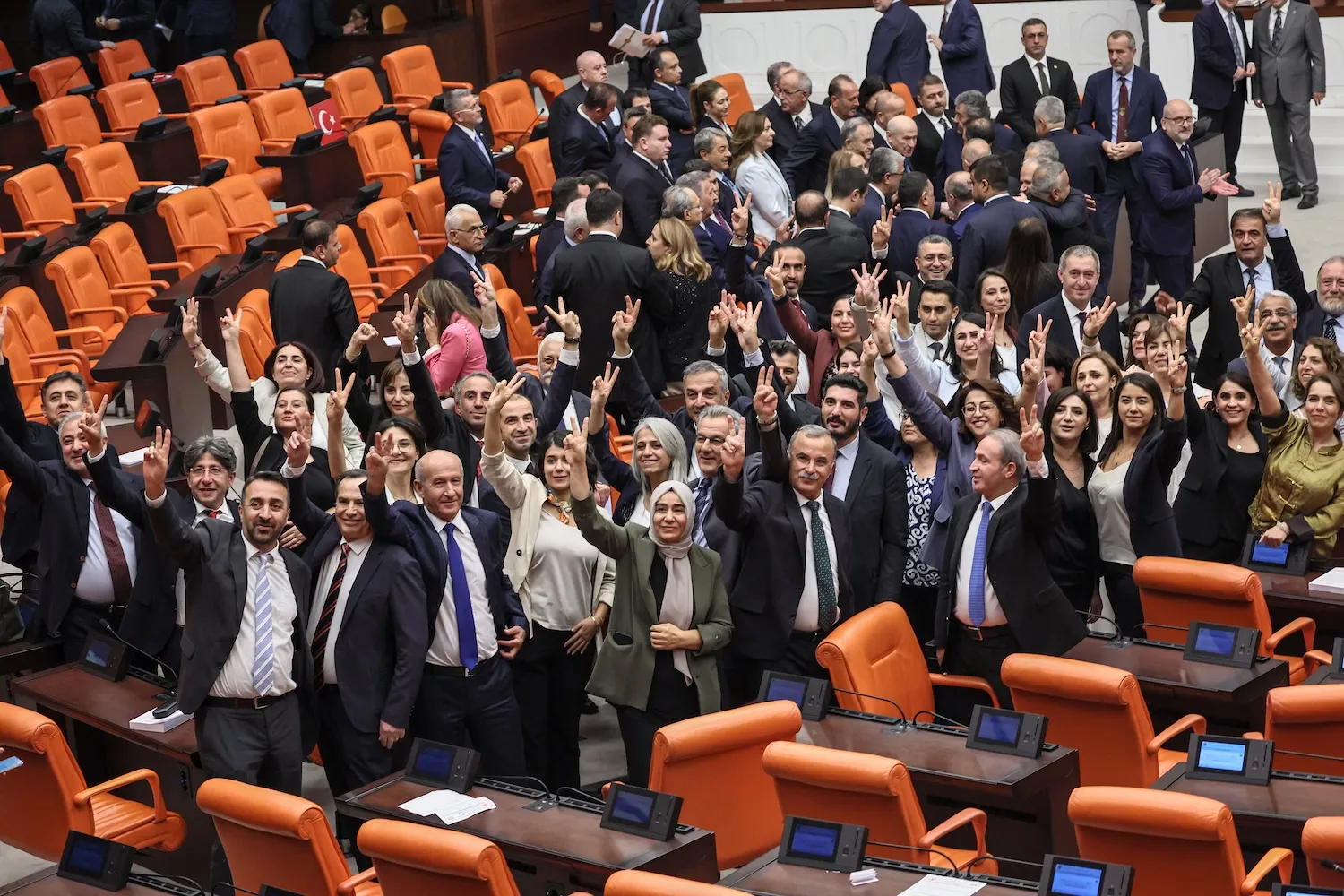
On Aug. 10, the Turkish parliament passed a bill providing limited amnesty for demobilized militants of the Kurdistan Workers’ Party (PKK). After waging an insurgency against the Turkish state since 1984, the PKK announced it was formally dissolving last year, following an order from its imprisoned founder, Abdullah Ocalan.
Now Ocalan, who won’t be included in the amnesty, has praised the bill as heralding a process of democratization that is “as significant as the founding of the [Turkish] republic.”
On Aug. 10, the Turkish parliament passed a bill providing limited amnesty for demobilized militants of the Kurdistan Workers’ Party (PKK). After waging an insurgency against the Turkish state since 1984, the PKK announced it was formally dissolving last year, following an order from its imprisoned founder, Abdullah Ocalan.
Now Ocalan, who won’t be included in the amnesty, has praised the bill as heralding a process of democratization that is “as significant as the founding of the [Turkish] republic.”
Resurgence and Revolution: The PKK and the Kurdish Fight in Turkey and Syria, Aliza Marcus, New York University Press, 279 pp., $30, May 2026
Meanwhile, the speaker of the Turkish parliament has proclaimed the end of Turkey’s longtime Kurdish issue. Announcing the “liquidation of the terrorist organization,” he promised the amnesty bill would usher in unity and solidarity in Turkey.
To understand why this optimism might be misplaced, a good place to start is Aliza Marcus’s Resurgence and Revolution: The PKK and the Kurdish Fight in Turkey and Syria. Marcus, a former Middle East-based journalist, previously wrote the definitive history of the PKK up to the time of Ocalan’s capture in 1999. Her new book takes the story up to today, showing how the group redefined its objectives to remain relevant in the region. In doing so, Marcus offers clues to how Ocalan might be thinking today and how the PKK may now evolve.
Crucially, Marcus points out that dissolving the PKK doesn’t mean that the movement will disappear. For members of the group, the current political settlement with the Turkish state represents just another stage in their struggle for Kurdish rights. Ocalan has long since argued that it was time to focus on a peaceful resolution of the Kurdish situation within the borders of a democratic Turkey. Marcus predicts that the group could now turn into a peaceful organization, or group of organizations, advancing Kurdish goals nonviolently. She quotes Bese Hozat, a member of the PKK leadership based in northern Iraq, who at the symbolic start to the disarmament in July 2025 said, “We are not planning to be satisfied just with coming down from the mountains. We want to be at the forefront of democratic politics in Amed (Diyarbakir), Ankara, and Istanbul.”
But will this be possible? In 2025, Ocalan consented to disarm and dissolve the PKK without any prior agreement with Turkey. Now, he has acquiesced to the exclusion of the senior PKK leadership from the amnesty bill, while those rebels who are repatriated will be banned from politics for between five and 10 years depending on the length of their sentences. Ocalan’s willingness to do this has remained a source of speculation and has driven uncertainty about the current political process. Hatip Dicle, a member of the Kurdish delegation in peace talks held between 2013 and 2015, told Marcus that Ocalan initially refused to tell the PKK to lay down its weapons without a formal agreement with Turkey: “Really, how do you drop armed struggle without an agreement? All over the world, in these sorts of conflicts, [weapons] are the last thing that get dropped.”
Why, a decade later, has Ocalan seemed to abandon this condition? Ocalan always knew that without the threat of war there was little reason for Turkey to pay attention to the Kurdish cause. Ultimately, though, he was compelled to reverse course because the PKK had hit an impasse. The armed struggle had been faltering for years and could not match superior Turkish military technology, notably the Turkish drone warfare that hemmed in the PKK in the mountains of northern Iraq.
Moreover, the failure of the PKK’s call for a people’s uprising in southeastern Turkey in 2015 marked a decisive turning point. Emboldened by its U.S.-backed success against the Islamic State in Syria, and frustrated with Turkish intransigence, the group launched a war for open control of several Kurdish-majority cities. Yet the crushing Turkish military response left many of these cities destroyed. Even some sympathetic Kurds blamed the PKK for this outcome, and the group lost much of the de facto power it had amassed in urban areas.
Seen against this background, what appears to be a capitulation today is best understood as an attempt by Ocalan to rectify this mistake and try to rebuild what influence he can for the movement. Ocalan seems to recognize that many of the movement’s long-term goals remain unachievable. For the foreseeable future, Turkey will continue to withhold full Kurdish rights, including Kurdish-language education and local self-government. What’s more, the regime of President Recep Tayyip Erdogan, which has cracked down on the Turkish main opposition and still keeps Kurdish politicians and elected officials incarcerated, will not devolve power to the Kurds or countenance activism, however peaceful, for Kurdish rights and democratic reforms.
But ultimately that may not matter to Ocalan. When Ankara didn’t respond to his earlier calls to recognize Kurdish rights within a more democratic Turkey, Ocalan developed an alternative strategy that seeks to operate outside of repressive state institutions. Ocalan argued that the Kurds did not have to wait for Turkey to grant them their demands. They instead needed to grab power locally, create democratic institutions from the bottom up, and set up micro-level representative bodies and local parliaments. “In essence, he was saying that the goal of an independent Kurdish state had to be replaced by an independent Kurdish people,” Marcus writes.
Presumably, Ocalan believes that the militants who can now return home following the amnesty bill will constitute the avant-garde of this people’s emancipation. Moreover, peaceful activism could in theory enable the Kurds to forge stronger political alliances with Turkish parties. While armed resistance mobilized Kurds, it delegitimized Kurdish aspirations in Turkish eyes. If nothing else, the peace process may lay the long-term groundwork for greater acceptance.
So, who stands to benefit from the current political process between Ocalan and Erdogan? Has Ocalan found a way to make space for Kurdish aspirations and lay the groundwork for undermining Erdogan’s authoritarian rule? Or has Erdogan finally pressured the Kurds to give up their struggle, further consolidating his hold on power?
Marcus, for her part, implies that peace may prove elusive. Her book suggests it won’t be simple for the PKK to shift course and recruit people solely for nonviolent activism. What’s more, it’s an open question whether Turkey will ultimately allow any serious advocacy for, much less grant, Kurdish political demands.
In fact, there is good reason to think that both Ocalan and Erdogan may be disappointed in their expectations for what the current political process will achieve.
The main obstacle to Turkish-Kurdish unity was always the hold of Turkish nationalist thinking. Counterintuitively, it’s Erdogan’s ultranationalist ally Devlet Bahceli, the leader of the Nationalist Movement Party, who has expended the greatest effort to promote the peace process. Erdogan, for his part, has been consistently more apprehensive of any steps that would provoke a Turkish nationalist backlash. As a result, Bahceli’s efforts notwithstanding, Turkish nationalists remain hostile to the Kurdish demands. Erdogan, who aspires to be reelected, won’t take the risk of challenging their supremacist thinking.
Even among the opposition, nationalism remains a source of division. The left-wing Kurdish movement and Turkish leftists share common sensibilities—labor rights, feminism, ecology, and secularism—and ought to be able to build a broad-based progressive counterweight to Turkey’s dominant authoritarian right. Yet historically, reconciling leftist class politics and Turkish and Kurdish nationalisms has proved impossible. Duran Kalkan, a member of the PKK leadership, in a recent interview lamented that the left and other democrats haven’t done enough to break the hold of “chauvinistic nationalism” and to mobilize societal support for peace.
The PKK was born out of this rift in the 1970s. Turkish Marxists demanded that their Kurdish allies prioritize the class struggle and postpone the realization of their ethnic aspirations until the advent of socialism. Ocalan broke ranks with them and launched an exclusively Kurdish revolutionary struggle for an independent and socialist Kurdistan. Today, he has come full circle, calling for what would amount to another kind of revolution, the democratic transformation of Turkey.
To have any chance to succeed, the Kurdish movement will need to forge an alliance with Turkish progressives. But the agreement between Ocalan and Erdogan has only made this harder. Turkish progressives suspect that, as part of the deal, Ocalan will endorse Erdogan’s reelection and further entrench his authoritarian power. For this reason, a majority of center-left opposition lawmakers voted against the amnesty bill.
Yet it may well be the Turkish regime that’s under the biggest delusion, believing that it has finally defeated Kurdish political aspirations. Turkey may have prevailed militarily and induced Ocalan to agree to a peace on its terms, but the Kurds have reclaimed their identity as a result of the PKK’s struggle. That is the legacy that Ocalan bequeaths and with which Turkey will have to contend. If Erdogan’s government does not address Kurdish demands for recognition and equality, Turkey will never achieve true unity and solidarity.
