

Close Menu
NCIJ Network NCIJ Network
    What's Hot

    How Judges Eviscerated Trump’s DOJ Voter Data Lawsuits — ProPublica

    October 16, 2026

    We are teaching children maths they will never use. Isn’t it better to help them speak fluently? | Simon Jenkins

    October 16, 2026

    Marine Le Pen’s EU dream is a nightmare for Brussels – POLITICO

    October 16, 2026
    Facebook X (Twitter) Instagram
    Trending
    • How Judges Eviscerated Trump’s DOJ Voter Data Lawsuits — ProPublica
    • We are teaching children maths they will never use. Isn’t it better to help them speak fluently? | Simon Jenkins
    • Marine Le Pen’s EU dream is a nightmare for Brussels – POLITICO
    • ‘A direct cultural threat’: your questions on the rise of the right across Europe answered | Europe
    • The tech backlash is now in theaters
    • Microsoft Patches Two Dozen RCE Flaws in Office
    • Isaias Dims the Gulf Coast
    • ‘Perpetuating stupidity’: Indonesia comes under fire for response to burning and haze
    • About
      • Our Team
      • Editorial Policy
      • Editorial Independence
      • International Support
    • Trust & Standards
      • AI Usage Policy
      • Conflict of Interest Policy
      • Corrections Policy
      • Ethics Policy
      • Fact-Checking Policy
      • Source Protection
    • Get Involved
      • Guide for Sources
      • Support Independent Journalism
    • Legal
      • Cookie Policy
      • Privacy Policy
      • Terms of Use
    Facebook X (Twitter) Instagram
    NCIJ Network NCIJ Network
    Friday, October 16
    • Home
    • World
    • Ai
    • Business
    • Politics
    • Health
    • Crypto
    • Science
    • Technology
    • Cybersecurity
    • Defense & Security
    • Economy
    • Energy
    • Europe
    • More
      • Fact Check
      • Investigations
      • Opinion & Analysis
      • Environment
    NCIJ Network NCIJ Network
    Home»Science

    Isaias Dims the Gulf Coast

    NCIJ NETWNCIJ NETWORKBy NCIJ NETWNCIJ NETWORKOctober 16, 2026 Science No Comments4 Mins Read
    Share
    Facebook Twitter LinkedIn Pinterest Email

    After a quiet start to the 2026 Atlantic hurricane season, Isaias became the season’s first hurricane on October 8 as it tracked toward the U.S. Gulf Coast. The storm brought heavy rain and flash flooding to parts of the Southeast, including Alabama and the Florida Panhandle, and winds that toppled trees and downed power lines, leaving many people in the dark.

    Isaias made landfall near Destin, Florida, on the evening of October 9 as a Category 2 hurricane with maximum sustained winds of 105 miles (170 kilometers) per hour. Gusts topped 100 miles per hour along a corridor west of the storm’s center, according to the National Weather Service, with preliminary reports showing a 117-mile-per-hour gust in Oriole Beach and a 102-mile-per-hour gust at Pensacola City Hall.

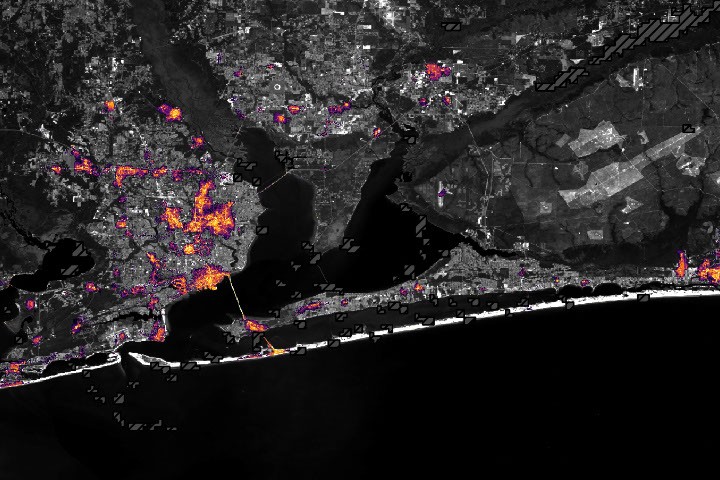
    These areas of high winds overlapped a broader area west of the storm’s eye where satellite images showed substantial decreases in nighttime lights. The image pair above shows nighttime lights before and after the storm. The left image is a composite of August 2026 data representing typical conditions, and the right image shows lights on October 11, after most of the storm’s clouds had cleared.

    The data depicted in the images, provided by Ranjay Shrestha of NASA’s Black Marble science team, come from the Black Marble HD product. The product uses data from the VIIRS (Visible Infrared Imaging Radiometer Suite) on the NOAA-20 satellite, which has a day-night band that detects light emitted and reflected at night. The team processed the data to account for changes in the landscape, the atmosphere, and phase of the Moon, and to filter out stray light that does not come from electric lights. Dark gray, hash-marked areas show where clouds prevented VIIRS from collecting data. The nighttime lights are shown over a base map from the Landsat 9 satellite.

    “Standard Black Marble nighttime lights imagery, available through NASA Worldview, provides a broad picture of the storm’s immediate impacts,” Shrestha said. “Black Marble HD takes this a step further by allowing us to visualize these changes at a much finer spatial scale.”

    At these finer scales, the images reveal lights decreasing sharply around parts of Pensacola, Florida, and along the U.S. Route 98 corridor toward Destin, suggesting widespread power disruptions. Shrestha also pointed out pockets where lights persisted, including Pensacola International Airport, Pensacola Christian College, and parts of downtown Pensacola. “These patterns could reflect backup power systems, differences in electrical infrastructure, or areas that maintained electricity during the storm, although the imagery alone cannot confirm the underlying reasons,” he said.

    Black Marble HD images also reveal the pace and spatial patterns of recovery. The image pair above compares the same October 11 view (left) with one from October 12 (right), when lights had begun to return to some affected areas. By October 14, lighting patterns looked similar to pre-storm conditions.
     
    “Understanding where recovery is progressing and where disruptions persist can help emergency responders and decision makers identify areas that may require additional attention, prioritize resources, and assess the effectiveness of restoration efforts,” Shrestha said.
     
    Black Marble data complement ground-based outage reports rather than replace them, offering a more comprehensive view of disasters’ impacts and recovery. “Ultimately, this is where the value of Black Marble lies: turning nighttime Earth observations into actionable insights that support informed decisions and help bridge the gap between Earth science and action,” Shrestha said.
     
    The NASA Disasters Program, in coordination with FEMA and the USGS Coastal Storms Team, is supporting the Alabama Red Cross and the Alabama Emergency Management Agency’s response to Hurricane Isaias. The team will be posting maps and data products on its open-access mapping portal as new information becomes available.

    NASA Earth Observatory images by Lauren Dauphin, using Black Marble HD data courtesy of Ranjay Shrestha/NASA’s Goddard Space Flight Center and Landsat data from the U.S. Geological Survey. Story by Kathryn Hansen.

    coast Dims Gulf Isaias
    NCIJ NETWNCIJ NETWORK
    • Website

    Keep Reading

    AI reveals a hidden chemical shortcut that could turn CO2 into fuel

    A planet 320 light-years away confirms what scientists long suspected

    AI can act exactly like a human, but we still don’t think it’s conscious

    Strokes have nearly doubled among younger adults, and scientists aren’t sure why

    Rare study reveals a striking divide inside an Alzheimer’s patient’s brain

    NASA Awards Enable Research, Technology to Build Future Workforce

    Add A Comment
    Leave A Reply Cancel Reply

    Editors Picks

    How Judges Eviscerated Trump’s DOJ Voter Data Lawsuits — ProPublica

    October 16, 2026

    We are teaching children maths they will never use. Isn’t it better to help them speak fluently? | Simon Jenkins

    October 16, 2026

    Marine Le Pen’s EU dream is a nightmare for Brussels – POLITICO

    October 16, 2026

    ‘A direct cultural threat’: your questions on the rise of the right across Europe answered | Europe

    October 16, 2026
    Latest Posts

    Early release scheme risks more serious crimes, probation chief warns

    August 12, 2026

    UK heatwave live: Met Office issues extreme heat warning as government convenes emergency Cobra meeting | Extreme heat

    August 12, 2026

    Rybakina defeats Osaka, advances to Canadian Open semifinals to play Gauff | Tennis News

    August 12, 2026

    Subscribe to News

    Get the latest sports news from NewsSite about world, sports and politics.

    NCIJ Network is an independent digital news platform delivering trusted investigative journalism, European and global news, in-depth analysis, and fact-based reporting with accuracy, transparency, and integrity.

    Facebook X (Twitter) Instagram Pinterest YouTube

    How Judges Eviscerated Trump’s DOJ Voter Data Lawsuits — ProPublica

    October 16, 2026

    We are teaching children maths they will never use. Isn’t it better to help them speak fluently? | Simon Jenkins

    October 16, 2026

    Marine Le Pen’s EU dream is a nightmare for Brussels – POLITICO

    October 16, 2026

    Subscribe to Updates

    Get the latest creative news from FooBar about art, design and business.

    Type above and press Enter to search. Press Esc to cancel.