


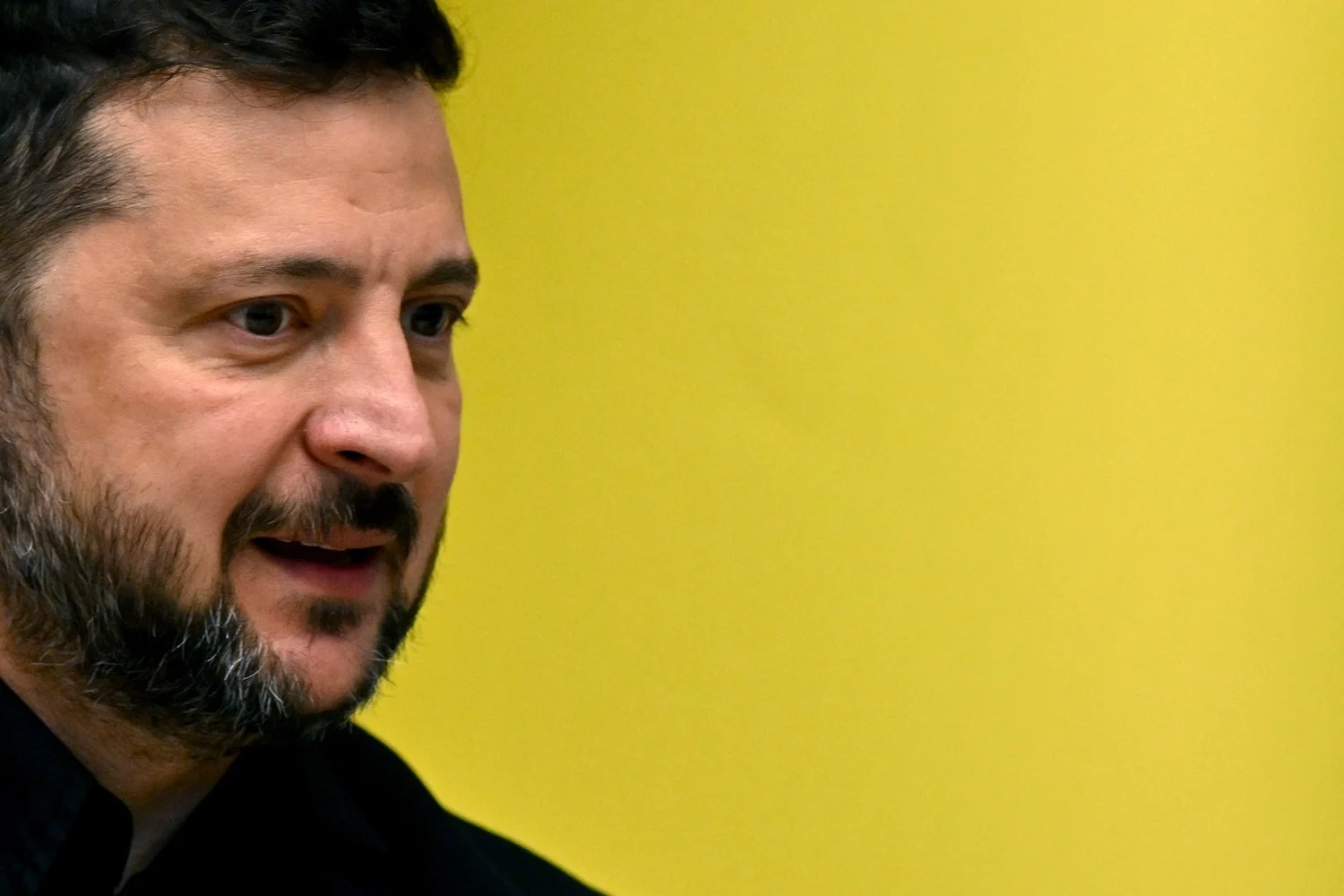
For most of his presidency and especially since Russia launched its full-scale war, Ukrainian voters have rallied around Volodymyr Zelensky as a pillar of national resilience and unity. That’s for good reason: He has been an effective wartime leader and helped mobilize the democratic world on Ukraine’s behalf.
But now, after more than seven years in office, four and a half years of war with Russia, and a series of scandals involving his leadership team and close friends, Zelensky appears to have lost the nation’s political support. Indeed, polling published in early August points to a major mood swing among Ukrainians, suggesting that many of them have lost faith in Zelensky and would vote him out of office at the earliest opportunity.
This swing in sentiment is likely to gain further momentum amid a new scandal involving the president’s key staff. Regrettably, Zelensky has spoken little of the alleged misdeeds of those in his inner circle. He highlights that he is not the subject of any investigations by anti-corruption agencies—a deceptive claim, since the Ukrainian Constitution bars such institutions from investigating or bringing criminal charges against a sitting president.
This lack of moral compass is all the more shocking given the extravagant promises that Zelensky made during his electoral campaign in 2019, when he guaranteed prosecutions and convictions of corrupt officials within months of taking office. Yet more than a dozen members of his party’s legislature, numerous government ministers, and members of his presidential office have been implicated or charged with corruption and illegal enrichment.
Recent polling from Ukrainian political research company SOCIS shows that Ukrainians now regard corruption as a greater problem than the war itself, in part because they link Ukraine’s fate on the battlefield to corruption at the highest levels of the state. Fully 90 percent of Ukrainians believe that corruption stands at a high or extremely high level. Most significantly and most emblematic of the shift, nearly 57 percent of Ukrainians blame Zelensky for the prevalence of corruption, nearly double the number in a similar poll by SOCIS in April 2025. The SOCIS polling also projects that three different rivals would beat him in a second-round election, each by a landslide margin of around 2-to-1.
Zelensky’s loss of support is largely a self-inflicted wound, the product of a philosophy of governance based on rule through a small group of functionaries prized for their personal loyalty. For years, Zelensky has touted and defended this highly centralized system of governance, in which nearly all decision-making emanates from the presidential office. In December 2023, he famously declared that he relies on a team of five to six key managers to run the country’s affairs. Such centralization, while in violation of the constitution, was long accepted by the public as necessary amid the wartime emergency.
In the past year, however, numerous scandals inside the heart of Zelensky’s office have shaken public confidence, and his system of rule through close confidants and managers is a shambles. Four of Zelensky’s top managers are implicated in allegations of illicit activities.
Andriy Smyrnov, a former deputy head of the presidential office, was indicted and brought before the High Anti-Corruption Court on charges of illicit enrichment and money laundering. In January, Rostyslav Shurma, a former deputy head for economic issues in the presidential office, was served with a notice of suspicion of involvement in a multimillion-dollar scheme involving state “green tariffs” earned by his brother’s solar power facilities; he now lives in Germany and has not returned to Ukraine.
Oleh Tatarov—a deputy head of the presidential office and perhaps Zelensky’s most influential current aide—likely benefited from the transfer of a bribery case against him from the independent National Anti-Corruption Bureau of Ukraine (NABU) to the prosecutor general’s office, which is firmly in the hands of Zelensky loyalists.
And of course, there is the notorious case of Andriy Yermak, Zelensky’s former chief of staff, who was charged by NABU and the Specialized Anti-Corruption Prosecutor’s Office (SAPO) in May with money laundering. He is accused of being part of a group laundering illicit cash and using some of it to build luxury housing. He is currently free on bail.
On Aug. 19, Iryna Mudra was dismissed as deputy head of the presidential office amid an investigation by NABU’s “Operation Forrest Gump” into an alleged $3.3 million money-laundering operation conducted through a state-owned bank to meet the bail requirements of a former government minister.
Mudra’s activities have deeper implications, as they appear to go further up the chain of command. The prosecution has presented evidence of phone conversations in which she says that she worked at the instruction of her “chief” to facilitate the illicit effort to raise bail. Many Ukrainian journalists believe that the chief she refers to is likely the head of the presidential office, Kyrylo Budanov, who is widely believed to have launched the effort to raise the bail funds at Zelensky’s behest.
In addition, a major corruption scandal involves Timur Mindich, a key business partner in Zelensky’s film and TV production company and a business partner of Serhiy Shefir, whom Zelensky entrusted with handling some of his assets after he became president. Recorded conversations and indictments by Ukraine’s anti-corruption agency suggest that Mindich was part of a criminal group that allegedly included a former justice and energy minister, a former deputy prime minister, and Zelensky’s chief of staff. That group is said to have engaged in extortion, benefited from government favoritism, and profited from state institution revenues. The wiretaps also suggest that Rustem Umerov, the man the president just named to run Ukraine’s foreign intelligence, may have worked to advance Mindich’s private business interests.
As the Mindich scandal was emerging, Zelensky’s administration appears to have used the country’s prosecutor general and the Ukrainian Security Service to open more than a dozen investigations of NABU agents and arrest several on charges of treason and trading with the enemy. Some of these charges came against Viktor Husarov, a detective, and Ruslan Mahamedrasulov, a top anti-corruption official, both of whom were investigating Zelensky’s circle of friends, appointees, and aides. These attacks, seen by some as designed to discredit anti-corruption agencies, were coupled with legislative initiatives launched by Zelensky’s office and party to end NABU’s and SAPO’s independence.
After a week of mass protests and pressure from Western donors, Zelensky relented. Eventually, charges of treason were dropped against Husarov, and Mahamedrasulov was released from arrest. His case is believed by most anti-corruption activists to be without foundation.
Zelensky’s descent into public disfavor has also been influenced by his erratic personnel policies. The first significant blow to Zelensky’s popularity came in February 2024 with the dismissal of Gen. Valery Zaluzhny, the popular and successful commander in chief of Ukraine’s armed forces. This was followed by the firing of Dmytro Kuleba, his effective foreign minister, and most recently, in mid-July, the dismissal—after six months on the job—of Defense Minister Mykhaylo Fedorov, who had helped spur Ukraine’s digitalization and shift to artificial intelligence- and drone-centered combat. Each of the dismissed officials enjoyed high levels of public trust and popularity in Ukraine.
The frequent firings of key officials have also eroded support for Zelensky. Under his presidency, there have been eight ministers of defense and seven economic ministers. Prime ministers have fared a bit better; there have been five in all, of which three were quiet and subservient to Zelensky and his top managers.
In the past, Zelensky recovered after dips in support—for example, after Zaluzhny’s dismissal and after the tense public White House showdown at the hands of U.S. President Donald Trump and Vice President J.D. Vance. But since last summer, public unhappiness with the charges of corruption in the Zelensky inner circle and the recent firing of Fedorov has solidified the public’s turn away from Zelensky.
To be sure, Ukrainian voters understand that conducting an election would be difficult amid a hot war, with its endless Russian attacks on cities and civilian targets. There are strong reasons why the Ukrainian Constitution delays all elections during time of war. But almost two-thirds of Ukrainians surveyed in the SOCIS poll now say that elections should come quickly in the event of a negotiated cease-fire or peace.
And while Zelensky maintains a strong core of loyalists, representing more than 20 percent of voters, few voters backing other candidates say they would support Zelensky if their candidate did not make it into a second round of voting. Thus, it isn’t surprising that the SOCIS polling indicates that in a second round, Zelensky would currently lose to Zaluzhny with 34 percent to the former commander in chief’s 66 percent, Fedorov with 36 percent to 64 percent, and Budanov with 38 percent to 62 percent.
Until a future election takes place, what are the implications of Zelensky’s diminishing popularity now?
While the SOCIS polling shows that 55 percent of Ukrainians believe Zelensky is governing ineffectively, the public shows strong unity and understands that it must continue to support Zelensky as the nation’s wartime commander in chief, even as they reject his domestic policies and style of rule.
Moreover, not everything in Ukraine’s war effort is dependent on Zelensky and the state. Ukrainians’ resilience and innovative capacity have been major factors in the turnaround on the battlefield. Civil society answered the initial call to mobilize and added vigor to the country’s resistance. And it was a small group of mainly women activists from nongovernmental organizations who initially trained thousands of combatants in drone operations, thereby creating a market for military drones that was initially supported through crowdfunding and only later by the state.
At the same time, Zelensky’s high levels of public disapproval carry risks. Disaffection with his leadership can affect morale on the battlefield. Moreover, Ukraine already faces serious problems with draft evasion. Growing public cynicism about the country’s rulers could exacerbate this problem. Just as importantly, attacks on civilian targets are on the rise. This winter will challenge Ukrainian morale when, given the scarcity of anti-missile interceptors, Russia is expected to seriously degrade Ukraine’s electricity and heating. Long blackouts and mounting destruction of civilian infrastructure will require civic courage and a leadership team that can—as in the past—inspire the people to hold on. It is unclear how much longer Zelensky can play that role and how effectively.
There are two ways of resolving this problem. The first—a wartime election—has little support among Ukrainians, remains logistically complex, and is currently illegal. The second is to reboot the system of governance by reducing presidential involvement in running the domestic government agenda, creating a government of national unity, and opening the door to a pool of effective and untainted officials from rival parties and the vast pool of effective officials whom Zelensky has dismissed because he saw them as potential competitors.
Unfortunately, nothing suggests that Zelensky can take such a step. He has always had absolute confidence in his decision-making and surrounded himself with a team of loyalists who rarely challenge his judgments. The time for centralized rule through a small group of cronies has long passed, and Western leaders and his own people should press him at every opportunity to take steps to ensure national unity and effective governance. With his own political future in tatters, it is time for him to try something new. A Ukraine at war requires no less.
