


I had to chuckle when I got the email. A PR blast announced “Netflix presents The New Stanford Prison Experiment.” Was this an attempt to one-up the satirically dystopian phrases in David Foster Wallace’s Infinite Jest? A “yes, and” to Wallace’s “Year of the Depend Adult Undergarment”? Alas, no. And for the streaming service that only became more ubiquitous after the global success of the gleefully sadistic Squid Game, it seemed apt.
The phrase “Stanford prison experiment,” like Lord of the Flies, is pretty much synonymous with violence, anarchy, and the bleakest confirmation of man’s inhumanity to man. Do we really need a “new” one?
Chances are you know about the original Stanford prison experiment. In August 1971, with the campus on break, a psychology professor at Stanford University named Philip Zimbardo offered a paying gig to students willing to run through an unusual and morally questionable exercise. The basement of a university building was made up to resemble a prison. Twenty-four students (all male, all white except for one Asian-American; “good boys,” Zimbardo called them) were randomly split into groups of inmates or guards and given appropriate uniforms. For two weeks, the professor thought, he would take notes on how unchecked power in an enclosed system would reveal itself. The experiment, funded by the U.S. Office of Naval Research, ended after six days, and that’s only because Zimbardo’s girlfriend stopped by and said, “Holy crap, what the hell is happening here?!”
Stanford professor Philip Zimbardo discusses the Stanford prison experiment on Aug. 20, 1971.Duke Downey/San Francisco Chronicle via Getty Images
At least that’s the lore. Zimbardo—a wonderful self-promoter later taken to wearing t-shirts with the letter Z resembling Superman’s logo—seemed eager not just to lean into his experiment’s findings, but to allow that he, too, lost his ethical mooring, suggesting that all closed institutions are incubators of depersonalization and madness.
You can watch this all play out in a pretty good fictionalized version of the experiment produced in 2015 called The Stanford Prison Experiment, adapted from Zimbardo’s 2007 book The Lucifer Experiment. In it, Billy Crudup plays Zimbardo, Michael Angarano plays a guard nicknamed John Wayne, and Ezra Miller and Tye Sheridan play the inmates who suffered the most, eventually quitting.
Indeed, the fact that the experiment went haywire and needed to be canceled surely aided in spreading its premise—that merely donning the costume of guard or inmate in a sealed-off environment would radically alter someone’s personality, and rather quickly. These findings, plus the inherent “wait, they let students do this?” question, made Zimbardo a notable and sought-after voice on cable news during the Abu Ghraib scandal.
But recent research and a three-part 2024 documentary that aired on the National Geographic channel, The Stanford Prison Experiment: Unlocking the Truth, offers firsthand testimony from the participants that they were coaxed to behave in ways that would conform to the experiment’s thesis. John Wayne, for example, wasn’t really a skull-cracking bully as the film clips suggest, but a pot-smoking theater kid who wanted to please his director. One of the kids who quit wasn’t on the verge of psychological collapse; he just thought the experiment was annoying and was told the only way to get out of it was to pretend he was losing it.
All these decades later, it’s hard to know which version is accurate. (As with so much in life, it is likely somewhere in between.) But the suspicion surrounding Zimbardo’s data is, I suppose, reason enough to call for a redo.
The punchline, of course, is that however bogus the original may actually be, this new iteration is a hundred times more manufactured.

Trymaine Lee and host Alison Wood Brooks in The New Stanford Prison Experiment.Netflix
Enter television producers Jane Lipsitz and Dan Cutforth, whose previous work includes competition shows like Project Runway, Top Chef, Nailed It!, and my personal favorite, the ongoing Is it Cake? franchise, which has somehow managed to stretch the act of wondering whether something is cake for three seasons plus five holiday-themed specials. With that eternal question still lingering, they decided it was time to turn their reality TV lens to issues of crime and punishment. (One wonders how Rodion Raskolnikov’s life would have been different had he had access to fondant.)
“Does power corrupt?” is the big question laid out in the first of six episodes in The New Stanford Prison Experiment. Our host—the Ryan Seacrest of this affair—is Alison Wood Brooks, an associate professor of business administration at Harvard University and a behavioral scientist, and she assures us this experiment will answer this question once and for all. Her two associates offering color commentary are Trymaine Lee, a Pulitzer-winning journalist and author, and Michael Cantrell, a retired federal corrections officer and podcaster.
In a decommissioned wing of an actual county correctional facility in Georgia, the trio sit before a bank of monitors from their panopticon’s perch, which naturally includes a whiteboard featuring circled names, flowchart markings, and vague phrases like “test ourselves.” They observe the activity of the show’s willing participants as though they were Harry Lime on a Ferris wheel, strikingly detached from humanity.
And who are the participants? Unlike Zimbardo’s crew—kids looking for a summer gig—these are adults with a full understanding of what they are doing. If there is a financial incentive, it is never mentioned. What is mentioned is that everyone involved considers this is a test of their character, and that the experiment may lead to an important conclusion. What’s more, the show has intentionally kept the pool of applicants diverse in age, race, and class—CEOs and bartenders walk side by side in their civilian clothes before the selection begins.

Contestants wait to join the experiment in The New Stanford Prison Experiment.Netflix
The original experiment left who would be an inmate versus a guard completely up to chance. Not so here. The producers have predetermined this, but the audience isn’t privy to how they made their decisions. (The three women are guards because someone must have wisely realized that mixing genders in a locked-down 24-hour quasi-jail was something no insurance company would cover.)
Once the guards and inmates are suited up, they are led to the “pod,” and the reality of their situation—even though everyone knows this is a TV show—sinks in. They overhear disturbing noises from elsewhere in the (real) prison. The food is horrible. There is no privacy on the toilet during lockdown hours, and each cell is limited in the number of allowed flushes (a reality in many prisons, I have learned).
But there’s an elephant in the room. Unpleasant though this may be, no one is actually incarcerated or in anything resembling danger. There are cameras everywhere, and all anyone needs to do is say the safe word (“pineapple”) and they are free to go.
Also, all of the inmates have clearly been encouraged to give periodic first-person addresses (cleverly shot through glass to resemble a visiting room)—a very common reality show trope to add narration and assist in the editing process. Annoyingly, while watching the finished product, we have no idea how scripted these moments are, or when during production they were recorded. Also, everyone, from all walks of life, uses Instagram-friendly therapy speak phrases. Great for marketing clips.
Read More
-

Four characters sit around a coffee table in an apartment living room. On the left, Seth Rogen in a denim shirt sits on a couch expressing something, while Olivia Wilde sits on the floor smiling. On the right, opposite them, Edward Norton in a black sweater sits on the green couch smiling with his hands on Penelope Cruz’s shoulders while she is sitting on the floor below him laughing. Four characters sit around a coffee table in an apartment living room. On the left, Seth Rogen in a denim shirt sits on a couch expressing something, while Olivia Wilde sits on the floor smiling. On the right, opposite them, Edward Norton in a black sweater sits on the green couch smiling with his hands on Penelope Cruz’s shoulders while she is sitting on the floor below him laughing. What 6 Different Versions of This Sex Comedy Say About the Countries That Made Them
Trust the French to add a wild twist.

-

A medium close-up of two young boys standing in a tropical jungle. The boy in the foreground wears round glasses and a tan undershirt with suspenders. The boy behind him has curly hair, wears a tan button-down shirt, and holds a long, forked wooden staff. Other boys are visible in the blurred background. A medium close-up of two young boys standing in a tropical jungle. The boy in the foreground wears round glasses and a tan undershirt with suspenders. The boy behind him has curly hair, wears a tan button-down shirt, and holds a long, forked wooden staff. Other boys are visible in the blurred background. A ‘Lord of the Flies’ for Our Time
This is the perfect project for the creator of ‘Adolescence.’
-

A blonde woman stands in an aisle between two rows of pharmacy shelves filled with medications. Her arms are outstretched to touch the shelves on either side. A blonde woman stands in an aisle between two rows of pharmacy shelves filled with medications. Her arms are outstretched to touch the shelves on either side. In Defense of the Hive Mind
Vince Gilligan’s “Pluribus” asks whether an AI-led society would really be that bad.
Over time, some personalities begin to shine. One of the younger inmates, Pete, who has a Jesse Eisenberg-like quality, is a fifth-grade social studies teacher who feels compelled to instigate and push back against authority. His reasoning is hazy, but he seems to be working toward some poorly defined, somewhat utopian ideal. (The show works mostly in soundbites, not thorough arguments.) He quickly finds some teammates in the art of pushing back, one specifically who seems even more eager to be a thorn in the guards’ side, even though Pete is quietly calling the shots.
The guards, meanwhile, are split into a night and day shift, and an alpha male soon finds himself the unelected leader of each. On night shift, there is Chris, an entrepreneur with a coaching business and an intense desire to be liked. He enforces rules but does it with a smile. On the day shift, there’s Chet, a supervisor on an oil rig, who seems more than eager to carry the metaphorical big stick.
The guards get printed memos (not unlike directives from the Gamemakers in The Hunger Games) with certain tasks and directives. They are to vote for a head guard among them on their shifts (in one case reversing what seemed like natural selection) then each shift must elect what is effectively a shop steward from among the inmates. As the choices are made, our three observers titter and murmur in fascination.
Things move along largely as expected. There is discord. Much of this is due, so the experts conclude, from too much individuality, which is anathema in a prison. Chris and Chet have different styles, and this imbalance causes a rupture. When penalties (such as removing a common clock) aren’t enforced, it creates a mess.
On the seventh day of the show, longer than the original experiment ever went, there comes a new twist. Some of the guards and inmates are directed to trade places. Wouldn’t you know it, the troublemakers are now wearing the badges. How will this change things?
Naturally, the show milks this reversal for as much drama as possible, but it is ultimately quite anticlimactic. This isn’t a real prison, it isn’t even a rogue college experiment from the early 1970s; it’s a Netflix reality show. It’s meaningless! You keep waiting for a hockey brawl to break out, but nothing like that ever happens.

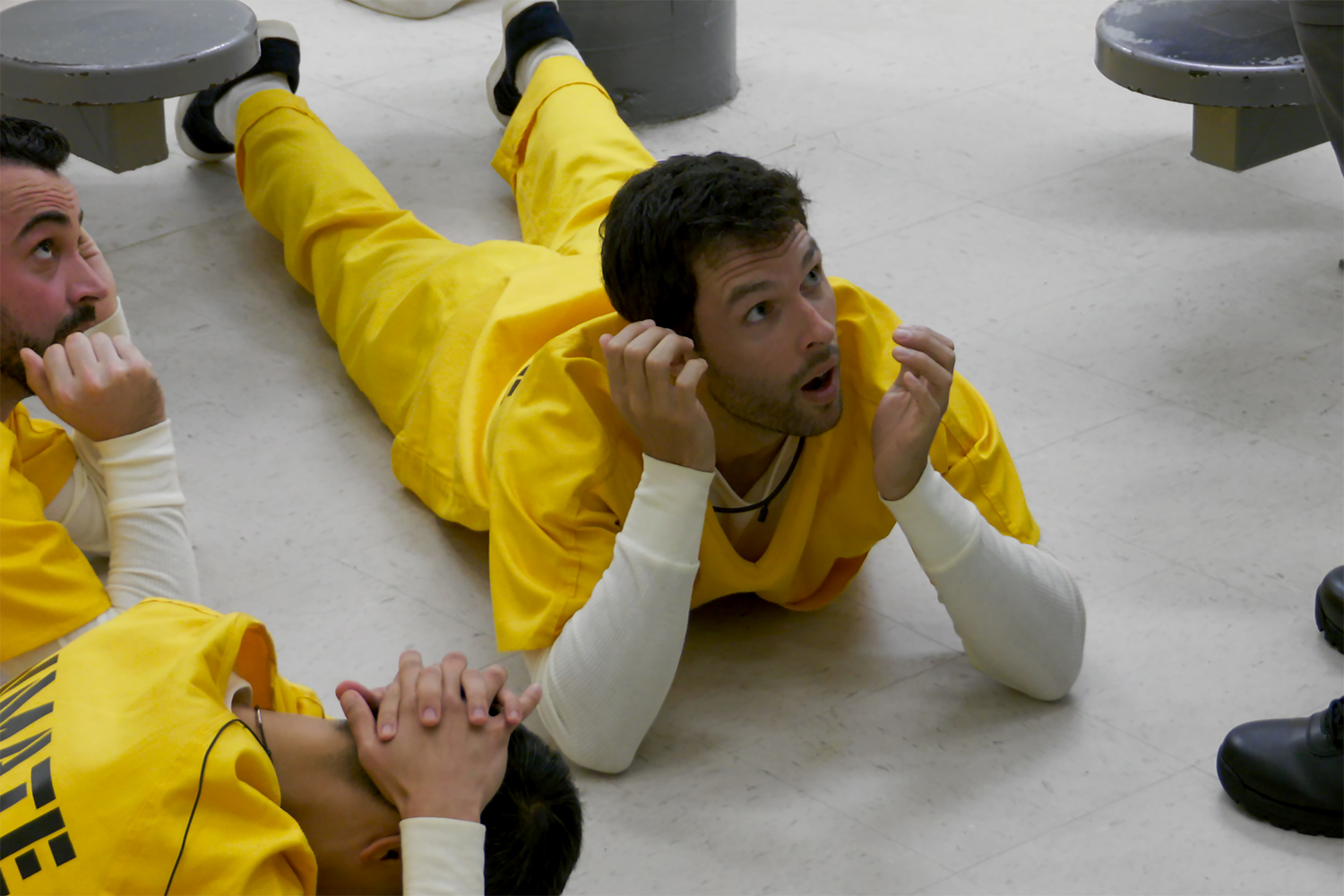
Guard and inmate contestants in The New Stanford Prison Experiment.Netflix
At first, the new guards try to act like “good” guards but soon realize this makes them seem like hypocrites. Instead, they ease up on restrictions, leading to a bit of a party atmosphere. Meanwhile, many of the inmates realize this is all kind of dumb (as will a great number of home viewers, I’m sure!) and start saying “pineapple.” Others are determined to make it to the end, to fulfill some sort of promise they’ve made to themselves. (Does Netflix cut them a bonus check if they last 14 days? None of that is ever discussed.)
Finally (to risk spoiling things), a decision emerges from the ranks. If the inmates all decide to leave as one, as a collective instead of individuals who have had enough, then they will have “taken power” and used it in the name of righteousness. Beaming with pride, our three overseers are delighted to conclude that, wowee, power doesn’t always corrupt! What a relief! The world’s systems can stay in place now. Or something.
If all this sounds preposterous, just know I’m leaving tons of extra nonsense out. I watched this series in awe of its stupidity. I am not one who automatically dismisses all competition shows. The Great British Baking Show is charming and RuPaul’s Drag Race is chock full of puns and creativity. But The New Stanford Prison Experiment is a round peg in a square hole—a ludicrous scenario desperate to rationalize its own existence.
Zimbardo’s experiment may have been unethical, but this is just humiliating, both to the audience and to the people who had to spend nearly two weeks in uncomfortable conditions before landing on a milquetoast and meaningless conclusion. If I were forced to watch all six episodes again, it would feel like a jail sentence.
