


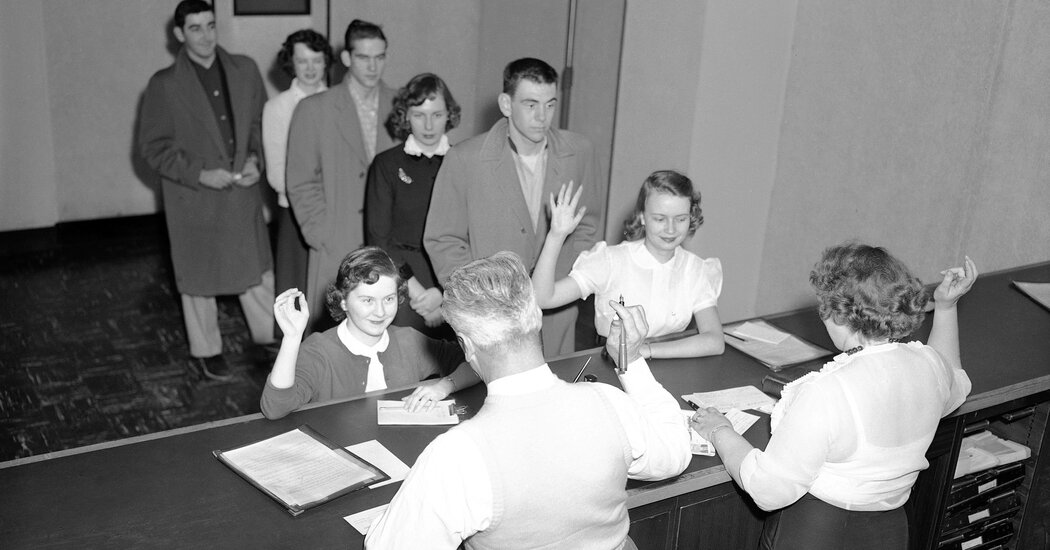
The 26th Amendment, which lowered the voting age to 18 nationwide, was in part a reaction to the Vietnam War. “Old enough to fight,” the slogan went, “old enough to vote.”
Until recently, the amendment, adopted in 1971, had not been the subject of much judicial scrutiny. Indeed, it had arguably done more work to protect young people’s gun rights than to prohibit age discrimination in voting.
But a federal appeals court made muscular use of the measure a couple of weeks ago. The ruling struck down a South Carolina law, finding that it discriminated against younger voters who want to vote by mail.
As in a handful of other states that otherwise limit voting by mail, people 65 or older can vote by mail in South Carolina just by asking. But younger voters need a reason, like being away from home on Election Day.
A unanimous three-judge panel of the Fourth Circuit said the law was at odds with the command of the 26th Amendment, which says the right to vote “shall not be denied or abridged by the United States or by any state on account of age.”
Last week, the Supreme Court ducked a challenge to the Trump administration’s efforts to curtail voting by mail, but that issue will reach the justices again shortly.
The South Carolina case is also a good candidate for Supreme Court review, as it created a split among the federal appeals courts. The Fifth Circuit upheld a similar Texas law making distinctions based on age in mail-in voting, and the Seventh Circuit did the same with one from Indiana.
The Supreme Court views resolving such splits as one of its core responsibilities.
When Texas voters asked the Supreme Court for emergency relief in 2020, before there was a circuit split, the justices turned them down. But Justice Sonia Sotomayor wrote that the case “raises weighty but seemingly novel questions” that she hoped the court would consider in a less hurried setting.
Originalism and Age Discrimination
Only the Fourth Circuit’s ruling is faithful to the original meaning of the 26th Amendment, Vikram Amar, a law professor at the University of California, Davis, wrote last month in Verdict, an online legal publication.
The measure’s language, he wrote, echoes earlier amendments that had expanded the franchise. The 15th Amendment, adopted in 1870, after the Civil War, said the right to vote “shall not be denied or abridged” based on race. The 19th Amendment, adopted in 1920, said the same thing about sex.
Those words, and particularly “abridged,” meant the same thing in all three amendments, Professor Amar wrote. They not only guaranteed the right to vote but also forbade curbing the right to vote, that is, discrimination.
The Fifth Circuit disagreed. Judge Leslie H. Southwick, writing for a three-judge panel in 2020, said a voting law violates the 26th Amendment “only if it makes voting more difficult for that person than it was before the law was enacted.”
Making it easier for older people to vote, in other words, did not hurt younger ones.
But would that reasoning fly if the criterion were race?
Judge James C. Ho, in a concurring opinion in an earlier chapter of the Fifth Circuit case, wrote that “it would presumably run afoul of the Constitution to allow only voters of a particular race to vote by mail.”
When the South Carolina case was argued before the Fourth Circuit in January, Judge Pamela Harris explored the question with a lawyer for the state.
“You’re asking me to write an opinion that says my state of Maryland — I’ll make it personal for me — tomorrow could pass a law that says we’re going to have voting on Election Day except all white people can vote early two weeks before Election Day,” she said, offering the same race-based hypothetical.
“That strikes me as a hard ask,” she said.
In their brief to the appeals court, lawyers for South Carolina argued that its law was justified by “the state’s vital interest in preventing voter fraud.” It made this point four times, echoing President Trump’s frequent false assertions that mail-in balloting is marred by widespread fraud.
Lawyers for the voters challenging the law said they were puzzled by that assertion. “Nowhere does the state offer any explanation as to how an age-based restriction on absentee voting combats fraud,” they wrote.
The Fourth Circuit did not decide whether South Carolina must allow people to vote by mail without regard to age or if it should, instead, limit mail voting for everyone. That question, it ruled, should first be addressed by a trial judge.
The answer is not obvious. The Supreme Court has generally “leveled up” in such situations, conferring the benefit in question on everyone. But in deciding in 2017 that unwed mothers and fathers must be treated the same for purposes of an immigration law, Justice Ruth Bader Ginsburg “leveled down,” withdrawing favored treatment from the children of unwed mothers.
The politics are also tricky. Republicans used to promote mail voting, which is particularly popular with older voters for whom visiting a polling place can be hard. Now that Trump has turned his party against the practice, it is not clear whether his allies would prefer to do away with it for everyone or open it more widely to younger people, too.
Got a news tip about the courts? If you have information to share about the Supreme Court or other federal courts, please contact us.
While that question remains unsettled, Sydni Bain, a spokeswoman for the South Carolina Election Commission, said that for now “the rules for absentee voting in South Carolina have not changed.”
Some good news about The New York Times app
Here’s something cool: If you’re not a subscriber, you can read The Docket’s archives, about 5,000 other articles by me and all of The Times’s journalism without any paywalls for one month when you download The New York Times app. No credit card needed. If you already subscribe, thanks a ton for your support. (Was this newsletter forwarded to you? Sign up here.)
Other Legal News
-
Jodi Kantor revealed private negotiations among the justices about locking away their papers, which may not be made public for decades.
-
Zach Montague and Matt Schwartz explored the Trump administration’s strategy of suing in friendly courts in North Texas.
-
Ann Marimow examined Chief Justice John Roberts’s unusual dissent from the Supreme Court’s decision that let construction of Trump’s grand ballroom proceed.
-
I looked at the mismatch between a judicial system characterized by unhurried deliberation and the Trump administration, which is built for speed.
Mailbag
‘What’s It to You?’
What is required for plaintiffs to have standing? — Norma Killilea
Now that’s a timely question. In just the last couple of weeks, the Supreme Court has refused to rule on challenges to President Trump’s ballroom and his executive order seeking to curtail voting by mail, both times on the grounds that the challengers lacked standing.
The Supreme Court court has developed elaborate tests to determine if plaintiffs have a proper legal basis, known as standing, to bring a lawsuit. But their essence, as Justice Antonin Scalia once observed, is a four-word question: “What’s it to you?”
To get into court, it is not enough to be unhappy about something. Only people with a direct stake in a dispute have standing to sue over it.
Walter Dellinger, a former acting U.S. solicitor general, once said that a rigorous approach to standing was consistent with Chief Justice John Roberts’s statement at his confirmation hearings that judges should aspire to be umpires.
“Before any judge begins calling balls and strikes,” Mr. Dellinger said, “he must first make sure the batter at the plate is an actual player and not just a fan who ran on the field.”
If you’d like to hear all of this translated into legal jargon, here goes: To establish standing, plaintiffs must show that they suffered an injury that is concrete and particularized as well as actual or imminent; that the injury was caused by the defendant; and that it would be redressed by judicial relief.
In the ballroom case, the majority said that a historian’s distaste for the new building did not satisfy the requirement of a concrete and particularized injury. “Nearly any government action or project offends someone’s sensibilities,” the majority said in an unsigned opinion.
In the case on mailed ballots, the majority said a challenge to the executive order from several states was premature because “the order itself does not harm the states.” That does not mean, the opinion continued, “that any measure taken by the government to implement the order will necessarily be lawful.”
What is certain is that the standing doctrine can mean that some legal questions never get answered in federal court, as Justice Brett Kavanaugh wrote in 2024. “Some issues,” he wrote, “may be left to the political and democratic processes.”
I would love to hear your questions on the law, the courts or whatever is on your mind. Send them my way at the-docket@nytimes.com.
Closing Argument
A Return Trip in Sex Shaming Case?
The Supreme Court last year gave the only woman on death row in Oklahoma a fresh chance to challenge her sentence and conviction, saying that prosecutors may have violated her right to a fair trial by introducing lurid evidence about her sexual activities.
The justices sent the case back to the 10th Circuit, and a panel of judges there concluded in January that the evidence “did not substantially undermine the fundamental fairness of the trial.” Last month, the full 10th Circuit refused to rehear that decision.
Lawyers for the woman, Brenda Andrew, say they will ask the Supreme Court to step in again in the coming weeks.
The justices will have to side with her again if she is to be spared from execution. Her case raises questions about how far prosecutors can go in presenting evidence about women’s sexuality to raise questions about their character with the jury.
Andrew was convicted of murdering her husband. Her trial was tainted, the Supreme Court said in an unsigned opinion last year, by “evidence about Andrew’s sex life and about her failings as a mother and wife.”
“Among other things,” the opinion said, “the prosecution elicited testimony about Andrew’s sexual partners reaching back two decades; about the outfits she wore to dinner or during grocery runs; about the underwear she packed for vacation; and about how often she had sex in her car.”
During closing arguments, a prosecutor dangled Andrew’s thong underwear before the jury. She had packed the undergarment for a trip to Mexico a few days after her estranged husband was killed.
The prosecutor said the item was strong evidence that Ms. Andrew had murdered her husband. “The grieving widow packs this to run off with her boyfriend,” he said, holding her underwear.
The spectacle “drew gasps from the crowded courtroom,” a local newspaper reported.
Prosecutors have said the evidence concerning Andrew’s appearance and sexuality was “but a drop in the ocean” in the case against her.
Andrew’s boyfriend, James Pavatt, admitted to shooting Andrew’s husband and said he had acted alone. But there was reason to think Andrew was involved, as part of a plot to obtain the proceeds of a life insurance policy, and the authorities charged both of them with capital murder. Pavatt was also sentenced to death, and he is scheduled to be executed in November.
Please send me your comments on voting rights, standing, the death penalty or anything else at the-docket@nytimes.com. See you next week. — Adam
