


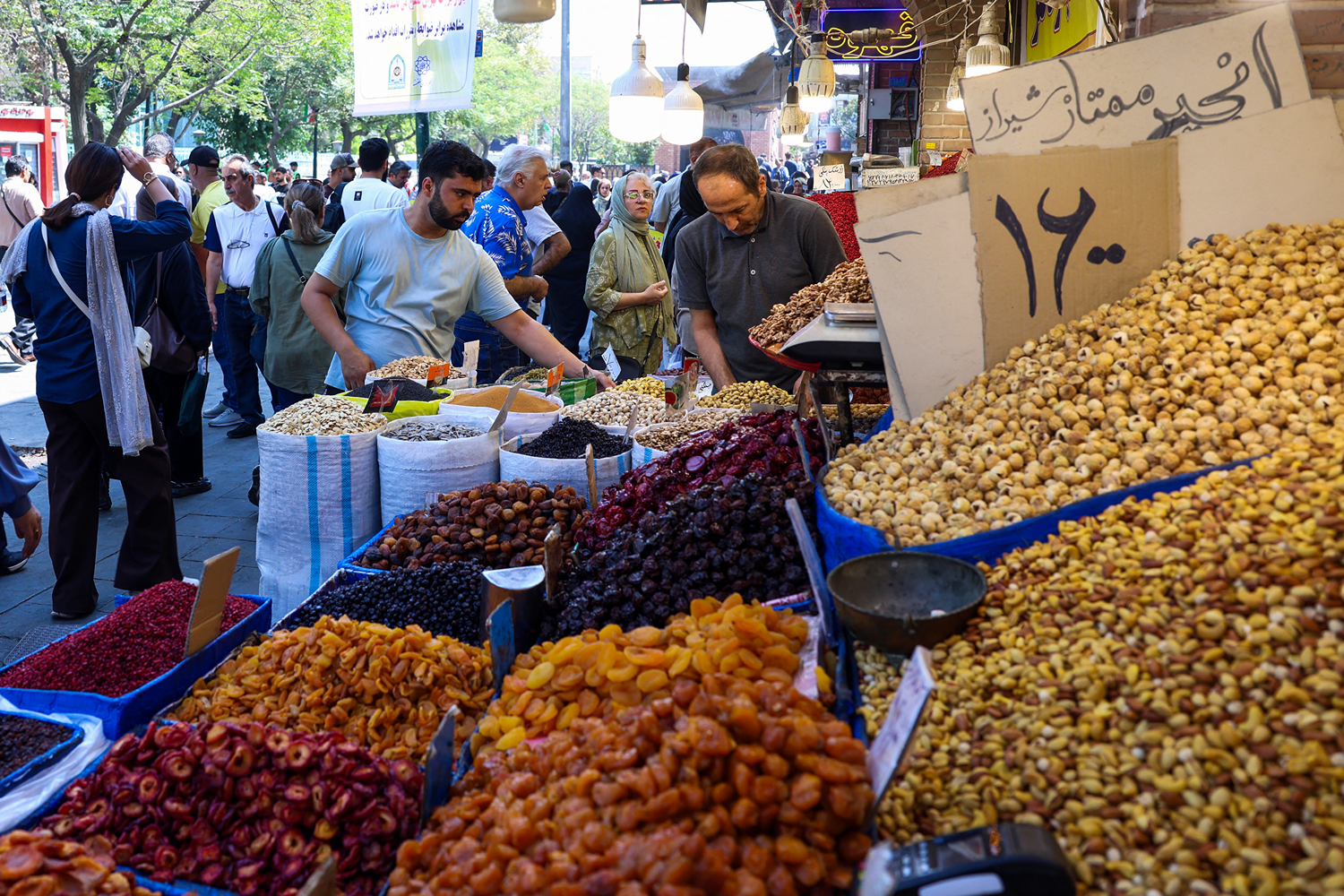
As Iran’s economic woes become harder to hide, the Trump administration is increasingly convinced that tightening pressure will eventually work. On Aug. 19, the U.S. president announced “the most crushing economic operation ever taken against any country.” Iran’s economy is certainly battered. Since the war began, the rial has depreciated, and prices have risen. President Masoud Pezeshkian has acknowledged that the country’s revenues have also fallen sharply. U.S. President Donald Trump’s team sees this as evidence that, despite the failure of heavy bombing campaigns to topple Tehran’s government, Iran’s economy is approaching a point of no return.
But how close is Iran’s economy to collapse? How long can it hold out, and how much further economic pain is needed to alter the leadership’s thinking? Iran’s capacity to absorb the pain is not unlimited, but that does not mean that collapse is imminent, let alone on Trump’s timetable. Even a severe economic breakdown will not necessarily force Tehran into capitulation.
As Iran’s economic woes become harder to hide, the Trump administration is increasingly convinced that tightening pressure will eventually work. On Aug. 19, the U.S. president announced “the most crushing economic operation ever taken against any country.” Iran’s economy is certainly battered. Since the war began, the rial has depreciated, and prices have risen. President Masoud Pezeshkian has acknowledged that the country’s revenues have also fallen sharply. U.S. President Donald Trump’s team sees this as evidence that, despite the failure of heavy bombing campaigns to topple Tehran’s government, Iran’s economy is approaching a point of no return.
But how close is Iran’s economy to collapse? How long can it hold out, and how much further economic pain is needed to alter the leadership’s thinking? Iran’s capacity to absorb the pain is not unlimited, but that does not mean that collapse is imminent, let alone on Trump’s timetable. Even a severe economic breakdown will not necessarily force Tehran into capitulation.
For economic pressure to fundamentally alter Tehran’s calculation, there are only two options. Firstly, it could be paired with credible economic incentives and a political off-ramp to make restraint more valuable than resistance, as the original Joint Comprehensive Plan of Action attempted. The alternative is to break Iran’s capacity to absorb shocks and adapt. In that scenario, the economic pain might translate into political pressure to bring about Washington’s desired changes in Tehran—namely, a full collapse of the government itself and, theoretically, its replacement with a more U.S.-friendly alternative. The Trump administration increasingly appears to be pursuing this second path.
Prolonged economic sanctions since 2011 have already severely damaged Iran’s economy. Iran has absorbed the pain through higher inflation and the devaluation of the national currency. While Iranians’ real purchasing power has declined, goods continue to flow through formal and informal trade networks. As such, inflation increased, but shelves were not empty. The economy gradually adapted through further diversification of trade and domestic production, expansion of a shadow network for sanctions evasion, and the provision of social protection programs.
This costly survival economy has kept trade and production moving and allowed the state to meet its core obligations, but the war and blockade risk ending this functionality. Despite damage to industrial facilities and energy infrastructure as well as disruptions to transportation networks and trade, the economy has not collapsed yet.
Collapse is hard to define, but let’s call it the point at which Iran’s economy can no longer absorb pain and adapt to shocks. That would demand the simultaneous—and sustained—collapse of several elements of the economy.
One key part of collapse would be the national currency losing its credibility and its function as a medium of exchange and of saving, leading to dollarization. A sustained high monthly hyperinflation rate above the IMF’s 50 percent threshold, with a rapid daily depreciation, could motivate households and firms to increasingly replace the rial with the dollar in everyday transactions.
Another element would be if the government can no longer meet its basic fiscal obligations. Iran’s public budget faces a severe deficit owing to rising military, reconstruction, economic, and welfare costs as well as dropping revenues. Based on my estimate, the war has reduced Iran’s export revenue by $30 billion to $35 billion. Even if the government were to address only part of the war’s damage to household welfare, it would require 31 percent of the public budget.
There is no sign that Iran is even close to the collapse of its national currency and fiscal system. The country is experiencing high inflation right now, but the rial still performs its basic functions as a national currency. Salaries and prices are still paid in rials, and there is no sign of severe daily devaluation.
The currency’s devaluation is worsening, but it remains below the monthly inflation rate, which is around 5 percent to 6 percent. If the blockade continues, average monthly inflation could rise above 10 percent. Still, it is highly unlikely that Iran’s economy will experience 40 percent to 50 percent monthly inflation in the next four to five months. There is also no sign that the government will run out of money to pay public sector salaries, pensions, security personnel, and basic subsidies any time soon.
Lack of access to food and a subsistence crisis could also accelerate collapse and fuel nationwide unrest. This June’s food inflation reached almost 130 percent compared with June 2025. In my estimate, more than 70 percent of the population is living in economic hardship; 90 percent are unable to afford the full food basket, including 30 grams of meat daily, as recommended by the Iranian Health Ministry. More importantly, 10 percent of the population cannot afford the basic calories needed for life and are now in extreme poverty.
Despite the devastating impact of the current pressure, a catastrophic food insecurity crisis—as defined by the World Food Program, in which more than 30 percent of the population has no access to food—is not close. As the government can afford to maintain a universal food assistance program and activate the Iran-Iraq war rationing system, the situation is sustainable.
How is the economy surviving the U.S. assault? Iran’s economic and geographical diversity undermines the effectiveness of the blockade. Thanks in part to $6 billion in oil revenue shipped during the brief respite offered by the Memorandum of Understanding with the United States, Iran’s oil revenues are still higher than in 2020. Iran’s $45 billion gold reserves are sufficient to cover three years of its basic food and medicine needs. And Iran’s diverse geography provides the country with access to essential goods, food, and medicine, although at higher costs.
The government, through borrowing from the banking system, printing money, and reallocating resources, can still meet its obligations. Iran’s remaining resources and experience of managing liquidity, exchange markets, imports, and expectations during wartime will help avoid the possibility of collapse in the coming months.
Even if Iran faced widespread dollarization, as Venezuela did during its 2017-2021 hyperinflation crisis and Lebanon did in 2019, with prices and transactions increasingly shifting from the rial to foreign currencies, and fiscal collapse undermined the state’s capacity to fund its institutions, economic hardship would not automatically translate into the desired political change. The state is still capable of absorbing public anger through force and crackdowns, as demonstrated by the responses to the December 2025 prewar protests, the 2022-23 “Woman, Life, Freedom” uprising, and the November 2019 protests.
Despite the decapitation of Iran’s intelligence services during the war, the country’s security forces remain capable of repressing large-scale unrest, restricting communications, arresting organizers, and securitizing economic protest. There is a growing dissatisfaction, but a sustained nationwide mobilization does not seem very immediate.
Economic grievances have been partly displaced by security concerns, fear, uncertainty, and skepticism about what protest can achieve. The war triggered a rally-around-the-flag effect, leading some disappointed Iranians to tolerate hardship when they believed that their country was under external attack. Mobilization in wartime also carries extremely high costs, particularly after the recent bloody crackdowns in December. Many are also skeptical that taking to the streets might lead to desired changes. Attacks on civilian infrastructure, schools, universities, and bridges, and Trump’s rhetoric calling Iran “a nation of terror and hate,” have only increased skepticism of revolt.
Iran’s capacity to absorb economic pressure is not unlimited, and public anger could eventually manifest as widespread unrest. But it is unlikely to come as quickly as Washington expects, and it may not even occur within Trump’s term. Even if it came, the collapse would not guarantee political submission. Instead, it might lead to a more aggressive adversary, still willing and able to disrupt shipping and energy markets, imposing higher military, economic, and political costs on the United States.
Economic pressure will impoverish Iranians and could eventually lead to the collapse of their economy without significant political gain for Washington. If the objective is to change Iran’s calculus for a compromise, then pressure needs to be paired with an off-ramp and tangible economic relief. The United States needs to increase the cost of resistance by offering credible incentives that make restraint more appealing in Tehran—a deal that rewards de-escalation, opens the Middle East’s largest untapped markets to U.S. companies, and convinces Iranians that compromise is materially worthwhile. This credible relief would shift the internal balance of incentives in Iran by strengthening the case that restraint delivers more than resistance.
