


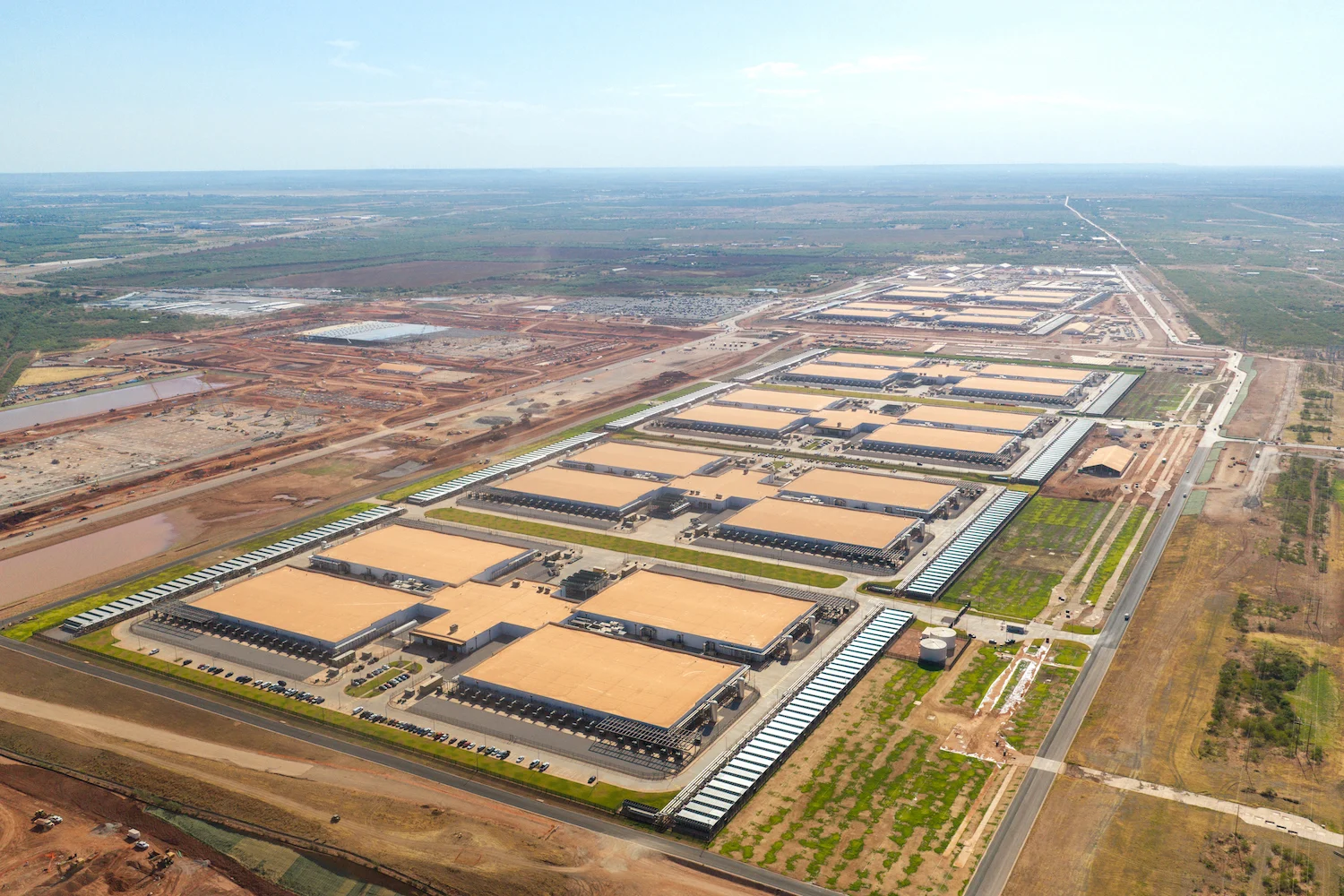
Weeks ahead of high-stakes midterm elections, many Americans are revolting against the data centers being developed in their communities to power President Donald Trump’s artificial intelligence ambitions.
About two-thirds of Americans oppose local data center construction, according to polls, and that resistance has been reflected in sweeping protests. In addition to concerns about the impact a new data center may have on jobs, local residents commonly cite the amounts of water, electricity, and land data centers consume and what that could mean for energy bills and the environment.
Most controversial are the “hyperscale” data centers used by companies such as Amazon, Microsoft, and Google, which can dwarf the size of other facilities and have taken off amid the AI boom.
Opposition has grown so fierce that at least 15 states are weighing moratoriums, while lawmakers on both sides of the aisle have aligned themselves with outraged locals. “We’ve finally found something that can unite the left and the right,” quipped Joshua Rhodes, a research scientist at the University of Texas at Austin.
Yet that backlash has done little to deter the Trump administration, which has championed data centers in its bid for global AI dominance. More than 1,500 data centers are now under development, adding to the 3,000 already operating in the country, according to the Pew Research Center.
“The only reason that communities throughout the U.S.A. should not want Data Centers is if they want to end up being backwards and poor,” Trump declared in a post on Truth Social in August. “If they want to be successful and rich, with far lower taxes and jobs all over the place, let Data Reign.”
As tensions threaten to reach a fever pitch ahead of midterms, here’s what we know about data centers’ actual resource footprint.
Power
At a time of surging energy costs, national attention has focused on data centers’ power consumption, with half of Americans saying that they spell trouble for energy bills, according to Pew.
Data centers accounted for 4.7 percent of total U.S. electricity consumption in 2024, up from 4.4 percent the year before, according to Lawrence Berkeley National Laboratory.
That share is set to surge in the coming years, though estimates range. Data centers could consume nearly 12 percent of U.S. electricity by 2030, according to Lawrence Berkeley. And by 2035, data centers could suck up so much energy that they make up about one-fifth of U.S. electricity consumption, according to BloombergNEF.
So far, the data center construction frenzy has been largely concentrated in a handful of hot spots, with the biggest in Virginia, Texas, and California. But that is poised to spread as even more data centers are planned, including in Illinois, Georgia, Ohio, and Arizona.
All of those forecasts point to a buildout unfolding at a speed and scale that states are ill-equipped for. “We’re looking at very rapid growth, and what’s been happening in recent years is very flat demand in the power sector,” said Lori Bird, an energy expert at the World Resources Institute. “So this is quite a reversal.”
Texas offers a window into how such an expansion can strain local infrastructure—and ignite a political firestorm. Texas Gov. Greg Abbott once vowed to make the state the “epicenter of AI development,” and at least 248 new data center projects are planned, adding to the state’s existing 335.
“There’s almost no muscle memory in the system to meet those growth rates,” said Ashish Sethia, the global head of commodities at BloombergNEF, citing a scarcity of technicians, transformers, and transmission lines. “Therefore, you’re seeing this kind of scramble to try and get hands on as much power capacity to support your data center.”
Demand has been relentless. Over the summer, the Electric Reliability Council of Texas (ERCOT), which operates the state’s grid, said it was considering about 474 gigawatts (GW) of interconnection requests—or over five times the state’s record peak electricity demand for the operator, according to the state officials; 90 percent of those new power requests are from data centers, ERCOT said. In August, Abbott directed state regulators to stop data center connections and ordered audits.
“It’s insane,” said Rhodes, who said that the entire Houston area sees about 17 GW at peak demand. “Houston is about 17 gigawatts, and we’re seeing multiple Houstons’ [worth of] data centers trying to connect to the ERCOT system at a time.”
The big question looming over the buildout, in Texas and beyond, is what this all means for consumers’ electric bills. The answer is, unsurprisingly, somewhat complicated.
“It really depends on how much are you doing [and] does the system have the capacity to manage it,” said Bird, who said that it can be a benefit if you have a power system with excess generation available. “But what we’re seeing is that in a lot of these regions there’s not enough, and that they’re trying to move so quickly.” Gas turbine prices, for example, have spiked nearly 200 percent as a result of the data center expansion.
As outrage has grown, Trump has said that corporations—not consumers—should bear the cost of the boom. And regulators, too, are scrambling to ease community tensions. Regulators and power grid operators are trying to ensure that increased costs are not passed to end-consumers, said Sethia.
Desperate for more energy—and fast—data center developers are increasingly looking outside of the existing grid. Many tech giants are building their own natural gas plants on-site to meet the facilities’ immense power needs. There are more than 80 gas-burning power plants under construction or proposed across the country, according to estimates by the Environmental Integrity Project, a nonpartisan, nonprofit organization that advocates for the enforcement of environmental laws. Companies, including Google, are also increasingly embracing nuclear power as an emissions-free electricity source.
But the outsized role that natural gas is playing in the national data center buildout, at least in the short term, has big implications for U.S. emissions and pollution. “It’s going to increase emissions from the power sector, which will accelerate the effects of climate change,” Rhodes said.
Water
A protester wearing an axolotl costume waits for the March for Water and a Sustainable Future to begin in San Marcos, Texas, on Aug. 19, 2025. Sara Diggins/The Austin American-Statesman via Getty Images
To prevent overheating, data centers of all sizes require powerful cooling systems that often use a lot of water. That has worried communities: Gallup found that excessive water usage is one of the top reasons that Americans oppose local data center construction.
But it can be challenging to measure their water footprint, in large part because there is a lack of consistent and transparent data, according to Joe Kane, an infrastructure researcher and former fellow at the Brookings Institution, a Washington-based think tank. Much of that information lies with the tech firms, he said.
There is also no one-size-fits-all value for water usage, either. “If you look at the full range of different data center designs across different climates, different ways of operating them and so on, there is a factor of 10,000 difference in the water intensity of the data centers on-site,” said Jonathan Koomey, an independent energy analyst.
Data centers directly consumed an estimated 66 billion liters of water by 2023, according to a 2024 Lawrence Berkeley report. That number is only set to get bigger: By 2028, hyperscale data centers alone are expected to swallow up between 60 and 124 billion liters of water.
And those figures don’t even include data centers’ indirect water footprint. Data centers across the country consumed a total of nearly 800 billion liters of water solely as a result of their electricity use in 2023, according to Lawrence Berkeley.
Those volumes pale in comparison to other highly water-intensive activities and sectors, such as residential lawn irrigation and U.S. beef and meat production, which guzzle thousands more gallons of water.
Yet data centers’ thirst has emerged as a key flash point as the facilities are built in states experiencing water stress, such as California, New Mexico, Arizona, Nevada, and Utah. In 2021, researchers estimated that one-fifth of data center servers’ direct water footprint hits places with moderate to high levels of water stress.
“We can move electricity thousands of miles, but we rarely move water that far, so water is much more of a local issue,” Rhodes said.
Resistance has been fierce. In drought-ridden Utah, for example, thousands of residents pushed back against a proposed 40,000-acre data center project in part over its risks to an already-shrinking lake. Opposition has also swept California, a state that has long been plagued by water challenges, and San Francisco recently approved a 45-day moratorium on data center approvals.
As scrutiny has intensified, many hyperscalers have rushed to show that they are taking the issue seriously, with an assortment of pledges to reduce water use. But for many companies, there’s a big financial trade-off between using water and using more energy.
“It’s a catch-22 there when it comes to water consumption,” Rhodes said. While there are ways of minimizing water usage in cooling, that generally requires more energy—and firms are financially incentivized to allocate that electricity elsewhere. “The value of the compute is so high, they want to put as much of the electricity into computers and [the] least amount into cooling as they possibly can,” he said.
Land and Pollution

An aerial view shows the area where the Stratos Project, a proposed data center, will be built in Box Elder County, Utah, on May 15.Natalie Behring/Getty Images
The rapid expansion of data centers has intensified scrutiny over their physical footprint and impacts on nearby communities. More than 40 percent of Americans live within a five-mile radius of at least one existing or planned data center, according to Pew.
All data centers are physically imposing structures, but they vary widely in size. A typical large data center can take up about 250,000 square feet—far eclipsing the size of an American football field.
Some proposed projects, like the aforementioned Utah bid, will now be set on almost 20,000 acres of land—about the size of Manhattan. (In fact, the investor behind the Utah project originally wanted the project to be double that size until fierce backlash forced him to scale back his ambitions.)
While nearly 90 percent of America’s existing data centers were built in urban areas, developers are now looking elsewhere. About two-thirds of planned data centers are in rural areas, while three-quarters of planned construction will be in the South and Midwest, according to Pew, and nearly 40 percent of those will be the first in their respective counties.
As the boom takes off across the country, reports have shed light on the potential fallout for local communities, particularly with regard to pollution. Just last month, one New Jersey data center spilled 5,000 gallons of diesel fuel into a nearby river, raising fears of long-term environmental risks despite cleanup efforts.
There’s also unseen pollution. Residents living near data centers have complained about the incessant noise pollution of the hulking facilities. The data center expansion—and the related natural gas buildout—also threatens harmful pollutants that imperil air quality and pose health risks. Researchers estimate that data centers’ air pollution could cost more than $20 billion in annual public health costs by 2028.
Maxine Davey contributed graphics research.
