


- About 200 people have invaded the Ituna/Itatá Indigenous Land in Brazil’s Pará state since August 13, breaking through Brazil’s Indigenous Affairs Agency (Funai) gates, removing signs and establishing camps.
- The invasion followed the creation of the Bacajaí Environmental Protection Area that completely overlaps with the federally protected Indigenous Land — creating legal confusion which authorities say has been exploited by individuals who wish to occupy the area.
- Federal authorities have warned of an imminent risk of confrontation and potentially genocide against Indigenous people living in voluntary isolation and have called for the urgent deployment of the National Force and Federal Police.
- On August 26, a federal court ordered the Union and Funai to send teams from the Public Security Force within 48 hours to contain the invasion but the deadline has passed and the teams have not yet arrived.
Nearly 200 people have invaded the Ituna/Itatá Indigenous Land in Brazil’s Pará state since mid‑August, smashing through the Indigenous Affairs Agency (Funai)’s gates, tearing down warning signs and setting up camps inside a territory reserved for uncontacted Indigenous peoples.
The surge followed the creation of the Bacajaí Environmental Protection Area (APA Bacajaí) under a new state law that completely overlaps the federally protected Indigenous land, creating legal confusion that authorities say has been weaponized by land‑grabbers to justify occupation for cattle ranching and other agricultural activities.
Federal prosecutors and the Public Defender’s Office have warned of an imminent risk of violent confrontation and possible genocide against the isolated Igarapé Ipiaçava people.
Since 2011, a series of temporary land-use restriction orders, which prohibit unauthorized individuals from entering Ituna/Itatá, protected the vulnerable population. Brazil’s Indigenous Affairs Agency, Funai, renewed the precautionary measure in 2025.
The first reported invasions occurred a day after Pará published the new state law in the Official Gazette on August 12, 2026, announcing the creation of the APA Bacajaí in the municipalities of Altamira and Senador José Porfírio. The APA covers about 142,400 hectares (351,880 acres) of land in the Brazilian Amazon, which overlaps “100% with the Ituna/Itatá Indigenous Land”. The bill, which was introduced in June by Pará state representative (state deputy) Francisco Torres de Paula Filho, also known as Torrinho Torres, was unanimously approved and made law one month later.
“What was on August 13th limited to indications of opening access routes and destruction of territorial control structures, on August 16th, became an established occupation, with a significant concentration of people and the demarcation of plots within an interdicted Indigenous territory,” the Public Defender’s Office (DPU) stated in an official letter.
An August 21 Instagram post by Leonaldo Albuquerque, mayor of Senador José Porfírio municipality in Pará, shows a large crowd gathered around a barbecue and fireworks to celebrate what Albuquerque hailed as a new chapter.
“Ituna‑Itatá is in the past. Now this is the Promised Land,” he wrote in the post.
In the video, local politicians and newcomers stand at the edge of the federally protected Ituna/Itatá speaking of plans to establish cattle ranches and other agricultural activities.
APA sparks a land rush
In official letters and public statements, the DPU and the federal public prosecutor’s office (MPF) linked the latest invasions to the state law published days earlier. After Torrinho announced the creation of the APA Bacajaí on Instagram on August 11, about 200 armed invaders broke through Funai gates, removed signs and established camps, according to the MPF.
A spokesperson for Funai told Mongabay via email that during territorial monitoring and protection operations, the agents faced multiple “situations” that hindered the work of their teams and the performance of inspection and access control activities.
“The absence of a rapid response would annihilate the rights of these groups, who depend on total isolation to avoid being exterminated by conflict or disease,” the MPF stated in a lawsuit filed on August 17, 2026, requesting the immediate deployment of the National Force and the Federal Police to Ituna/Itatá.
By August 24, the number of settlers had swelled to around 500 people, according to Helena Palmquist, deputy coordinator of the Observatory of Isolated and Recently Contacted Indigenous Peoples (OPI), who has been monitoring the situation via satellite imagery and field reports.
“In the many years of following this type of activity here in Pará, in the Amazon, I have rarely seen a situation escalate so rapidly,” Palmquist told Mongabay.
For over a decade, Ituna/Itatá has suffered systematic illegal invasions, losing around 20,000 hectares (49,420 acres) of primary forest. It was Brazil’s most deforested Indigenous Land in 2019 but federal operations to remove invaders in recent years improved the situation. Previous investigations reveal that cattle raised illegally within the land are laundered through fraudulent permits and sold directly to major slaughterhouses like JBS, Marfrig and Frigol.

While an APA sounds positive on paper, it is legally weaker than a Funai restricted area, Felício Pontes Júnior, a regional prosecutor with the MPF, told Mongabay by phone. In an APA, private landowners can still build homes and raise livestock.
A spokesperson at the Ministry of Indigenous Peoples (MPI) told Mongabay via email that “the establishment of the APA, coupled with the provision for mechanisms to regularize non-Indigenous occupations, raises concerns, as it may create expectations of recognition of irregular occupations, encourage new invasions, and amplify conflicts and territorial pressures.”
Pontes, who brought the recent urgent appeal before the federal court, said that the creation of APA Bacajaí was a “calculated strategy” devised to create legal confusion that could then be exploited by people seeking to justify their entry and occupation of Ituna/Itatá. According to Pontes, this is a recurring pattern during election periods, when political and legal uncertainty can be used to encourage land occupations and improve the electoral success of political figures.
“There’s always a group that uses its campaign to claim that the Indigenous areas of the Xingu region, or the Madeira region, or the Amazon, will no longer be Indigenous areas,” he said. “This is impossible because it would require changing the federal Constitution. It’s a lie, but they also use this lie as the basis for their election campaign.”
Supporters of the creation of APA Bacajai — among them state deputy Torrinho Torres, the author of the bill that became law — argue that smallholder farmers have campaigned for years for access to land and that the measure recognizes their rightful claims.
However, available documentary evidence indicates that a significant proportion of actors in Ituna/Itatá operate as intermediaries in speculative land‑grabbing operations and associated illicit enterprises, including fraud, illegal deforestation and organized land speculation.
Torrinho Torres, a cattle rancher who is running for re‑election in the current state electoral cycle, has framed the policy as a victory for family agriculture. Mongabay sought comment from state deputy Torrinho Torres on these findings. At the time of publication, he had not responded.
Experts have flagged the inefficiency of such state-run environmental protection areas for their leniency before. One example is the neighbouring Triunfo do Xingu, which has had some of the highest deforestation rates within the Brazilian Legal Amazon in recent years.
Meanwhile, Funai restricted areas ban all outsiders. The latter offers critical protection for uncontacted peoples, whose immunological vulnerability means a single encounter with invaders could trigger a catastrophic health crisis.
A federal court decision on August 26 found that the APA reduces the level of protection for Ituna/Itatá established by the federal government and declared it unconstitutional. While it did not annul the state law, it ruled that the law cannot be used to alter the federal protection regime currently in force.
The judge also said that the Union and Funai must send teams from the Public Security Force within 48 hours to contain the invasion. A daily fine of R$ 50,000 (around USD $9,627) was established in case of non-compliance. The deadline has now passed and no teams have arrived.
Mongabay contacted the mayor of Senador José Porfírio, who posted the celebratory video on social media, but did not get a response by the time of publication.
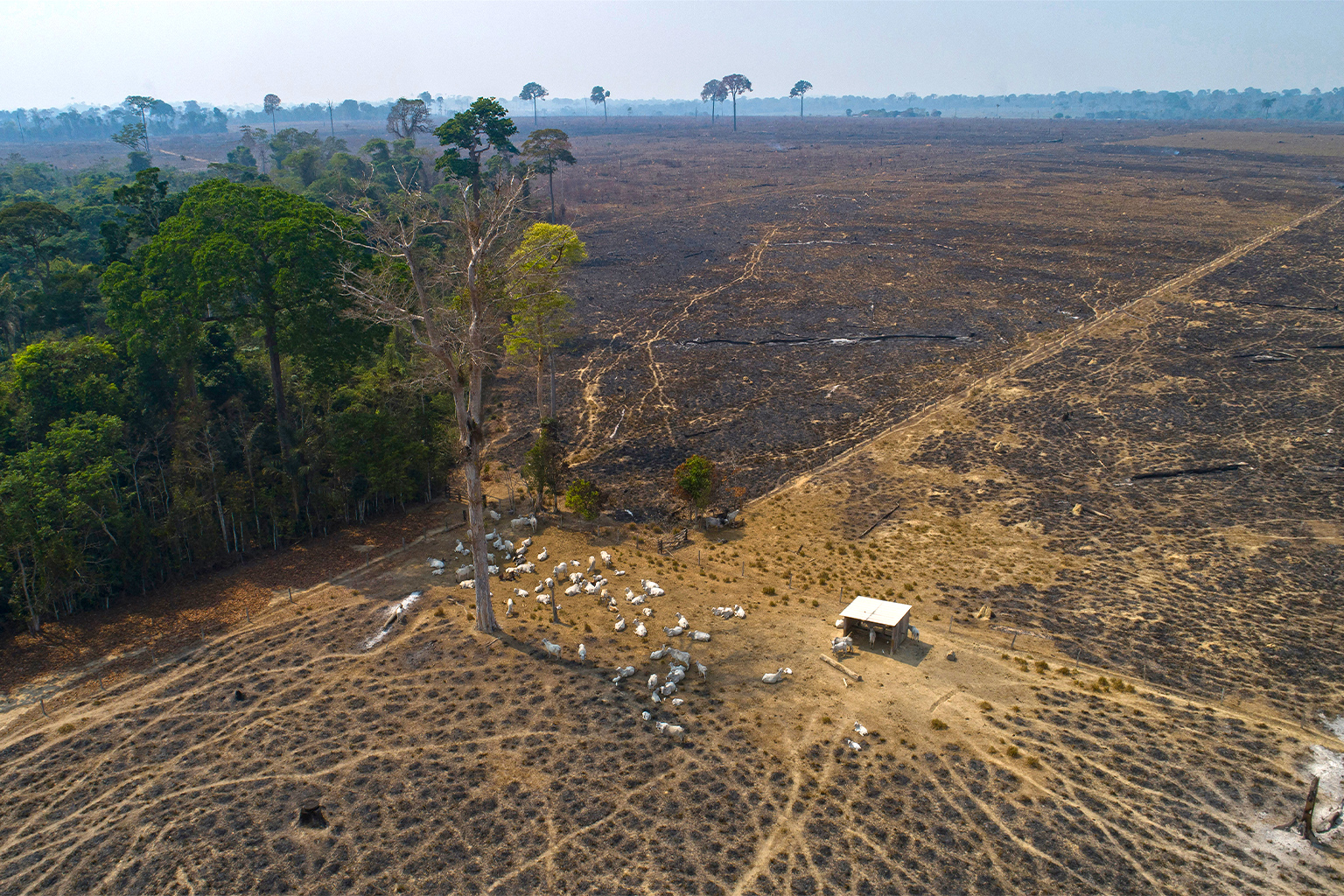
Banner image: Cattle graze on land that has been burned and deforested by cattle farmers near Novo Progresso, Pará state, Brazil. Image by AP Photo / Andre Penner.
Despite restrictions, forest loss continued on Ituna land, home to isolated people
FEEDBACK: Use this form to send a message to the author of this post. If you want to post a public comment, you can do that at the bottom of the page.

