


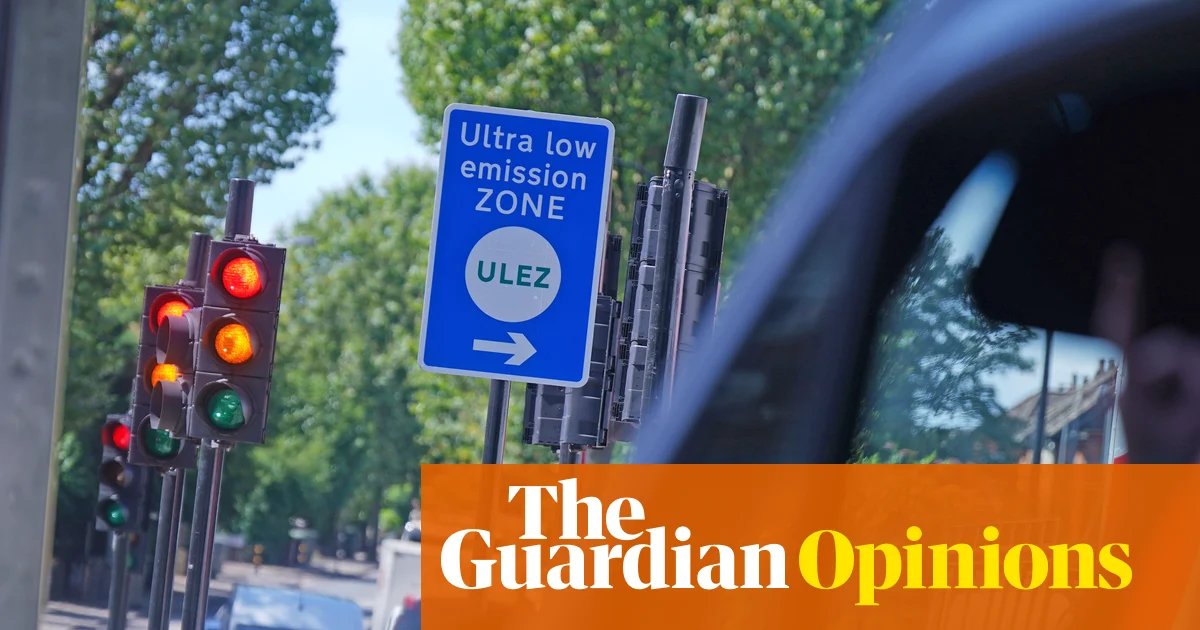
When I introduced London’s clean air zone – the ultra-low emission zone (Ulez) – more than seven years ago, no city had ever attempted anything quite like it. At the time, the scheme in central London provoked fierce opposition. When I decided to expand it – first in 2021, to inner London, and then again in 2023 to the whole city, making it the biggest clean-air zone in the world – my detractors were louder still. I had, they claimed, declared war on drivers in blind pursuit of a policy that may not even work. All the mainstream political parties, including my own, were opposed. In recent years, though, those critics have gone quiet.
There is now a mountain of evidence to show that the Ulez has slashed air pollution and improved air quality across London, and research published by Imperial College London earlier this year showed that this is already saving lives. Between 2019 (when I first introduced the Ulez) and 2024, estimated deaths associated with air pollution in the capital fell by around 40%. But a new, independent study published by Queen Mary University of London today goes further still, showing how – by helping to clean up the capital’s air – the Ulez is improving the lungs and lives of London’s children.
Young children are the first to feel the impact of air pollution. They breathe faster than adults, and more often through their mouths, allowing more pollution to pass into their bodies. Their heads are lower to the ground, too, meaning they’re closer to vehicle exhausts pumping out poisonous chemicals. And, because they’re still growing, long-term exposure to air pollution can do lasting damage to their development, leading to problems such as asthma, chronic obstructive pulmonary disease (COPD) and lung cancer when they’re older.
One of the first places I visited when I was elected mayor 10 years ago was the Sir John Cass’s Foundation primary school in Aldgate, now known as The Aldgate school. On the school’s roof, I joined children who were growing a garden. As they proudly showed me what they’d planted, the kids told me about how much they loved spending time outdoors. But, speaking to their teachers, it was obvious that they were worried about the air the children were breathing. The school was next to one of inner London’s busiest roads and, while an air-quality monitor had been installed in the playground, they were powerless to stop toxic fumes from the traffic passing by. As a father of two daughters myself, I remember trying to imagine how those children’s parents must have felt, knowing that every day their kids were being exposed to a danger that they couldn’t control.
I’ve never forgotten that day. Because, for me, meeting those kids confirmed what the fight for cleaner air was really about: not punishing motorists or making money, but protecting the lives of London’s most vulnerable people.
The Ulez has already had an astonishing impact on London’s air. According to research done by King’s College London, without additional action, it would take almost two centuries to get levels of one of the most toxic chemicals in our air – nitrogen dioxide (NO2) – within legal limits. But, last year, we announced that we’d done it already – 184 years earlier than predicted. Now, we’re beginning to see what our success means for London’s children.
The independent study published by scientists at Queen Mary today is one of the most comprehensive of its kind. In it, researchers tracked the lung growth of more than 3,400 children in Luton and central London, beginning in 2019 and concluding five years later. The results are remarkable.
Before we introduced the Ulez, London’s filthy air meant that children in the capital had significantly poorer lung function than children in Luton. But, across the five-year period when the Ulez was in force, children’s exposure to NO2 fell twice as fast in London as it did in Luton. And, when scientists measured lung function again at the end of the study, young Londoners’ lungs had caught up. This shows that cutting air pollution doesn’t just help Londoners being born today – it can help children whose lungs have already been stunted by toxic air to recover, proving that it’s never too late to act. Over the course of the research, the proportion of children in London with clinically impaired lung function fell from 14% to 9%.
Introducing and expanding the Ulez involved some incredibly difficult decisions. I never took them lightly, but I knew that – as mayor – I could not stand by while Londoners young and old lost their lives to a problem it was within my power to solve. For years, politicians and pundits opposed to the Ulez have cynically sought to turn questions of public health into a crude culture war. Today, though, it’s clear that we’re winning the battle against toxic air in the capital – and it’s London’s children who are reaping the rewards.
Two months ago, I returned to the roof garden of The Aldgate school. It was just over 10 years since my first visit and, getting ready to garden with a group of smiling children, I felt a strange sense of deja vu. This time, though, something was different. Back in 2016, the air-quality monitor in the playground showed that levels of nitrogen dioxide in the air were exceeding legal limits. But, when they were measured again last year, they’d fallen by 48%. As a result, the kids I met didn’t have to think twice about what a game of football outside may mean for their health, and their parents didn’t have to worry about whether walking to school may stunt the growth of their lungs.
after newsletter promotion
Today, you’ll find stories like this in schools across the capital: kids who are breathing easier and parents who are sleeping better because they no longer have to worry about the damage being done by toxic air. The Ulez has been the toughest fight of my political life, but I have no regrets. Though there’s more to be done, it’s clear that cleaning up the capital’s air has changed young Londoners’ lives for the better – and nothing could matter more than that.
-
Do you have an opinion on the issues raised in this article? If you would like to submit a response of up to 300 words by email to be considered for publication in our letters section, please click here.
