


Native fish in the lakes and rivers of India’s Kashmir Valley are under increasing pressure from pollution, habitat loss, dam construction and other human activities, a recent review finds. These same threats are also likely giving exotic fish introduced to these freshwater habitats an edge, researchers say.
“Our indigenous fishes are becoming vulnerable, endangered and critically endangered, while the introduced fishes are flourishing,” Durdana Qazi, co-author of the review and a Ph.D. student at the Faculty of Fisheries, Sher-e-Kashmir University of Agricultural Sciences and Technology (SKUAST-K), told Mongabay.
Kashmir’s lakes, rivers, streams and wetlands are home to native cold-water fishes such as snow trout (Schizothorax spp.), locally known as Kasher gaad, the birdi loach (Botia birdi), locally called Rama gurun, and Kashmir catfish (Glyptothorax kashmirensis).
Over the past century, however, several non-native species have been introduced to these freshwater ecosystems. These include the common carp (Cyprinus carpio), grass carp (Ctenopharyngodon idella) and rainbow trout (Oncorhynchus mykiss), which were introduced to improve fish production because they grow quickly, are commercially valuable and are easier to culture.
The review finds that several native fish species are already under threat of extinction. The Kashmir catfish is listed as critically endangered on the IUCN Red List. Two species of snow trouts are classified as vulnerable, while the golden mahseer (Tor putitora) is endangered.
The conservation status of some snow trouts, including S. niger, and the birdi loach, haven’t yet been evaluated, meaning we don’t know the details of their population trends or what threats they face.
Meanwhile, many introduced fish species are now thriving. For example, the common carp has become one of the most widespread fishes in Kashmir’s lakes and slow-moving rivers.
Farooz Ahmad Bhat, dean of the Faculty of Fisheries at SKUAST-K, told Mongabay that “pollution, habitat degradation and sand mining have fundamentally altered freshwater habitats over the past several decades.”
“Hardy introduced species such as common carp … can tolerate these changing conditions, while native snow trout struggle to survive and reproduce,” he said.
Native snow trout, for instance, require clean water and rocky riverbeds for spawning, many of which have been degraded or lost. By contrast, the common carp lays its eggs among aquatic vegetation and can reproduce under a much wider range of conditions, Bhat told Mongabay.
“The ecosystem has changed in ways that favor hardy introduced species, while native fishes have lost suitable habitats,” he added. Bhat heads the same department where Qazi is a Ph.D. student, but he wasn’t involved in the study.
Restoring native fish populations will require improving freshwater habitats, reducing pollution and protecting spawning grounds alongside managing fisheries, the review notes.
Scientists at SKUAST-K are developing programs in which native snow trouts are bred in hatcheries and released into rivers to help rebuild wild populations.
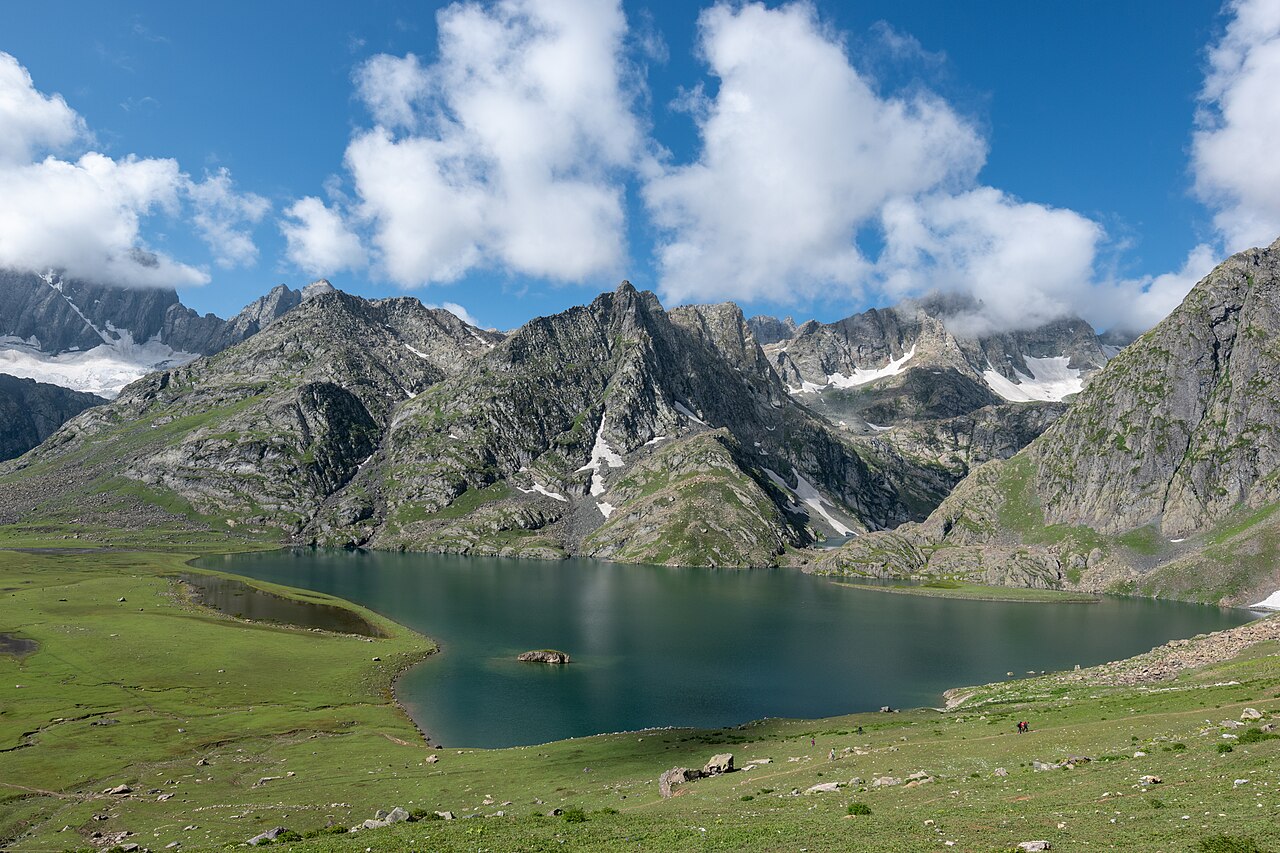
Banner image: Krishansar Lake sits at more than 3,700 meters in the Ganderbal district of the Kashmir Valley. Image by Rohit Sharma via Wikimedia Commons (CC BY-SA 4.0).
