


- A new study found that the restitution of 217,000 hectares (about 538,000 acres) of land to Mapuche communities in Chile did not produce the environmental gains often associated with Indigenous land stewardship.
- Researchers found that restitution was associated with an increase in grasslands and a decline in non-native plantation forests, but found no significant changes in natural forest cover, carbon sequestration, biodiversity or erosion control.
- The study challenges the assumption that Indigenous land restitution automatically results in environmental restoration, while emphasizing that restitution’s primary goals are historical justice and Indigenous self-determination rather than conservation.
- Researchers also pointed out that much of the land that was returned to the Mapuche had already been degraded after decades of intensive agriculture and that Mapuche livelihoods have changed since the 16th century, when they were introduced to livestock by the Spanish.
Indigenous land restitution in Chile came with a mixed bag of environmental outcomes and did not boost natural forest cover, according to a new study published in Nature Sustainability.
While the return of ancestral lands gave the Indigenous Mapuche communities in southern Chile greater control over how their land was used — leading to an increase in grasslands for livestock production and a reduction in non-native tree plantations — it did not improve biodiversity, carbon sequestration or erosion control. Researchers say these findings challenge long-held assumptions that Indigenous self-determination automatically equates to positive changes in natural forests, carbon sequestration or biodiversity.
“In the past, conservation advocates have at times adopted romanticized views of what such self-determination would mean, assuming that Indigenous communities will always choose to allocate land towards more ‘natural’ uses,” said study co-author Robert Heilmayr, an associate professor at the University of California Santa Barbara in the U.S.
He told Mongabay over email that the new research “complicates this narrative,” arguing that true self-determination only emerges when Indigenous communities define for themselves what land uses align with their needs and values.
The study set out to understand how Indigenous land restitution in Biobío, Araucanía, Los Ríos and Los Lagos reshapes the environment. It did so by analyzing satellite and administrative data from 1,577 properties across 36 communities to compare land use and environmental outcomes before and after land restitution. Researchers focused on what happened after a Chilean land restitution program, known as the Chilean Indigenous Land and Water Fund (FTAI), returned 217,716 hectares (about 538,000 acres) of land to the 36 Mapuche communities in these regions between 1994 and 2022. The primary objective of the FTAI, established under Chile’s 1993 Indigenous Law, is to address historical dispossession by purchasing land from private or state entities and transferring ownership to Indigenous communities.
The land titling system falls under the management of the National Corporation for Indigenous Development (CONADI), which Mapuche people have criticized for being slow and inefficient, in some cases taking up to 25 years to process a land claim. In June 2023, former President Gabriel Boric ordered the creation of a commission to address violent land disputes in Mapuche areas that stemmed from the slow land titling process and an influx of logging. The commission estimated that it would take between 80 and 162 years to process all the claims currently backlogged in CONADI’s system.
Researchers emphasized that the new study focuses on the specific history and landscape of the Mapuche people in southern Chile and that the environmental and economic impacts of land restitution should be considered case by case. For instance, research has shown that carbon sequestration on Indigenous lands varies by region. While Indigenous forests in the Amazon remain major carbon sinks, some Indigenous lands in Boliva and Peru are considered carbon sources.
It found that there are various factors that influence how land is used once in the hands of Indigenous communities, including the condition of the land handed to them, which in many cases is already heavily modified for agriculture. In addition, the restituted lands may be far from the reservations the recipients occupy and, due to historical dispossession, communities may not have the strong institutions needed to effectively manage collective lands.
Recovering ownership
The study found that after receiving land through the FTAI, communities rejected commercial land uses associated with historical dispossession and instead expanded grasslands for livestock.
According to the study, Mapuche lands used to be densely forested, but after livestock was introduced by the Spanish in the 16th century, the activity became central to the Indigenous peoples’ culture and livelihoods. Military campaigns by Chile and Argentina in the late 19th century stripped the Mapuche of more than 90% of their original territory. Forced onto reservations, their land was rapidly deforested to make way for wheat farming and industrial pine and eucalyptus plantations.
When the new lands were given to the Mapuche communities, there was very little native forest left.
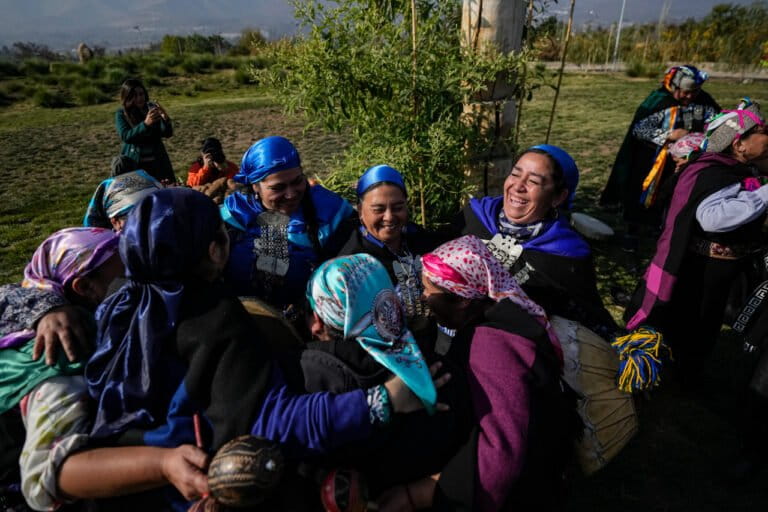
Verónica Figueroa Huencho, a Mapuche academic at the University of Chile, who was not involved in the study, explained to Mongabay over email that “most communities usually receive fragmented, degraded or plantation-covered lands, so recovering ownership does not mean immediately restoring a native forest or recovering in a few years the soils and water affected for decades by extractive industries.”
To achieve specific environmental outcomes, which she emphasized must be decided by communities based on their economic, cultural or spiritual values, they require time, financial resources, infrastructure and technical assistance.
Huencho also explained that there is a risk in evaluating the restitution of Indigenous lands primarily through environmental indicators, such as forest cover, carbon and biodiversity.
“The exercise of the rights of Indigenous peoples, in this case the Mapuche people, could end up becoming a reward conditioned on an environmental performance defined by third parties,” she said. “The lands are not returned because a community captures more carbon, but because there was dispossession and because Indigenous peoples have the right to decide their development priorities.”
While environmental stewardship is integral to Mapuche culture and responsibility to Ñuke Mapu (Mother Earth), “the problem arises when this relationship becomes an obligation imposed from the outside or the stereotype that they are guardians of biodiversity, without clear and effective mechanisms for them to fulfill this role,” Huencho emphasized. “The burden is transferred to them without any structural changes in the behavior of corporations or states.”
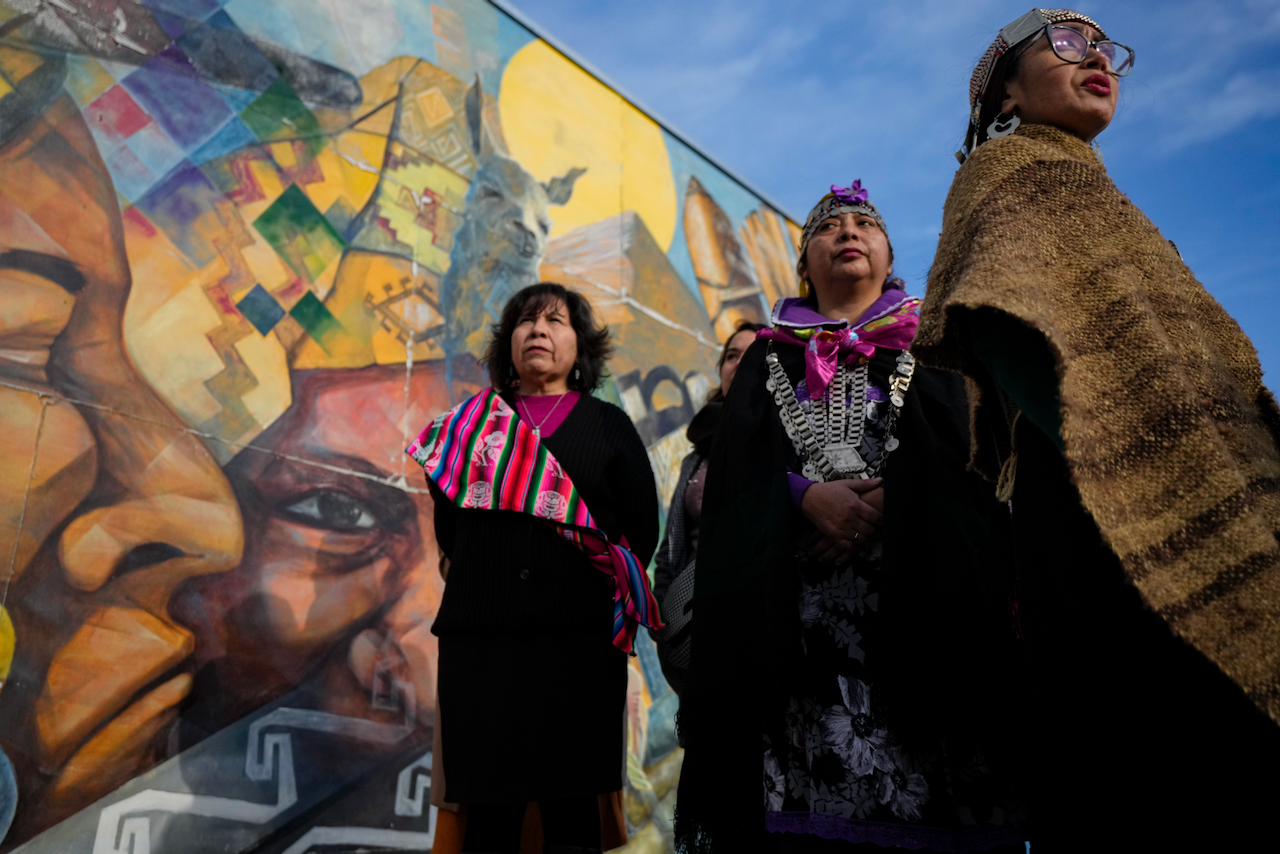
Banner image: Mapuche Indigenous women prepare to commemorate the National Day of Indigenous People as part of celebrations of “We Tripantu,” the Mapuche new year coinciding with the winter solstice in the Southern Hemisphere, at the Original People’s Ceremonial Park in Santiago, Chile, June 19, 2023. Image by: AP Photo/Esteban Felix.
Chile’s plan to protect another 10% of its ocean is stalled by the new government
Latest Mongabay podcast episode: A health crisis for Peru’s recently contacted people brings planetary health to the fore. Listen here:
Citations:
Han, Y., Li, Y., … Alibegović, A. (2026). Tree as Method: How Translocalization Makes the International. Millennium: Journal of International Studies . doi: 10.1177/03058298261468158
Jaimovich, D., Jordán, F., Black, M. et al. (2026). Environmental impacts of Indigenous land restitution in Chile. Nature Sustainability, 1-13. doi: 10.1038/s41893-026-01876-x
FEEDBACK: Use this form to send a message to the author of this post. If you want to post a public comment, you can do that at the bottom of the page.
Cite this article
Aimee Gabay (2026). Indigenous land back in Chile brings mixed bag of environmental outcomes: Study. Mongabay Conservation news. DOI: https://doi.org/10.66709/news-329292

