


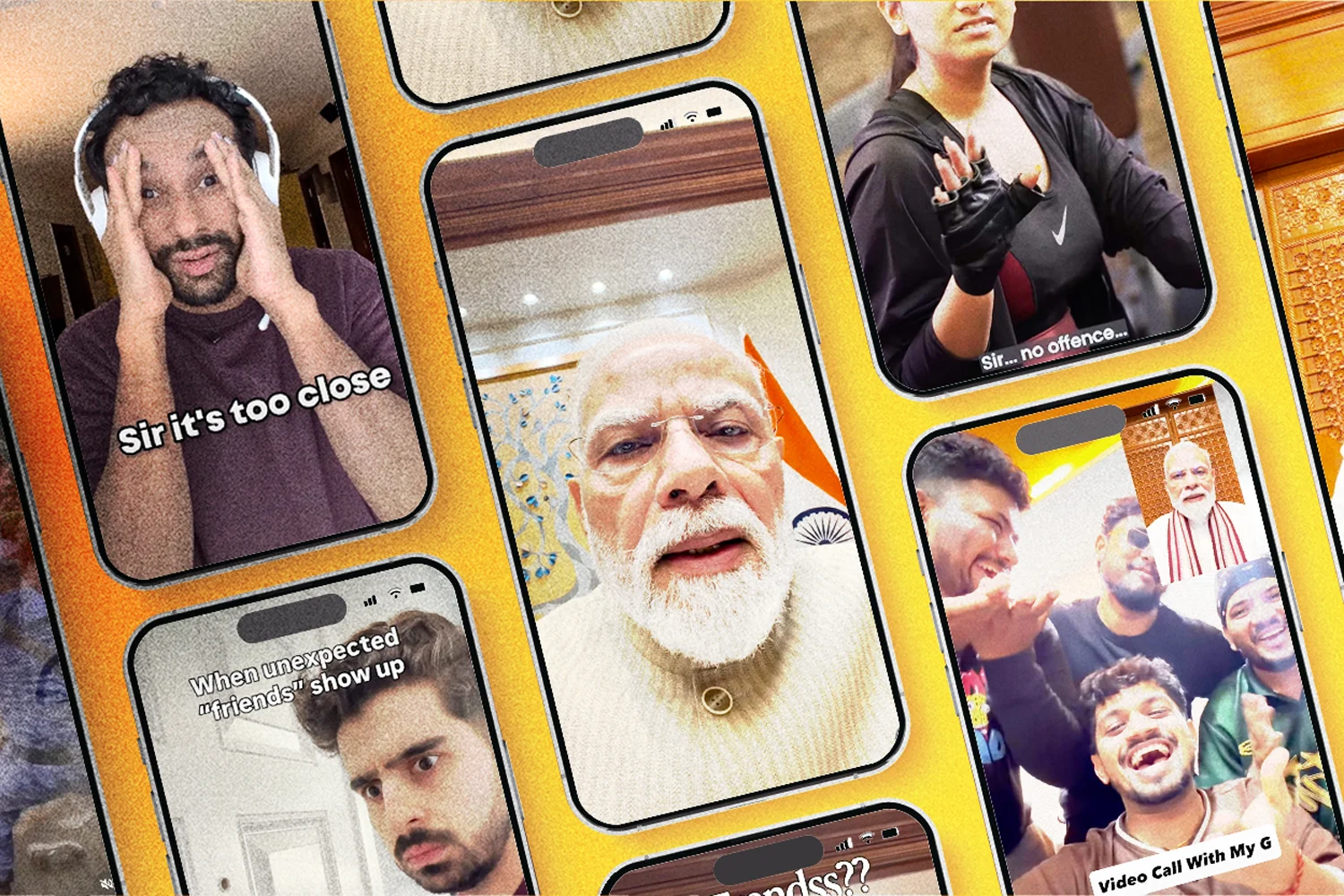
Last Thursday, as weeks of mass protests against the leak of a medical school entrance exam paper continued to rock India’s capital, Prime Minister Narendra Modi uploaded his first-ever selfie video to Instagram.
“Friends,” he began in English, before switching to Hindi and pledging to take action against those responsible for the leak through “fast-track courts.” In another selfie video the following day, he thanked the “youngsters” who responded to his first video “late at night.”
Both videos were instantly lampooned by their intended audience. Instagram creators made fun of Modi’s long pauses and his chosen camera angle that made him look as if he was ringing a doorbell and posted satirical videos taking his characterizations of them as “friends” quite literally. There were also more pointed videos that stitched his attempt at camaraderie with images of police in New Delhi beating up protesters.
On Saturday, Education Minister Dharmendra Pradhan resigned, acceding to the protesters’ main demand and handing them a significant, if largely symbolic, win. The protests were officially called off by organizers, and the thousands of mostly young people who had flooded the streets of New Delhi cleared out.
Modi and his Bharatiya Janata Party (BJP) have long used social media very effectively to build the prime minister’s carefully curated public brand, control the national narrative, and go after political dissent. But the protests, led and attended largely by India’s Gen Z, appeared to be a rare wake-up call for Modi and his government and the first time in a long time that they felt they had missed a trick. In a cabinet meeting over the weekend, Modi reportedly asked his ministers to start using Instagram more and build their presence there.
But the BJP’s first attempt to do so on Tuesday—a heavily produced and scripted video featuring young people talking about the protests in a gym before a slightly older trainer steps in and tells them that the Modi government is actually building a foundation for their future—was skewered in the comments. “At least hire GenZ to write the [propaganda] meant for them?” one comment read, with another adding that “bjp’s gen z advisors have never spoken to a gen z” and a third saying “their Gen Z advisors are also 60 or 65 years old.”
While larger questions remain on what comes next, and deeper debates around addressing gaps in India’s education system and employment pipeline are still ongoing, the youth-led protests succeeded in extracting at least a measure of accountability from a leader who has built his public image on being unassailable and above reproach. The relatively narrow goal of getting the education minister to resign helped coalesce a wide cross-section of people from different walks of life, according to half a dozen protesters whom Foreign Policy spoke to, and helped create a bigger tent than a movement representing a specific political agenda might have.
And they mobilized through memes, Reels (short-form Instagram videos), and humor—in the process exposing a deep generational divide between India’s youth and the country’s elected leaders.
“We didn’t just share news articles. We made memes, Reels, and short videos to explain the issue in 10 seconds. … That’s how it reached people who don’t usually follow politics,” said Isha, a 24-year-old theater artist from Delhi who took part in the protests and who only uses her first name. “Social media made the protest feel like a conversation, not a lecture,” she added. “That’s why it went viral so fast.”
Cockroach Janta Party (CJP) founder Abhijeet Dipke takes part in a protest over education reform in New Delhi on June 6. Arun Sankar/AFP via Getty Images
The protest itself started as a meme of sorts on X (formerly Twitter)—Modi’s favored platform, where he has 107 million followers—in response to a statement by Indian Chief Justice Surya Kant in mid-May comparing India’s jobless youth to “cockroaches.”
Abhijeet Dipke, an Indian student in the United States who had recently graduated from Boston University, fired off a snarky retort on X: “What if all cockroaches come together?” Dipke’s post went viral on X, receiving thousands of shares and likes and prompting him to create the “Cockroach Janta Party,” or CJP—a satirical play on the BJP.
But Instagram is where it really took off, with the movement’s newly made account amassing followers by the millions and overtaking the BJP’s official Instagram handle in just four days. As of this writing, the main CJP handle is closing in on 27 million followers.

Security personnel detain Indian opposition leader Rahul Gandhi as he stages a sit-in calling for Prime Minister Narendra Modi’s resignation outside Modi’s residence in New Delhi on July 21. Arun Sankar/AFP via Getty Images
The streets came later. Dipke traveled to India in early June to stage a sit-in at Jantar Mantar, a historical observatory in central New Delhi that has traditionally served as a stage for mass protests. The CJP gathered momentum over the next several weeks, spurred on by the hunger strike of one of India’s most prominent activists, Sonam Wangchuk; the detention of opposition leader Rahul Gandhi as he tried to march on Modi’s residence; and viral videos of Delhi police firing tear gas and beating student protesters with sticks.
Solidarity protests sprung up in other cities and even overseas, where the Instagram irreverence made it onto placards, signs, and slogans. Meanwhile, the memes continued to flow.

Demonstrators hold placards during a protest in Mumbai on July 22 in solidarity with the Jantar Mantar protests in New Delhi. Punit Paranjpe/AFP via Getty Images
These aren’t the first major protests Modi has faced since he first came to power 12 years ago, with mass mobilizations against new agricultural laws in 2020 and against a citizenship bill that was criticized as anti-Muslim in 2019 the most notable examples. In those protests, social media was a tool. This time, for the CJP, social media was the battleground.
“The earlier movements were physical movements that used social media as an amplifier,” Apar Gupta, the founding director of the Internet Freedom Foundation, a Delhi-based advocacy group, told Foreign Policy. “The Cockroach Janta Party was a content-first movement built by influencers and younger political operatives,” he added. “The mascot was AI-generated, the manifesto was satire, and the content was produced by the crowd rather than by an organizing committee.”
That is where the Indian government’s social media toolkit, perfected over more than a decade, fell short. Modi’s use of social media to build his personal mythology and push the party narrative has long been bolstered by a mainstream media ecosystem that is overwhelmingly pro-BJP, alongside an army of keyboard warriors commonly referred to as the “BJP IT Cell” who spread pro-Modi messages and troll his critics online.
“The BJP built the most formidable political propaganda machine in Indian history,” Gupta said. “That machine rests on two claims: that it speaks for young India and that no one can beat it at this game. The CJP has damaged both.”
The Modi government has also gone after Big Tech platforms including Facebook, Instagram, WhatsApp, YouTube, and X, frequently ordering them to take down speech it doesn’t like—particularly during protests—and updating India’s technology laws to bring them to heel. India leads the world in internet shutdowns over the past several years, according to estimates by the Internet Society and Access Now advocacy groups.
Read More
-

Dozens of protesters are seen a shot taken from slightly overhead. Many of them are young people, some holding up phones as they record photo and video, others holding signs. A young man across the crowd sits on someone’s shoulders so he looms over the rest as he waves an Indian flag. Dozens of protesters are seen a shot taken from slightly overhead. Many of them are young people, some holding up phones as they record photo and video, others holding signs. A young man across the crowd sits on someone’s shoulders so he looms over the rest as he waves an Indian flag. Does Modi Have a Cockroach Problem?
India’s youth-led protest movement led to a rare instance of the government giving in.
-

British King Charles III and Indian Prime Minister Narendra Modi meet at Sandringham House in Norfolk, England, on July 24, 2025. British King Charles III and Indian Prime Minister Narendra Modi meet at Sandringham House in Norfolk, England, on July 24, 2025. Modi’s Great Anglo Paradox
Cultural decolonization advances alongside unprecedented Western partnerships.

All of those measures were in evidence during the CJP protests. The CJP’s original X account was restricted for several weeks and was only restored this month after an order from the Delhi High Court (by which time the group had switched to a new handle @Cockroachisback). The CJP Instagram handle was briefly blocked but reinstated the same day.
The government also shut down the internet in many parts of Delhi for several days. When some protesters moved to Bitchat, a Bluetooth-based messaging app that does not rely on internet access, it tried to curb that, too, according to Bitchat (and Twitter) founder Jack Dorsey.
But internet shutdowns have now become a feature of protests rather than a bug, said Pranav Sawhney, a Delhi-based marketing professional and activist who has participated in several protests in India’s capital. “Because now it’s like: ‘OK, they have done this to us. They have now switched off our internet.’ So you band more together. You do more sloganeering: ‘Jab jab Modi darta hai, internet bandh karta hai,’ ‘Jab jab Modi darta hai, police ko aage karta hai,’” Sawhney said, referencing two of the CJP’s most popular slogans that translate to “Whenever Modi gets scared, he shuts down the internet” and “Whenever Modi gets scared, he puts the police in front.”
There were also widespread reports of the Delhi Police using surveillance technology at the protests, including cameras mounted on vans as well as body-worn cameras and smart glasses (also made by Meta) capable of recording photos and video. The Delhi Police said in a post on X on Sunday that it had not “unlawfully detained any individual or restricted anyone’s freedom through the use of facial recognition technology” but did not respond to follow-up questions from Foreign Policy seeking to clarify whether it had used the technology at all during the protests.
According to Gupta from the Internet Freedom Foundation, there was another big reason the BJP anti-protest toolkit fell short.
“Because those tactics were built for territorial protests and this movement lived and grew on the internet,” he said. “The on-ground mobilization was growing and substantial, but the turn in public opinion occurred on social media. The blocking, internet shutdown, and surveillance attempts all backfired due to wider public participation.”

A schoolgirl takes shelter under an umbrella during a CJP protest at Jantar Mantar in New Delhi on July 24. Arun Sankar/AFP via Getty Images
Yet the irreverence and defiance of the protesters did come with a degree of fear. “I was extremely worried,” said one Gen Z protester, who requested anonymity out of fear of professional repercussions for participating in the protests. She said she wore a hat, glasses, and a mask “because I was extremely scared of facial surveillance and whatnot.”
Even with those precautions, she remains worried that the government could track her down using the license plate of her car, which she drove to the protests and parked near the protest site.
She pushed back on the assertion that the protesters’ flippant posting on social media showed a degree of fearlessness of Modi. “I don’t think it’s a lack of fear that led people to post all of this—I think it’s just that there were so many people posting at the same time that those who were scared also felt like [they] can finally openly do this,” she said. “I think people are very, very scared of the government and what they’re capable of.”
That sentiment was echoed by Chinmay Lenka, a technology lawyer based in the northern Indian city of Dharamshala who traveled to Delhi to participate in the protests and offer help to protesters—including letting them know their rights and helping them to use Bitchat.
“The Delhi Police have this argument that they are doing it for public safety, to make sure that people with criminal backgrounds who have entered these peaceful protests don’t end up creating a ruckus,” Lenka said. “But in my opinion, if you are constantly monitoring and surveilling peaceful protesters who are well within their right to peacefully protest, I don’t think there is any legality there,” he added. “Nobody knows how the Delhi Police uses this black box.”

Police personnel use water cannons to disperse demonstrators during a CJP protest in Patna, India, on July 22. Sachin Kumar/AFP via Getty Images
India does not currently have any specific laws governing the use of facial recognition, and tech freedom advocates say the Modi government has significantly expanded its legal power to rein in tech platforms, a push that is only likely to intensify in the wake of the CJP protests.
“What I think is more important, actually, is less the fact that this took place and more about what the government will do next,” said Raman Jit Singh Chima, the global program director at the Association for Progressive Communications, a tech-focused social justice advocacy group. Much of the power that the government can call on, both legally and technologically, has not been fully accounted for, Chima said.
“While we’re seeing this very active political and judicial conversation around what legal standards apply to the use of deadly force or the use of riot guns and pellet guns by the Delhi Police, we need similar questions to be asked about what sort of surveillance capabilities are being deployed by the Delhi Police and other agencies as well,” he added. “India has increased its technical capabilities while intentionally keeping its legal architecture for oversight and control at perhaps the lowest amongst all the major democracies in the world.”

A protester holds a cockroach mask during a CJP demonstration in New Delhi on June 6. Arun Sankar/AFP via Getty Images
The traditional government playbook has only intensified this week after the protests were officially called off. The Delhi Police has reportedly ordered X to help investigate “derogatory, malicious and defamatory content” that is “targeting constitutional heads,” asking for the content to be taken down and for the platform to provide the government with the names, addresses, and email addresses of the accounts responsible for those posts. It has reportedly also issued similar takedown notices to Instagram.
X did not respond to a request for comment, and a spokesperson for Meta—which owns Facebook, Instagram, and WhatsApp—directed Foreign Policy to the company’s policy on government takedown requests without sharing specifics on how many posts it took down at the Indian government’s behest.
The CJP has pushed back—at least rhetorically—against the government’s efforts to go after protesters and take down social media posts this week.
“Delhi Police is frantically issuing takedown notices … to scrub social media of posts criticizing the Prime Minister during the recent protests,” the CJP wrote on X on Wednesday. “By treating online criticism as a criminal offense and a threat to ‘public order,’ the state machinery is sending a chilling message: the Prime Minister is beyond the reach of public scrutiny.”
Dipke appears ready to restart the protests if needed. “These were kids who were fighting for their future,” he told reporters. “If the government … keeps harassing these kids, then we’ll get back on the streets.” It remains to be seen whether and how that fight will escalate and which side has more staying power.
But India’s Gen Z has undoubtedly undergone a “political awakening,” Isha told me.
“It’s not just about one minister resigning—it’s about a generation learning that if we are organized online, people have to listen offline, too,” she said. “Gen Z doesn’t separate online and real life. If something is wrong, we post it. If we don’t understand it, we make a meme to understand it. This protest taught me that we have a voice. We are not just scrolling. We can ask questions, and people have to answer. We are tired of being ignored, so we learn to make noise in our own way.”
