


It used to be that a new report of budgetary red ink would touch off a political crisis in Washington. There would be speeches and news conferences and blue-ribbon commissions and legislation and brinkmanship over how to get the nation’s fiscal house in order.
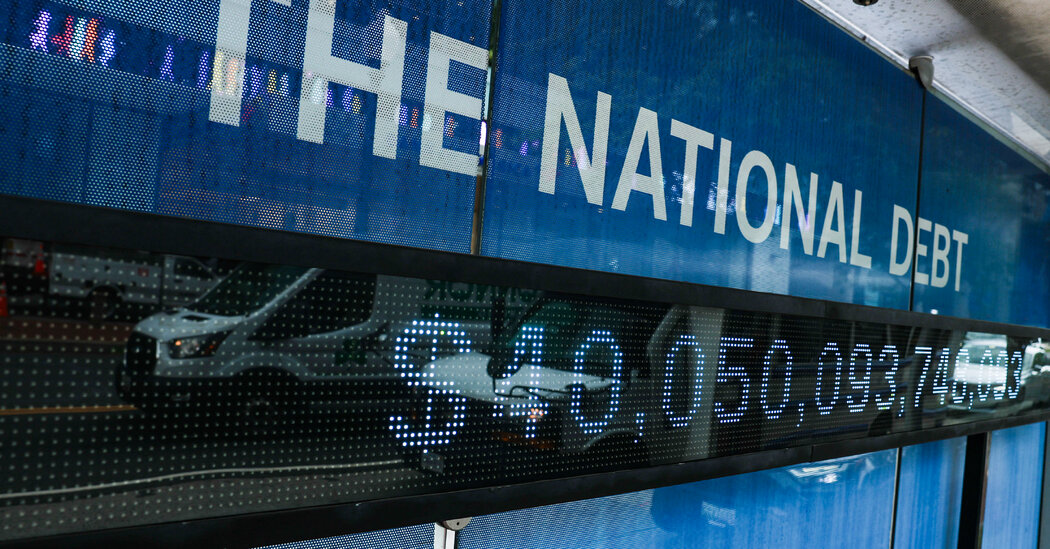
But when the national debt topped $40 trillion last week — that’s trillion with a T — the collective body politic all but shrugged. Never mind that the U.S. government now owes twice as much money as a share of the economy than two decades ago. Republicans and Democrats issued perfunctory, my-we’re-concerned statements and promptly moved on.
The bond markets were not so sanguine, as a sell-off indicated, but the relative indifference in the nation’s capital demonstrated how drastically the politics of deficit spending has changed in recent years. For generations, the nation’s fiscal imbalance was a constant preoccupation of presidents and members of Congress, a defining issue that shaped the rest of their agendas. Now it seems to be barely an afterthought as Washington borrows heavily to finance tax cuts and spending programs.
Both parties are engaged in a kind of conspiracy of silence about the eye-watering numbers, preferring to concentrate on other issues, whether it be the Iran war or the cost of living. President Trump is busy trying to restrict mail-in voting in the midterm elections and build his ballroom. Democrats are busy tying Republican opponents to an unpopular president in hopes of taking back one or both houses of Congress.
It has been 15 years since the last time Washington engaged in a serious bipartisan effort to curb the deficit, and both political polarization and government indebtedness have only grown exponentially since then. Few think that today’s leaders would or could come together anytime soon to make the hard choices, compromises and sacrifices that analysts say are necessary.
“The fiscal situation has never been worse and yet the political situation has never been worse and so we are absolutely unable to meet the moment,” said Maya MacGuineas, the president of the bipartisan Committee for a Responsible Federal Budget, one of the few institutions in Washington that still consistently focuses attention on deficit spending.
“The political norm was as soon as you passed some line where things started to feel worrisome, everyone would put on their grown-up pants and do some of the hard work of being political leaders,” she said. “And that’s just not the case anymore.”
Erskine B. Bowles, who led a bipartisan commission to tame deficit spending in 2010, said leaders in both parties these days are applying “the ostrich theory” to the issue, putting their heads in the sand. “They get the arithmetic,” he said. “They understand that we have a dysfunctional government, that we’re addicted to debt, that we have these $2 billion deficits as far as the eye can see. And we don’t have a plan to deal with it.”
The only real reaction from Mr. Trump’s administration came from Treasury Secretary Scott Bessent, who tried to settle the bond markets with a debt buyback plan that failed to reassure investors and was derided even by his mentor, the hedge fund billionaire Stanley F. Druckenmiller. In the long run, Mr. Bessent’s stated prescription for the sky-high deficits was to say that “we’re going to have to grow our way out of this.” That is a hope, not a plan, and one that would require the kind of sustained economic growth not seen in decades.
The government is set to spend $1.9 trillion more than it takes in this fiscal year, or 5.8 percent of the entire economy, according to the Congressional Budget Office. That gap is projected to grow to $3.1 trillion, or 6.7 percent, by 2036. Debt held by the public already equals 101 percent of the American economy and at this rate will grow to 120 percent in 2036, surpassing the record of 106 percent just after World War II. The government now spends more on interest payments than on the Pentagon budget.
Both parties have contributed to the gap over the years through tax cuts and spending programs that appealed to voters. President Joseph R. Biden Jr. pushed through an expansive economic stimulus package after the Covid-19 pandemic as well as legislation to finance roads, bridges and other infrastructure and to invest in climate change, semiconductors and other priorities. Mr. Trump has enacted large tax reductions while pushing for a vast increase in military spending.
Neither Mr. Biden nor Mr. Trump devoted much energy to finding a way to bring the books closer to balance nor did they pay a political price, reflecting a new reality when it comes to deficits. During Mr. Trump’s first term, Mick Mulvaney, while his acting chief of staff, reportedly told supporters of the president that “nobody cares” about the deficit anymore.
That may not be exactly true but it is not quite as high on the voters’ priority list. Fifty percent of Americans said they cared about the deficit “a great deal” in March, down from 64 percent in 2011, according to Gallup surveys. Only 2 percent of voters think the deficit or debt is the most important problem facing the country today, according to Gallup.
On the other hand, the Pew Research Center found that those who consider the deficit a “very big problem for the country today” has swelled from 55 percent in 2018 to 64 percent this year. Taken together, the surveys seem to suggest that voters believe it is an issue but do not care as much as they once did.
Stephanie Kelton, a former chief economist for Democrats on the Senate Budget Committee, said Americans had grown inured to doomsday predictions that did not materialize. “It’s just a running, century-long commentary where there’s always an iceberg or a giant dinosaur or a cancer eating you, gobbling you, terrifying you,” she said. “But nothing bad has happened. You would think if it was going to happen, it would have happened by now.”
That represents a profound change in Washington, where for years the deficit dominated politics. President Ronald Reagan was elected in 1980 in part on the issue, but his tax cuts and military buildup only increased the deficit, forcing him to reverse course and raise some taxes again. President George H.W. Bush was so concerned about the deficit that he broke his “no new taxes” campaign vow and negotiated a package of increases and spending cuts with Democrats that helped doom his re-election in 1992.
President Bill Clinton pushed through his own politically risky deficit plan with tax increases and spending reductions, relying entirely on Democratic votes, which propelled Republicans in taking over Congress in 1994 elections. But in his second term, buoyed in part by strong economic growth, Mr. Clinton and Mr. Bowles, his chief of staff, brokered a deal with Speaker Newt Gingrich that finally balanced the budget.
The brief surpluses turned back to deficits under President George W. Bush thanks to his tax cuts, a recession and national security spending prompted by the Sept. 11, 2001, terrorist attacks and wars in Afghanistan and Iraq. Mr. Bush invested hundreds of billions of dollars to stanch the financial crisis of 2008, although the government recouped most of that. President Barack Obama spent hundreds of billions more to stimulate the economy.
Mr. Obama was the last president to make a serious effort to control the deficit, appointing a commission led by Mr. Bowles and Alan K. Simpson, a former Republican senator from Wyoming, who developed a painful menu of spending cuts and tax increases. It was too much for Mr. Obama, and his own negotiations for a “grand bargain” with Speaker John A. Boehner later collapsed.
Mr. Trump, who was such a prolific borrower as a private businessman that he termed himself “the king of debt,” has never seemed to care much about deficit spending. During his 2016 campaign, he almost offhandedly boasted that he could eliminate not just the deficit but the entire cumulative national debt in eight years as president. Instead, the debt has doubled since then under him and Mr. Biden.
Mr. Trump never mentioned the deficit as a priority in any of his State of the Union addresses in his first term, unlike every president since Harry S. Truman, according to a database search. In his second term, he talked about stopping wasteful spending and empowered Elon Musk to find it. Mr. Musk, who initially promised to cut $2 trillion in spending for Mr. Trump, managed $200 billion in savings, then gave up.
The lack of alarm at the latest debt numbers suggests that budget doves have gained traction in the perennial debate over deficit spending. For years, some economists have argued that deficits are not necessarily bad and can even benefit the economy.
Ms. Kelton, now a professor of economics and public policy at Stony Brook University and author of “The Deficit Myth,” is a leading champion of Modern Monetary Theory, which holds that if a government issues its own currency, it can always create money if needed to take care of its people.
A deficit on the government side, she said, means a surplus in the private sector, which can be good for the economy. The real restraint on spending, she said, should not be matching it to incoming revenue but making sure that the government does not pump so much additional money into the economy that it generates inflation.
Mr. Mulvaney’s comment that no one cared about deficits anymore, she said, “felt like a sea change to me” in terms of the perspective of the nation’s leadership. “I would like to believe there’s been some learning along the way and that people have come to understand that the thing we call the government deficit has another side to it. Too often we only present half the story.”
But deficit hawks argue that soaring government debt results in higher interest rates, which make it harder to take out a car loan or a home mortgage.
“We’re spending a trillion dollars a year on interest,” former Senator Rob Portman, a Republican of Ohio who served as the younger Mr. Bush’s budget director, said in an interview. “It’s crazy. Almost 20 cents of every dollar you send to Uncle Sam is interest now. It’s gotten to the point that it’s crowding out other priorities of the American people. We haven’t done a good job explaining that.”
Despite the restrained response to the latest debt numbers, Mr. Portman said he sees signs that people are taking the situation seriously and he has been trying to generate interest through symposia, panels, hearings and other efforts.
“I think there’s a little bit of a groundswell now to do something,” he said. “It isn’t going to be easy, it never is. But even kicking off some sort of process is important.”
Dylan Freedman contributed reporting.
