


- The government in Suriname has pledged to combat illegal mining and the industry’s use of mercury, maintain 90% national forest cover and preserve its status as one of the few countries in the world that absorbs more CO₂ than it emits.
- But on the border with French Guiana, where the government is largely absent, Indigenous Wayana communities have had to adapt to illegal gold miners, who for decades have cut down the forest and polluted rivers with mercury.
- One Wayana chief controls the only airstrip in the area, giving him some leverage with miners who have no other practical way into the forest. But in some instances, those relationships have led to violence.
- The Mulokot Foundation, an advocacy group, is working to help the Wayana improve education and map its ancestral territory. In the future, these initiatives may help residents move beyond mining to more sustainable activities.
KAWEMHAKAN, Suriname — Beneath thousands of square kilometers of rainforest here lie vast deposits of gold and other minerals. Around a million ounces are extracted legally every year, but much more remains buried throughout the Amazon.
In some of the farthest-flung parts of the rainforest, such as these small villages along the border with French Guiana, the government hasn’t stopped locals — joined by Brazilian miners and Chinese traders — from clearing the forest in search of gold. Moving up and down the Lawa River and its tributaries, these criminals establish mining camps and trading posts far beyond the reach of most law enforcement, where robberies, extortion and other violent crimes happen out of sight.
Many Indigenous Wayana families live on both sides of the Lawa River — which also marks the border with French Guiana — and face a growing list of challenges, including health issues from mercury use on their land and dwindling wildlife populations they’ve long relied on for food. Indigenous Wayana communities have lived in the area for generations but still lack an official land title that might offer some protection.
The only airstrip for kilometers around, and the primary practical connection to the capital, Paramaribo, sits in the middle of one of the Indigenous villages, giving leadership some leverage with miners and traders: Unless they want to travel for days by river to get back and forth from the city, it’s important to be on good terms with the community, residents said.
These delicate relationships mean that Indigenous leaders, miners, traders and concession holders are constantly vying for power and influence. Some of them use it to get more gold. Some want to stop environmental degradation. Others want to preserve law and order on the edges of a country that has failed to enforce it.
Mongabay visited the Wayana chief and his son last October, and traveled up and down the Lawa River documenting where gold is mined, sold and transported. Mongabay also met with gold miners and uncovered the history of a mining family driven out of the area after allegedly robbing and extorting other miners — and who have since passed on their work to a foreign company.
“I would like to stop the situation because they destroy our area,” Marciano Pelenapïn, the chief’s son, told Mongabay through an interpreter. “Maybe in the future, if they don’t stop this mining thing, our territory, our land, won’t be the same anymore.”
A culture of gold
The border with French Guiana has become a hotspot of gold mining in Suriname, with around 25,000 hectares (61,776 acres) lost between 2021 and 2024, according to an analysis by Monitoring of the Andean Amazon Project (MAAP), part of the NGO Amazon Conservation.
There were at least another 2,800 hectares (6,918 acres) of deforestation in the region last year, the MAAP analysis found.
In 2025, the government pledged to combat illegal mining and the industry’s use of mercury, maintain 90% national forest cover and preserve its status as one of the few countries in the world that absorbs more CO₂ than it emits. But in remote areas like Kawemhakan, little action has been taken to meet those pledges, and there’s almost no government presence at all, members of the Indigenous community said.
Part of the challenge is reaching Kawemhakan, which is accessible only by air or river. Most people arrive via a single-engine aircraft holding about 10 passengers. It leaves the capital three times a week and after about 1.5 hours, lands on a long, dirt airstrip in the middle of the village.
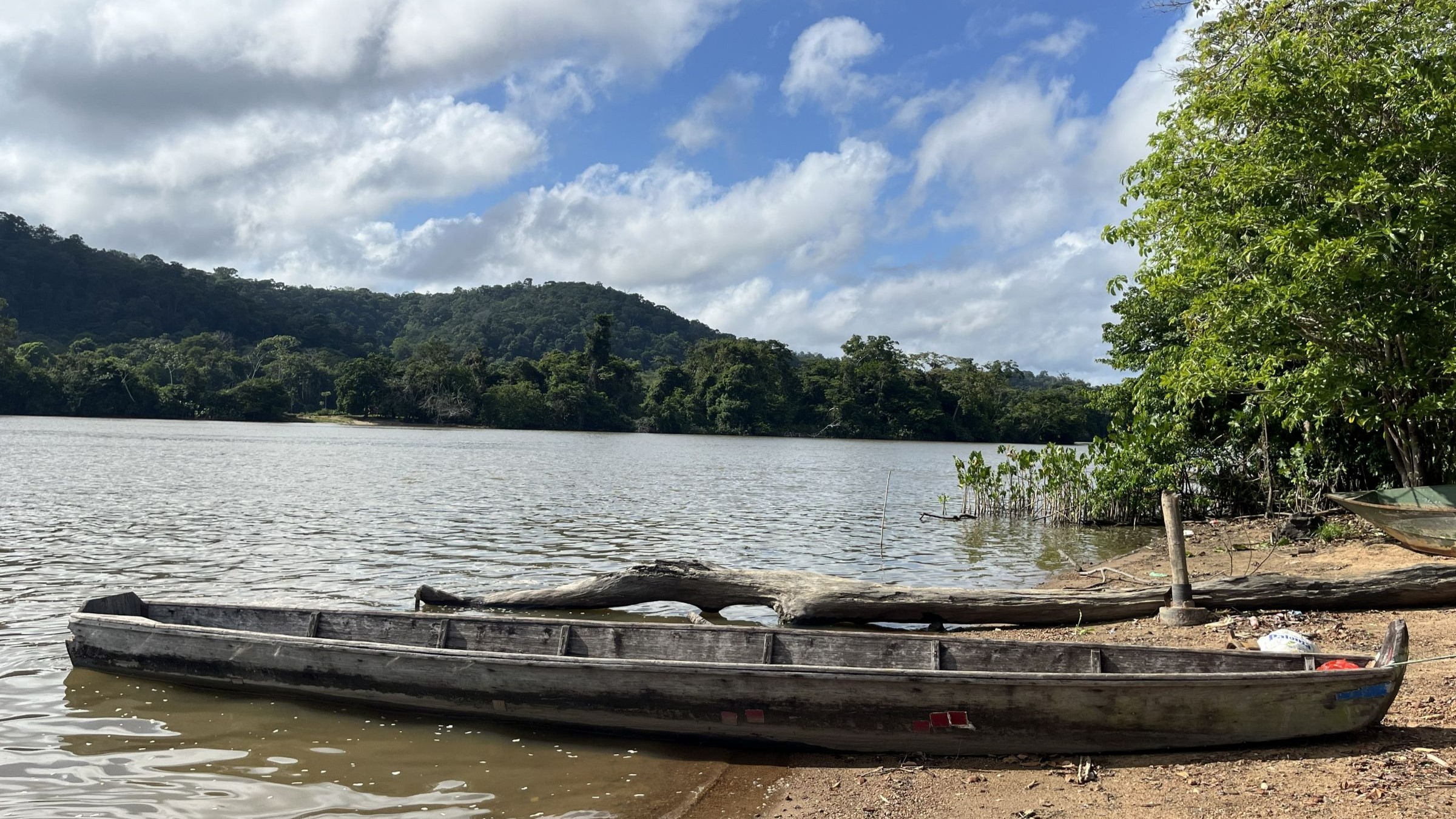
There aren’t any roads in and out, only the Lawa River. People rely on canoes and other small boats to get around. Long stretches of rainforest appear undisturbed along the river except for small cuts in the trees where miners park their boats and continue by foot or in all-terrain vehicles (ATVs), sometimes traveling days into the forest to get to mine sites.

Approximately 25 kilometers (15 miles) upriver is the French Guianese city of Maripasoula, the site of a thriving cross-border economy that’s largely exempt from standard customs or border oversight. People move back and forth between the countries to shop, visit family and drop their kids at school.
“Grocery stores” also line the riverbanks, many of them owned by Chinese families. They sell everyday items like milk and eggs, but also cater heavily to the mining sector, with generators, water pumps, fuel canisters, hand tools, tarps and hammocks, safety gear and rope.
Behind the counter, clerks measure gold and other minerals on scales, paying out cash in euros and dollars. Not all gold is the same quality. Some have better color and purity, while others might be duller or mixed with less valuable minerals.
Buyers take the gold to Paramaribo, where private companies buy it, often through other intermediaries in the city’s gold district. Much of the gold passes through the custody of Kaloti Suriname Mint House, a company that owns processing facilities and is jointly owned by the Surinamese government, local gold dealers and a United Arab Emirates conglomerate.
After purchasing supplies from the grocery stores, miners travel deeper into the rainforest to carry out the first steps in this supply chain. It can be extremely grueling, according to one miner, who asked to remain anonymous for safety concerns. He told Mongabay he works six days a week, riding an ATV for hours into French Guiana to reach the current mine site where he’s been contracted. His crew is made up of seven people — much smaller than the 30 people working at other sites — because smaller crews make it easier to avoid law enforcement.


Typically, staff carry out manual labor in the mine under the guidance of a foreman, who takes direction from an owner funding the operation. Staff rarely know who the owner is, the miner explained. In some cases, they’re businessmen in the city.
Miners say staff must be constantly vigilant. Depending on which side of the border they’re on, law enforcement can visit periodically and burn their pumps, generators and other equipment — a costly loss for smaller operations. For larger ones, losing equipment is just part of business.
“If something goes wrong with the machine, you have to buy another one,” one miner, who asked to remain anonymous for safety concerns, told Mongabay. “You have to repair it, and you have to use [your] extra money to repair the machines and then you can start work again.”
Delicate relationships
If someone tried to set up a new mining operation near Kawemhakan, it would be very difficult to reach the village, let alone start work, without the permission of one person: Ipomadi Toko Pelenapïn, the Wayana chief of the Lawa River area.
Pelenapïn, a 53-year-old with narrow glasses and a serious gaze, has been known to require miners to show they’re legally permitted to work in Suriname and have been granted a formal concession. In some cases, he has prohibited them from mining in the area and blocked them from taking flights in and out of Kawemhakan.
His father Anapaikë Pelenapïn, the former chief before him, was the first to grant permission to miners sometime around the 1960s. However, miners have been present in the area for over a century.
“If the chief told you that you can’t do anything then you can’t do anything,” said Michel Nailoepun, a member of the Wayana community and education coordinator for the Mulokot Foundation, an advocacy group working closely with the Wayana. “You can’t do anything because he’s the authority.”
Chinese businessmen also need permission before setting up stores on ancestral territory. Like gold miners, they pay a percentage of their earnings to the chief.

One group of Brazilian miners, working a small-scale operation with pumps and a generator, told Mongabay that Pelenapïn lets them work on the land. They also give the community a portion of their earnings.
“Out of 100 grams [Pelenapïn] gets 10 grams,” one of the miners explained.
But not all relationships with outsiders are so straightforward. More miners have arrived to the area than Pelenapïn could have imagined, overwhelming the Indigenous communities in recent years and casting doubt over their control of the land.
On the one hand, miners and traders respect Pelenapïn’s authority, especially because of the location of the airstrip. But on the other, they significantly outnumber Indigenous residents and tend to have more firearms and stronger financial assets. If they wanted to, they could ignore a lot of his commands simply because they have power in numbers, community members said.

Pelenapïn said he also has to compete with the unseen powers of the capital. Officials there sometimes grant concessions in sensitive parts of ancestral territory, without ever visiting or consulting the community. That puts him in the difficult position of either accepting a mining project that could bring pollution, deforestation and violence to his home, or trying to deny one that has the legal authority to move forward regardless.
In recent years, officials have asked him to stop leveraging the airstrip and controlling permission to miners.
Sometimes, he calls a community meeting to help preempt conflicts with new arrivals, explaining to Wayana community members who the workers are and why they’ve come. While it doesn’t usually stop operations from moving forward, it does create transparency with the community and foster healthier relationships with the miners.
“I have no power against the government,” he said through an interpreter. “The government sends the people here.”
The Spence family case: When alliances fall apart
One clash with a mining family tested the limits of Pelenapïn’s authority. The Spence family, including four male adult members, allegedly started arming themselves after the coronavirus pandemic and recruiting Indigenous people to extort other operations.
Before the conflict, the Spences had been allies to the Wayana community, according to Pelenapïn and other Indigenous people who knew them personally. Mongabay also interviewed members of the Mulokot Foundation, several Brazilian miners and reviewed business records connected to the Spence family.
According to people in the community, the Spences helped map some Indigenous areas and plan the construction of the airstrip in Kawemhakan. They were close enough with the Wayana to build a home in the village, just a few minutes’ walk from Pelenapïn’s.
The Spences were allegedly low-level mining staff for many years before climbing the ranks and accumulating enough wealth to begin operations of their own. Unlike Brazilian miners, they had the advantage of knowing Dutch and having connections in Paramaribo.
“[One of the Spences] told us he was one of us,” recalled Maika Mitiju Pelenapïn, the chief’s brother, through an interpreter. “That’s why they accepted him.”
Around 2020, workers allegedly started abandoning the Spence’s mining operations, located on Indigenous land, because they were asking for an unfairly high cut of the earnings — sometimes as much as half of what was being extracted. In one case, a miner who wished to remain anonymous due to security concerns told Mongabay that the family demanded a kilogram of gold, worth approximately $40,000 at the time.
The demands continued to intensify, with the Spences allegedly traveling with rifles, pistols and bodyguards, and threatening to remove miners from the area and confiscate their equipment.
In one instance, the family allegedly recruited young men from Wayana villages to drive ATVs into Brazilian mining camps, extorting them while wearing masks and black clothing.
After the miners complained to Pelenapïn, a meeting was held in 2023 to discuss the Spence’s behavior. It’s unclear whether they were exiled from the community or left on their own, but the Spences haven’t been seen in the Lawa River area since. The home they built in Kawemhakan is almost entirely boarded up and locked but in excellent condition, the inside mostly empty.
Members of the Spence family weren’t available for comment for this story. Others denied multiple Mongabay interview requests.
The Spence family has registered multiple mining companies with Suriname’s Chamber of Commerce and Industry, according to records reviewed by Mongabay. It isn’t clear whether the companies all operate in the Lawa River area or somewhere else.

Two of them, X1 Eco Mining and X2 Clean Mining, were incorporated and entered into the business register in October 2025. The companies’ purpose includes operating mining enterprises “in a sustainable and environmentally friendly manner and, in connection with this, to develop, extract, use and manage natural resources.” This includes gold, precious stones, minerals, gravel, sand, stone, shells, natural stone and other construction materials.
A third company, Mine Rehab, obtained a 10,000-hectare (24,710 acre) concession in June 2024 for the exploitation of gold located west of the Lawa River near Kawemhakan, according to a memo to workers at the site, which was reviewed by Mongabay.
Mine Rehab was purchased in 2025 by Canadian-based exploration company Founders Metals, which holds a 70% interest in Lawa Gold N.V., another company with exploration rights in the area.
A spokesperson for Founders Metals said in an email that the company is in the earliest stage of exploring the Mine Rehab N.V. concession and has no mining activities on the property.
“We are committed to complying with all applicable laws and regulations in Suriname,” the spokesperson wrote.
With the sale, the Spence family’s presence in the area appeared to come to an end.
Mulokot Foundation Director Andre Verhoogt said he’s happy to see the Spence family out of the area because they weren’t mining responsibly. But with a large international mining company taking over the work, there will likely be new challenges for the Wayana.
“Now we have a Canadian company that’s officially active in our territory and reorganizing everything and expanding,” he said.
A future beyond gold
Before the pandemic, the Mulokot Foundation operated a school in Kawemhakan. Although most Indigenous children speak Wayana and French, the school taught all of its standard subjects in Dutch to ensure the community would one day be able to access government services and be competitive for jobs in Suriname that aren’t related to mining.
The school shut down in favor of online courses during the COVID-19 pandemic in 2020 before pausing them indefinitely. The foundation hopes to revive operations but will likely keep them online rather than in-person. Online learning reduces the logistical difficulties of finding teachers willing to travel to such a remote area without standard electricity and sanitation, Verhoogt said.
“[It] was very hard to keep [teachers] because it’s very remote,” he said. “How do you keep people motivated?”
He didn’t provide a set timeline for the program’s relaunch.
Right now, many Wayana are technically unemployed, and mainly survive by hunting or fishing. The jobs that do exist in the area are related to the mining sector, such as operating boats or delivering resources to work sites. Others still cross the border to work in Maripasoula, the most developed city within reach.

With better education, the Wayana people may find jobs in other parts of Suriname or develop the economy around the Lawa River area, Verhoogt said. The idea is to give people employment options beyond hunting and fishing, and the occasional transportation job, while also making sure they maintain Indigenous traditions.
“[It’s] a beautiful initiative,” he said.
At the same time, the foundation is helping the community monitor gold mining activity and forest loss through satellite imagery. They’re also mapping ancestral territory in the hopes of demarcating their territory and obtaining land rights from the government.
Suriname is the only country in South America that hasn’t granted ancestral land rights to Indigenous communities. Legislation containing different proposals has stalled over the last decade, despite a 2007 ruling by the Inter-American Court of Human Rights to grant rights due to the existential threat of mining and other economic activities.
Pelenapïn’s son, Marciano Pelenapïn, who is expected to one day take over as chief of the Wayana, has made mapping his own personal project. He said Indigenous territory is much larger than many of the government’s proposals suggest. It’s important to have a reliable map of their own to show officials, he said.
“Being a leader is a big challenge … If everyone comes to me with a problem and we don’t have land rights, that makes things difficult for us and for me as a leader in the future.”
Banner image: A lone boat sits on the banks of the Lawa River outside of Kawemhakan. Image by Maxwell Radwin
See related from this reporter:
Uncertainty mounts as Suriname struggles to evict illegal settlers in the Amazon
FEEDBACK: Use this form to send a message to the author of this post. If you want to post a public comment, you can do that at the bottom of the page.
Cite this article
Maxwell Radwin (2026). In Suriname’s Amazon, the Wayana community struggling to keep gold miners at bay. Mongabay Conservation news. DOI: https://doi.org/10.66709/news-334444

